Ona Bailey’s Garden – Soldier Road

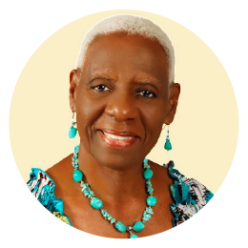
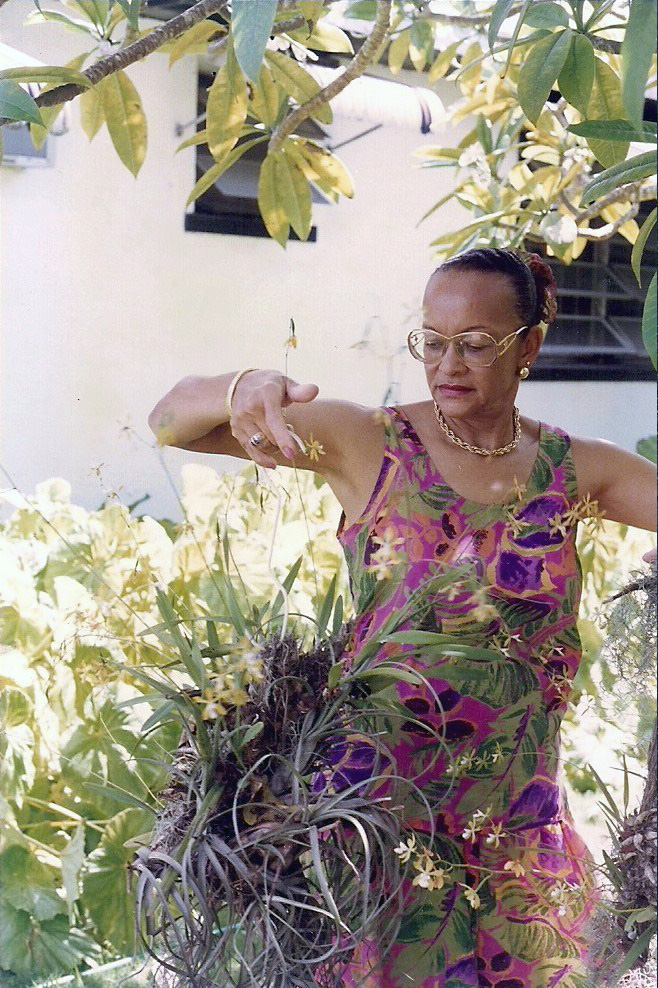
Ona Bailey_2I fell in love with plants at an early age. During the summer, my brother Stephen and I spent time in Aunt Clara’s garden watching and helping her with her plants. As a child, her garden became my favorite place.

Eventually, I grew my own garden with Bachelor Buttons and Marigolds at first. My garden was full of flowers, each one with its own peculiarity and personality.

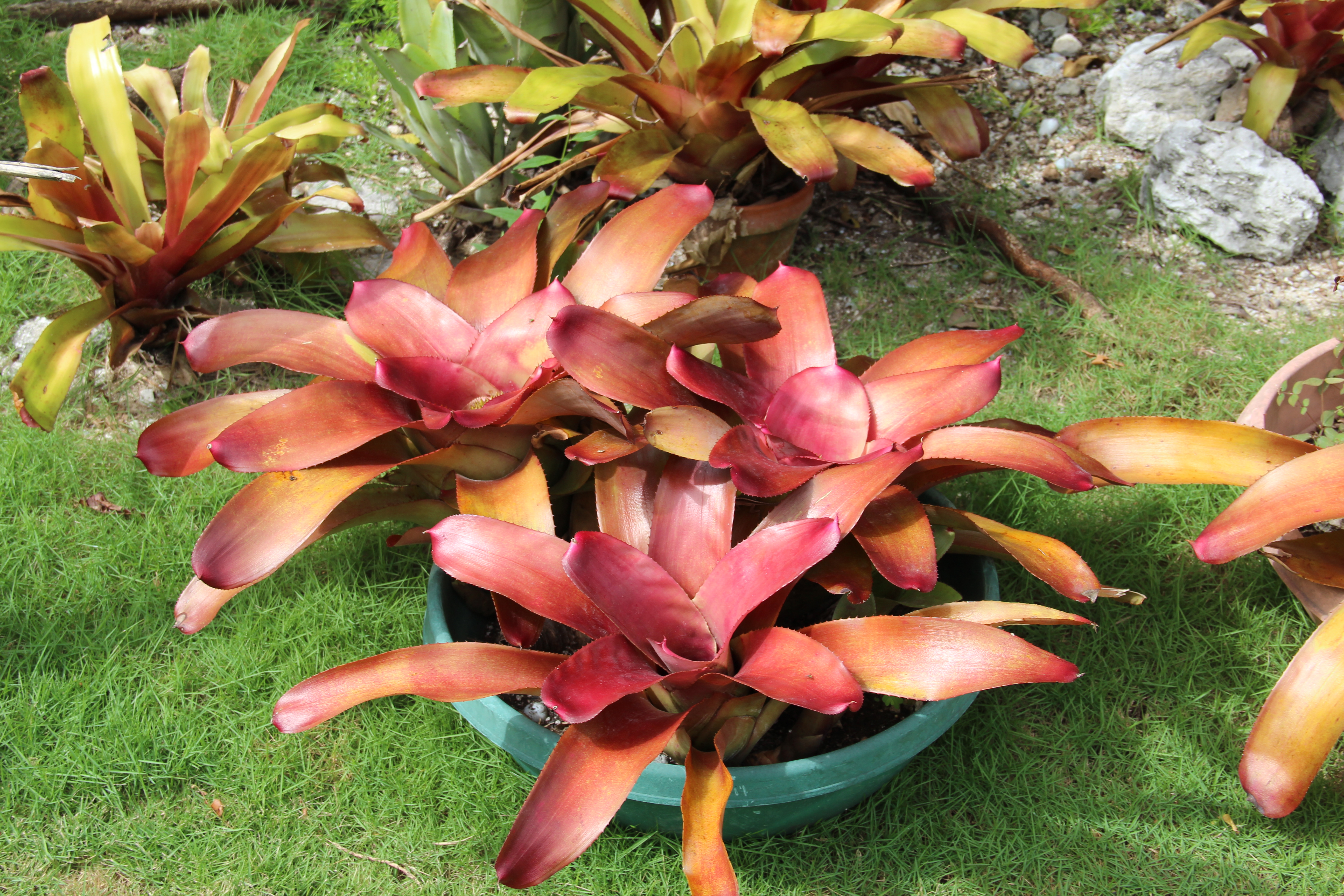
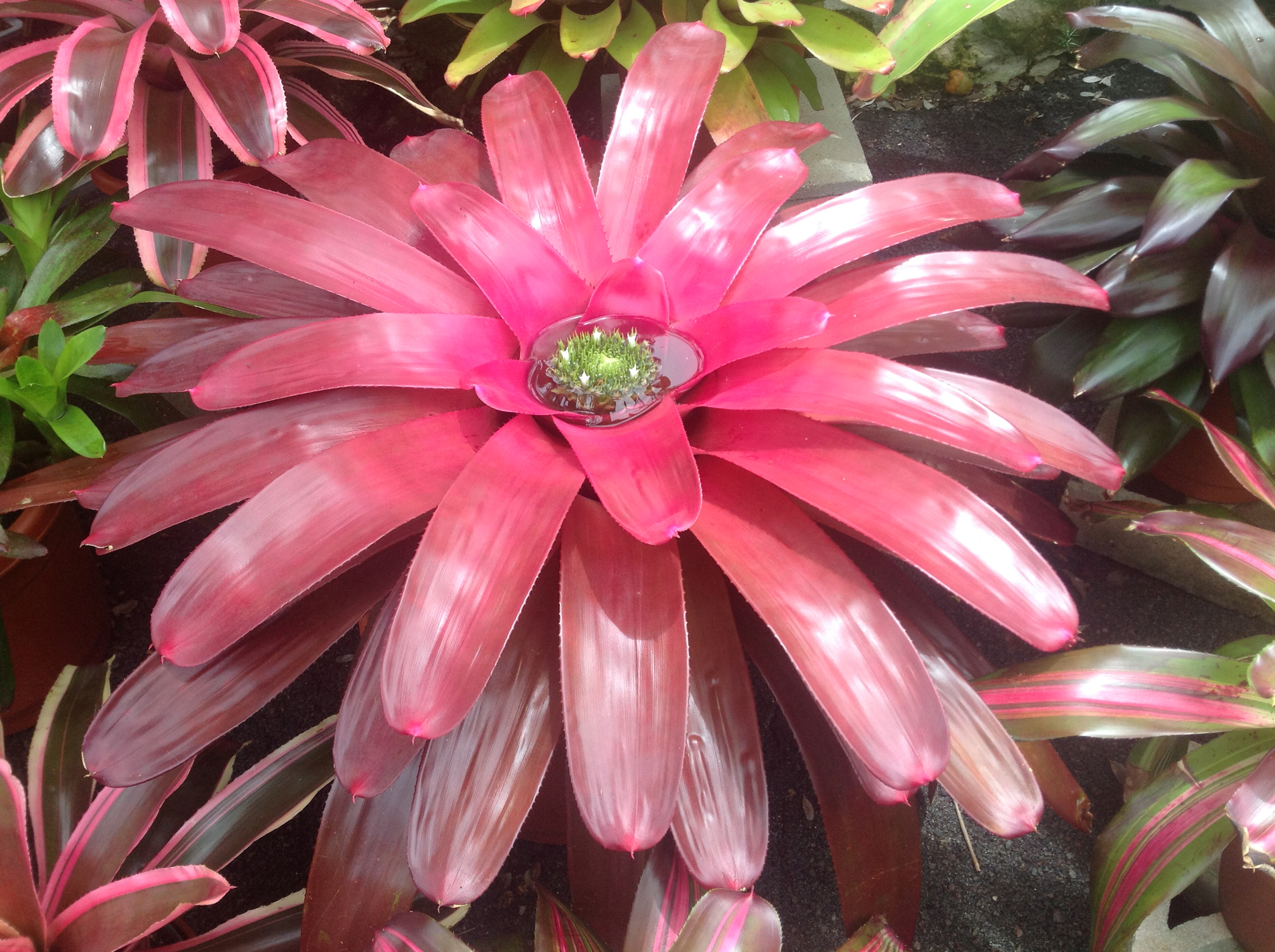
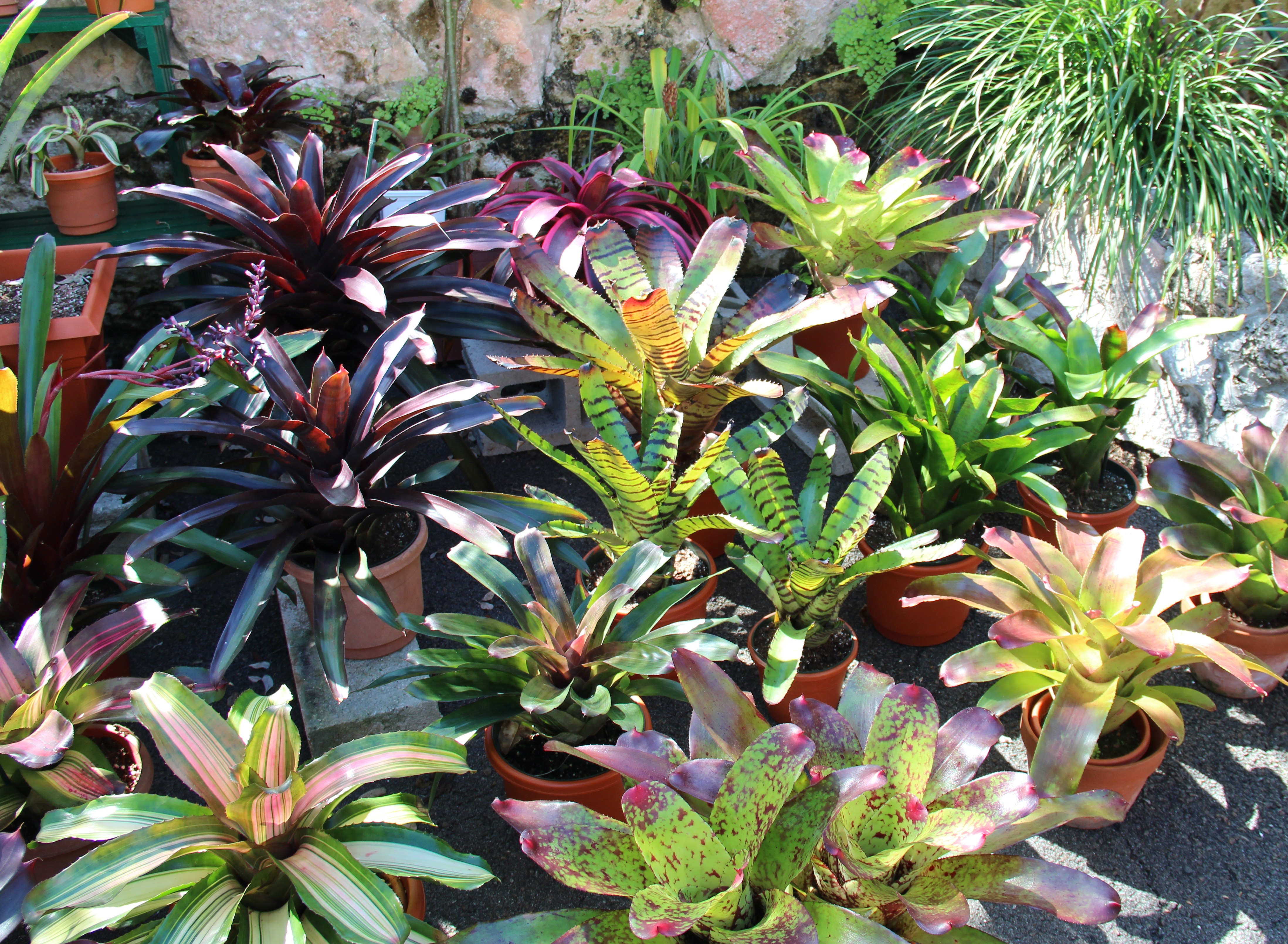
IMG_6655Then I met Sarah Bardelmeier, Founder of the Horticultural Society of The Bahamas; my garden   began to bloom and, as the saying goes: “the rest was history”.  I enjoy attending the monthly meetings at members’ gardens, where we exchange tips and also get expert advice from various speakers. Gardening is a joy to me and bromeliads are now my favourite plants.

Ona Bailey


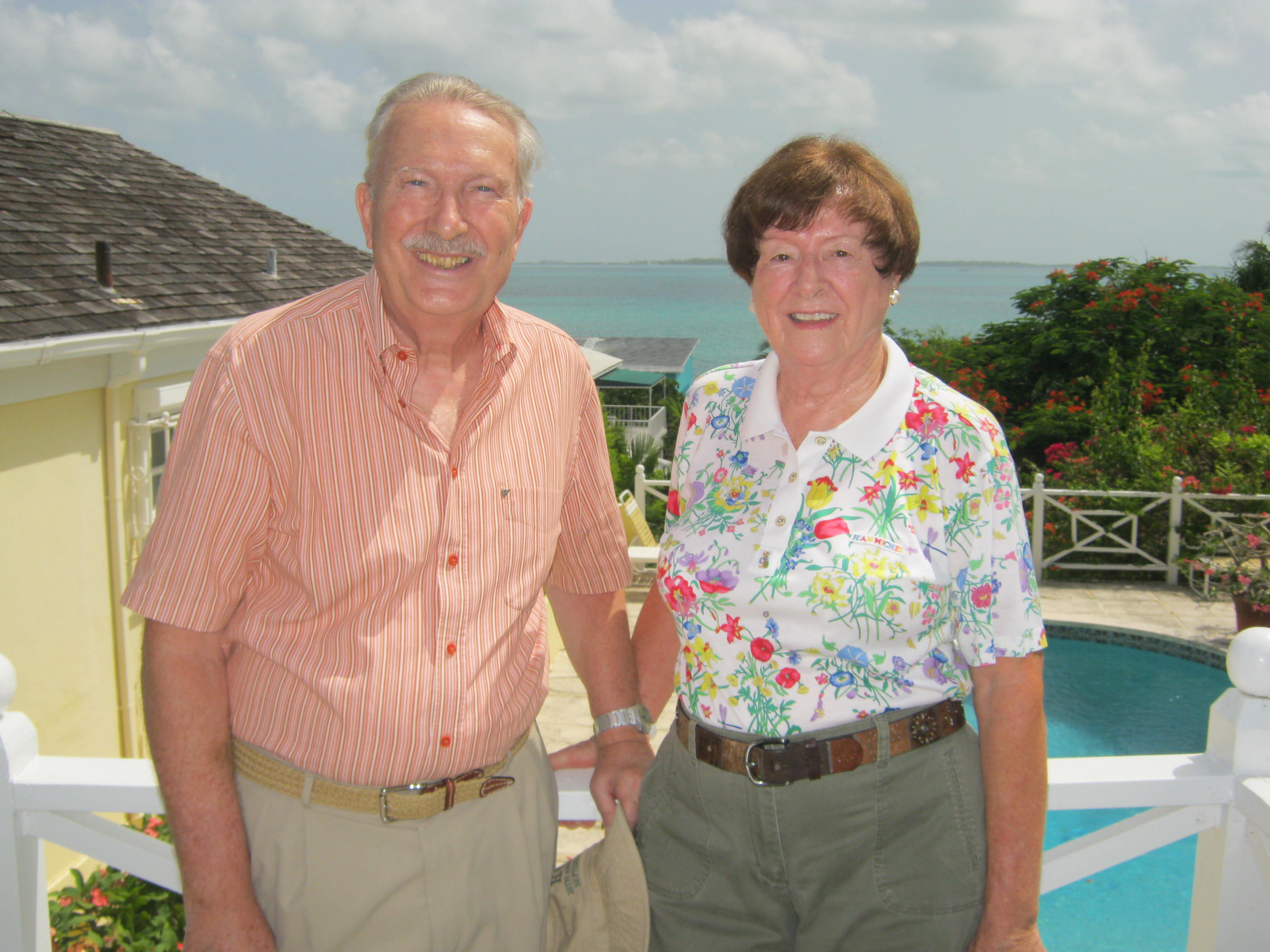
Dr. Colin and Marjorie Archer’s Garden – Winton

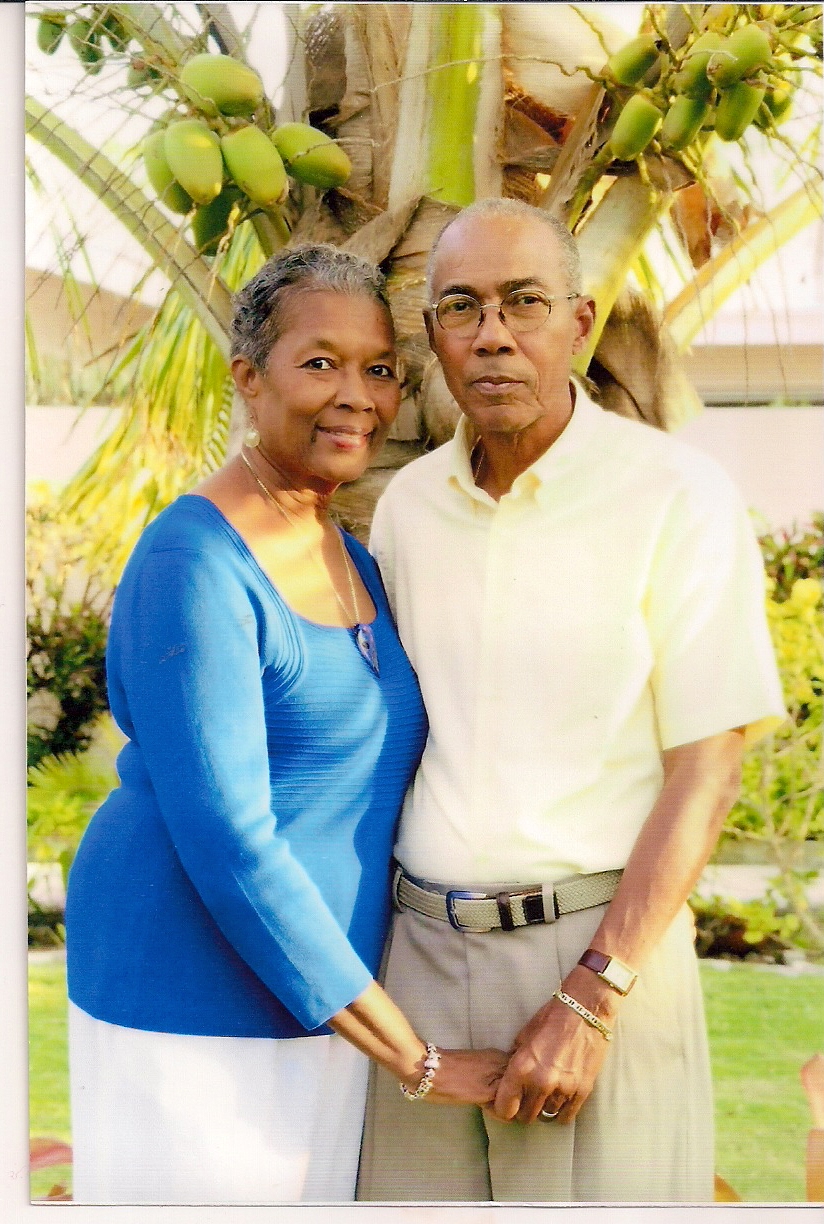
Colin_Marjorie ArcherI have always felt closest to my Creator when connecting with nature.  As a child, rambling in the wild in New Providence and Eleuthera, I became fascinated with a variety of plant life, wild flowers, unusual rocks and wood.  I try to bring all of these aspects into the confines of my garden.IMG_5262

There are many images of life and life lessons that are learnt, in the garden.  I have become tolerant of a snake in my garden (a small one of course) with beautiful markings on its skin which I could speak to (from a distance).   I once watched with fascination as one gracefully slithered over to a patch of plants, skillfully grabbed a lizard scurrying by, embraced it completely (loved it to death), devoured it before my eyes and went merrily along its way.  It is also a delight to watch the turtles, including 30 year old “Mutt”, after escaping the harassment of “Mr. Speckles” (a different breed from the others) basking in the sun before plunging back into their pond.  There they enjoy a feast of gelatinous eggs left by the frogs after a night of symphony (croaking like you have never heard).

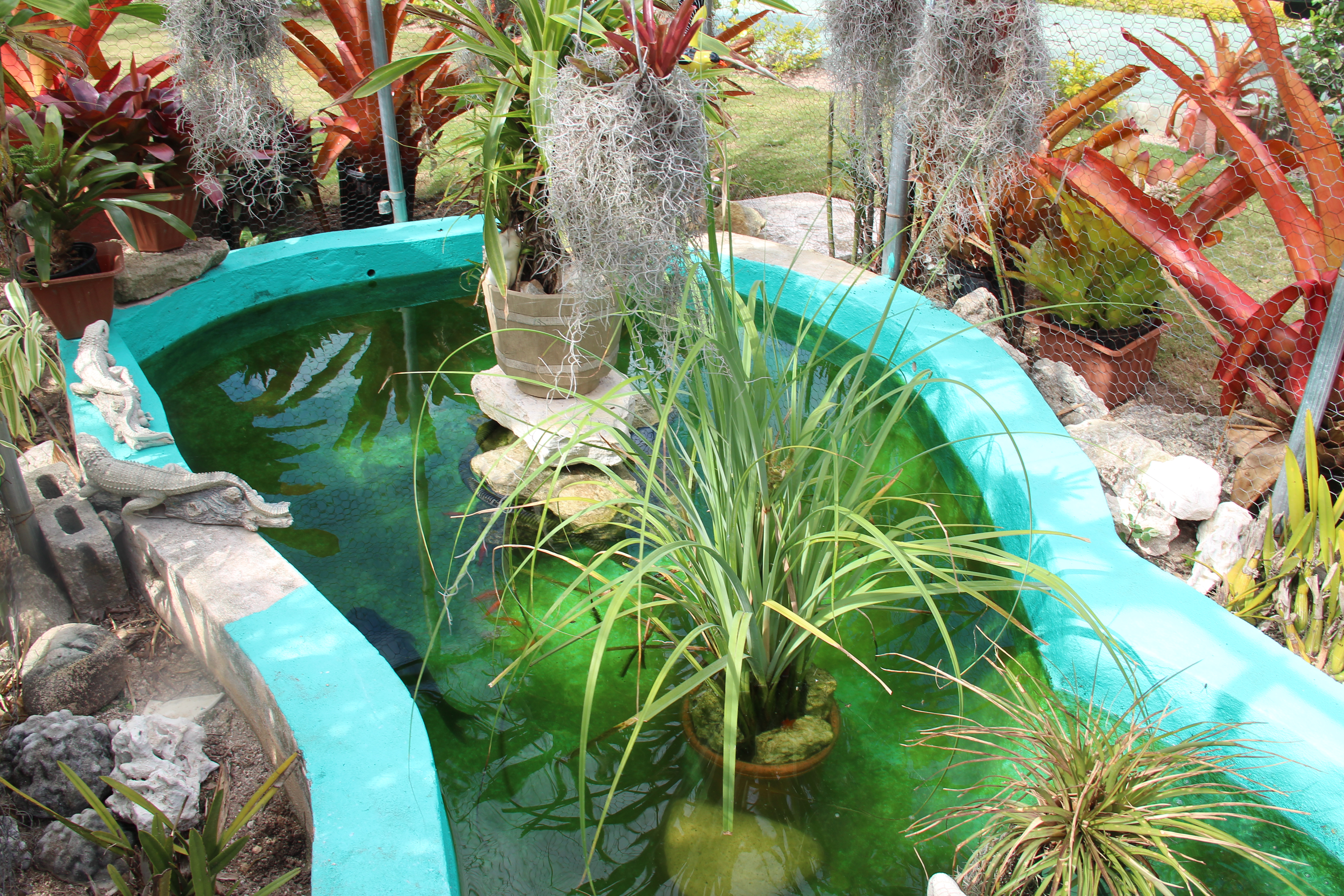
IMG_5276It is a peaceful experience to sit by the fish pond listening to the trickling water and watching the goldfish, sharks and albino catfish swim aimlessly together.  This is sometimes temporarily interrupted if a heron manages to force its way into the pond enclosure to snatch a goldfish.  While my first instinct is to “wring its neck”, I accept it is only doing what it was designed to do, and gently shoo it away.  The peaceful mood is restored when suddenly a pretty little hummingbird appears, stopping in mid-air for two seconds, eyeing me before yielding to the seduction of the bromeliad’s bloom tasting its sweet nectar.  IMG_5239

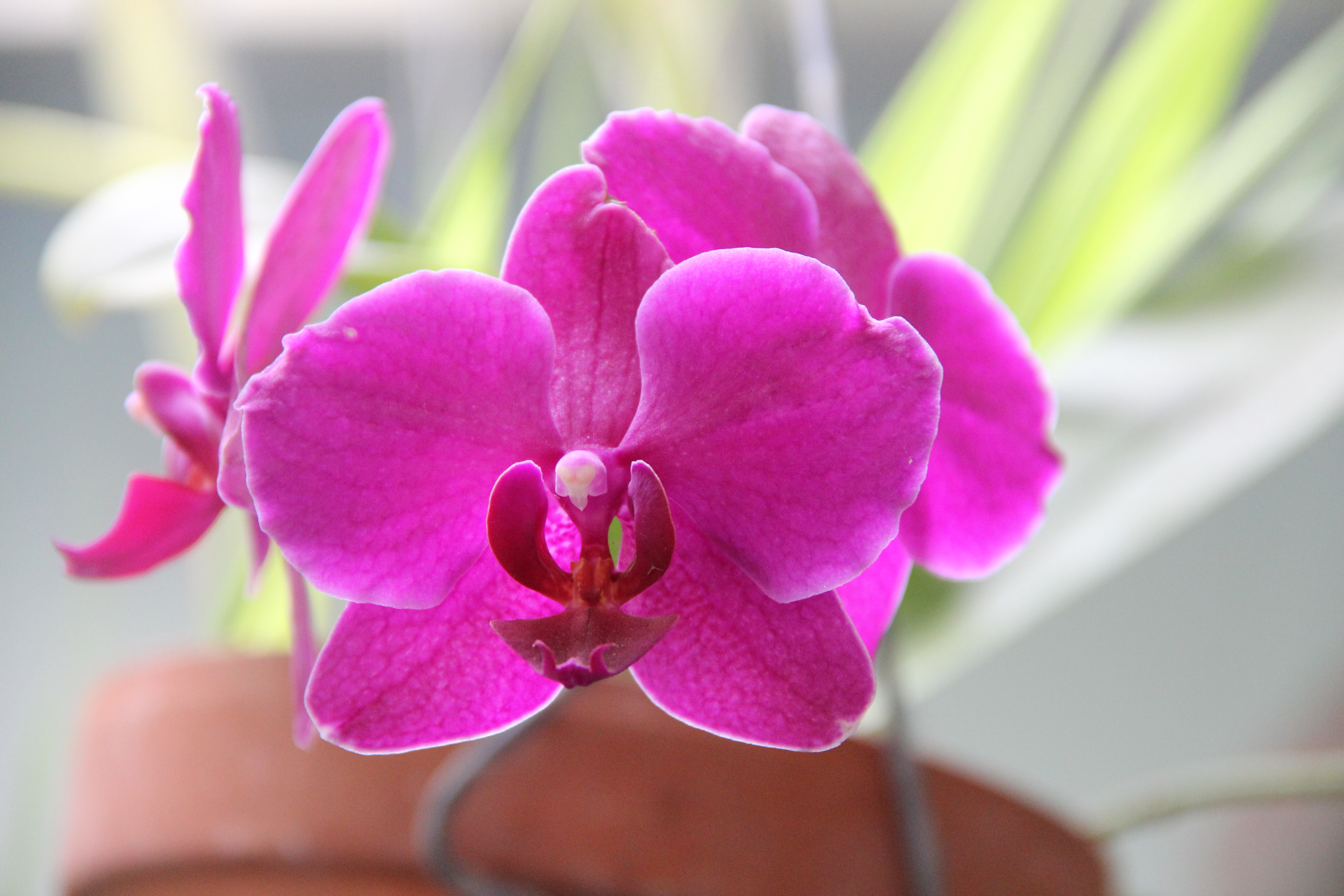
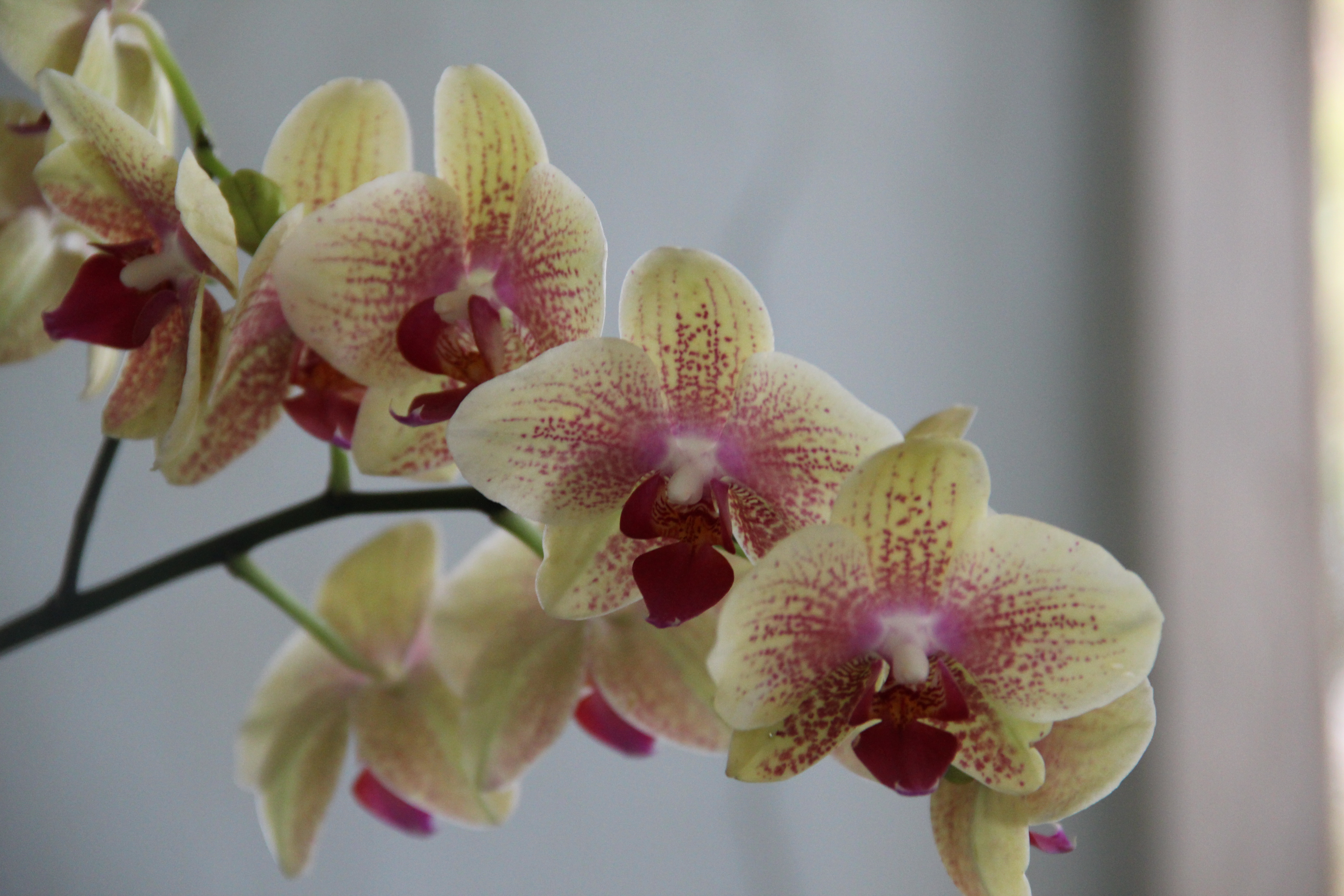
Of course there is always the element of surprise in finding a beautiful orchid in bloom (my favourite flower) that was not there the day before.  Or the explosion of colour from the orange blooms of the plant that gives painful warning from its thorny branches to “touch me not”.

Gardening, in all of its aspects gives balance and wholeness to life.  It is therapeutic, a kind of medicine for all ailments.  With nurturing, pruning, patience and placing everything in the right spot, the result is sheer joy.  The gardener would say after we finished watering the plants, “They happy, they smiling.”  And so am I.

Marjorie Archer

David and Beryl Sheasby’s Garden – Winton

IMG_4765IMG_0316_edited-2Our married life began in l978 and in the October we bought “Junkanoo” on Winton Highway. It came with a magnificent view, looking across to Rose Island, and a house and garden with “possibilities”.    Some thirty-seven years later we continue to work on the “possibilities”!

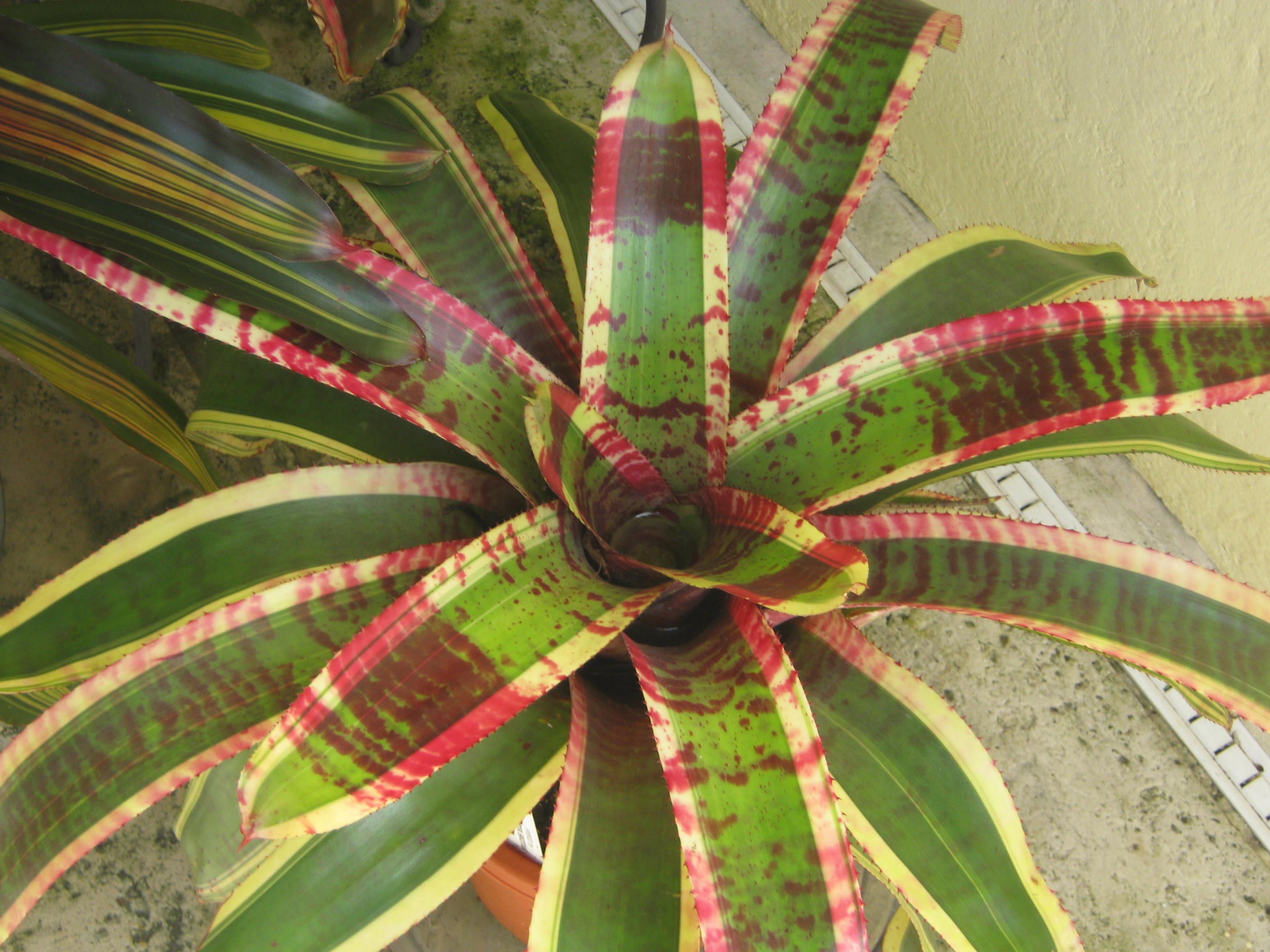
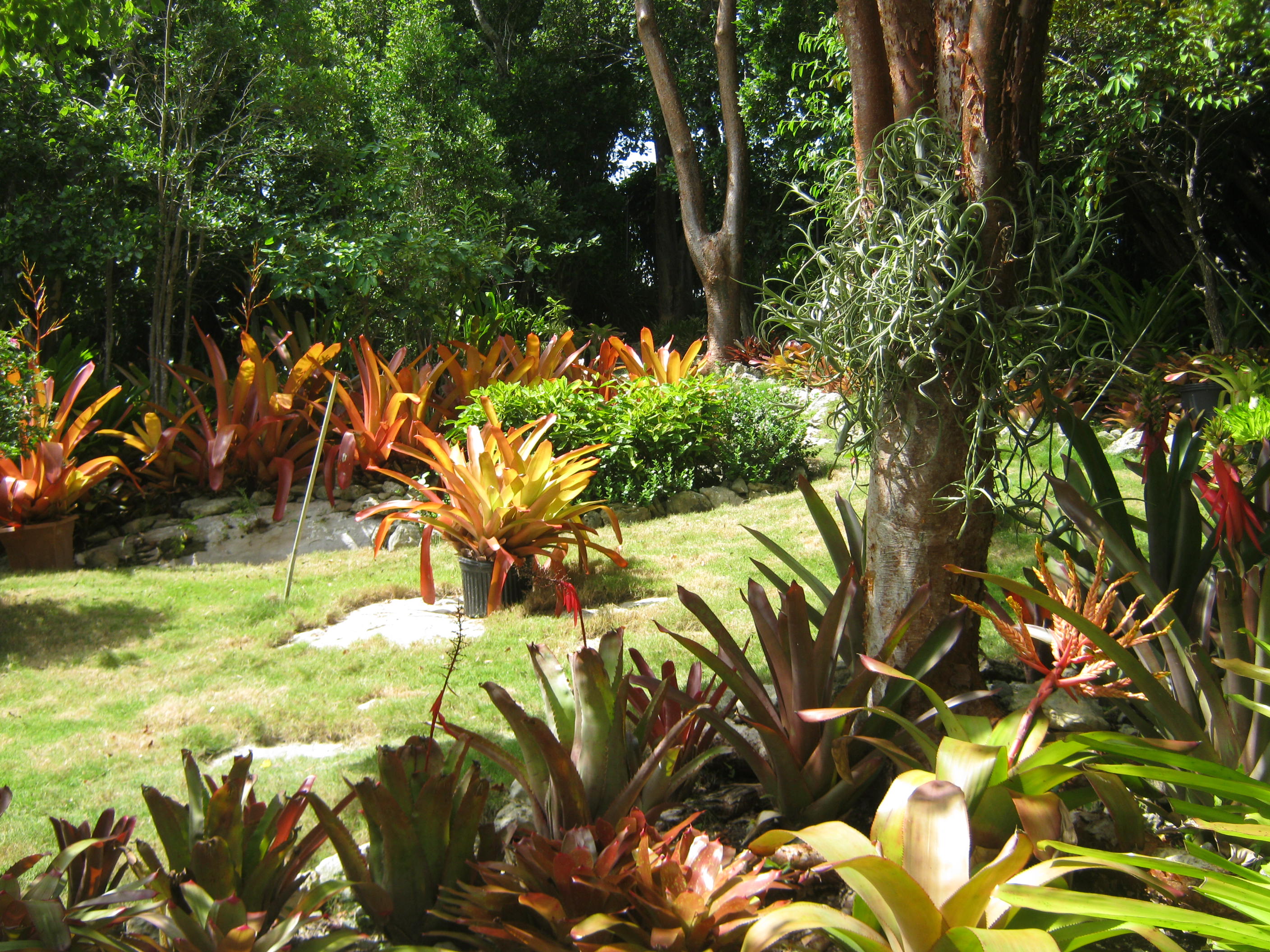
In l984 David and I joined the Horticultural Society of the Bahamas (HSB) and were introduced to the then little known species Bromeliaceae. I confess initially they did not really appeal to me – those prickly, spikey, unmanageable plants!    However, by this time we had acquired the lot adjacent to our house and began to clean it up.   We cleared the undergrowth, got rid of the rubbish dumped there over the years, kept all the native trees and were ready to develop a garden.   So much of the “land” was coral rock and the problem was “what to plant”?    Suddenly those huge prickly bromeliads started to look very attractive, and so began what has become my love affair with bromeliads.

IMG_6381 IMG_4733Like Rosemary, membership of HSB became a focal point for information, and the sharing of information at its monthly meetings which was invaluable in the trial and errors of putting my Bromeliad Garden together.    Such was my addiction to bromeliads that I joined the Bromeliad Society International (BSI) which helped to widen my knowledge even more.IMG_4749

I attended BSI World Bromeliad Conferences and over the years brought back an even greater variety of bromeliads than are available in Nassau – hybrids, new and limited releases – adding to an ever and always growing bromeliad collection!

IMG_9390The Bahamian climate is excellent for growing bromeliads – following a good downpour of rain you can watch the plants practically growing before your eyes.   There is no doubt our garden is a great source of pleasure, pride and contemplation as I wander around looking for new shoots, new inflorescences,  and new surprises of nature.

Beryl Sheasby


Mrs. Antoinette Weech – St. Agnes “Precious Pearl”

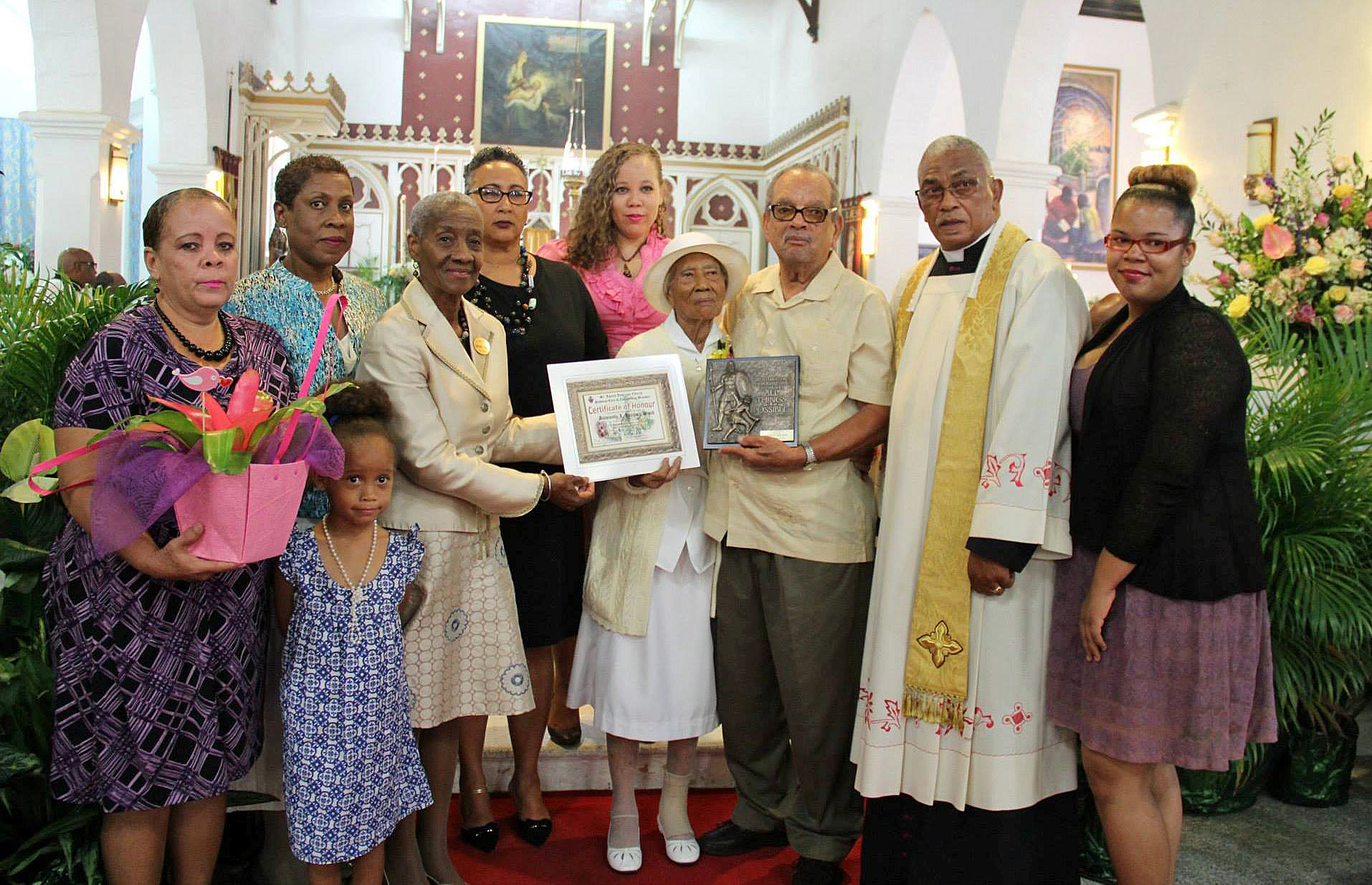
Antoinette Weech - Precious PearlMrs. Antoinette Weech (nee Ritchie) is the senior member and a “Precious Pearl” of St. Agnes Church, where she regularly worships on Sundays and during the week.  She is still very active, reads without eye glasses, crochets and tends to her garden.  Mrs. Weech has lived at her home on Hercules Street for the past sixty-there (63) years, ever since the day she got married in 1948.

She was born in Long Island on 12th June 1915, the second child of Leopold Arlington Ritchie and his wife the former Doris Vivienne Taylor.  Antoinette’s older brother was Leopold and her sister was Pearl.  Mrs. Weech was christened and confirmed in Long island.  Her mother died when Antoinette was twelve years old.  In 1933 her father allowed her to move to Whymms Bight, Eleuthera to live with his only sister, Virginia Eliza Adelaide and her husband, Henry Martin Gibson, who had no children.  Mr. Gibson was a teacher.  He died six months later and Antoinette and Mrs. Gibson moved to Savannah Sound.  Mrs. Gibson was an accomplished tailor and Antoinette assisted her with the finish work and learnt how to make shirts.  Her father later remarried and had eleven children with his second wife.   Mrs. Weech became foster mother to her younger sister, the late Dr. Mary Ritchie, when she came to New Providence to attend the Government High School and later the University of The West Indies.

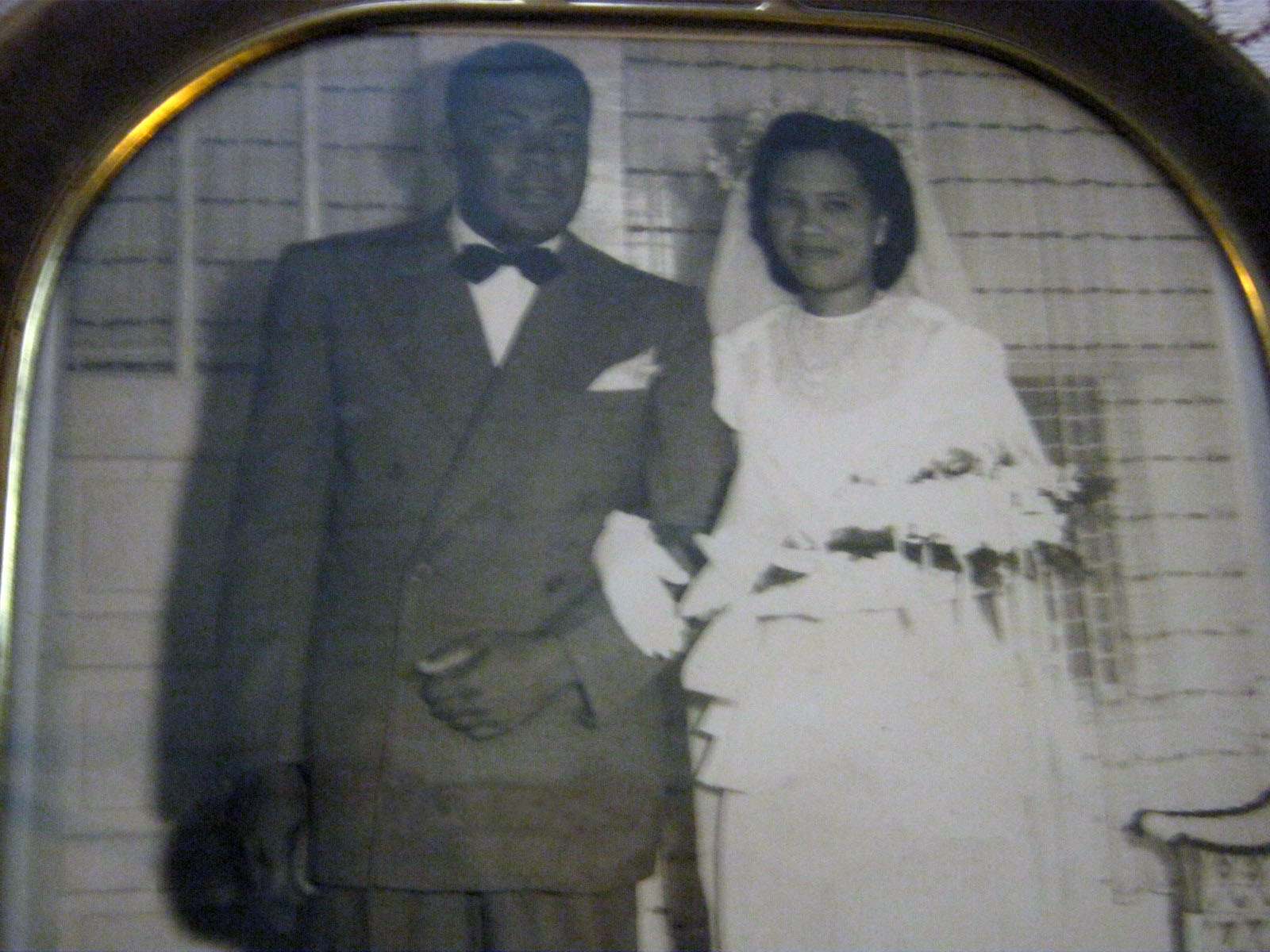
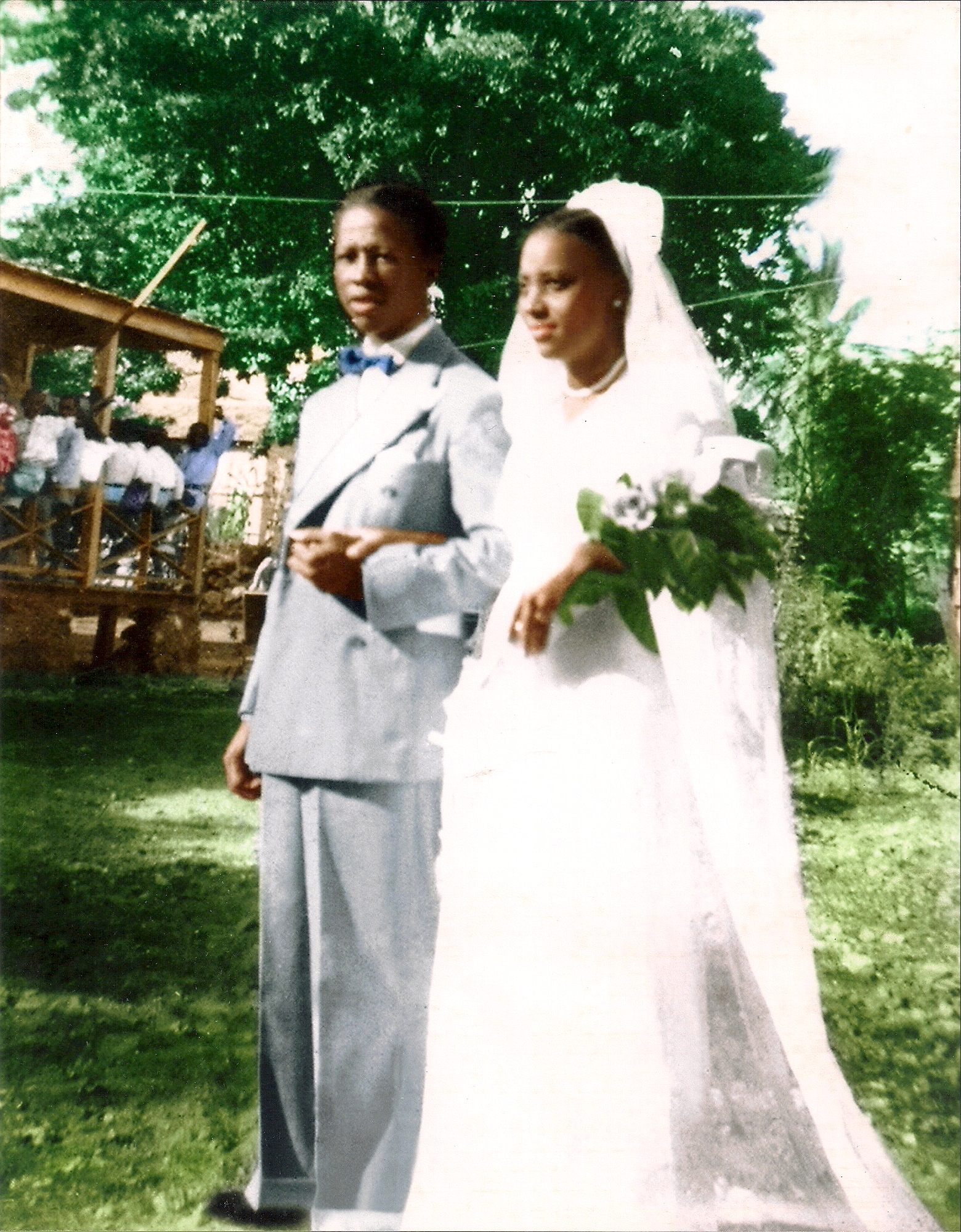
Weech wedding 3Mrs. Weech says that it was love at first sight for both of them in 1939 when she met her future husband, Leland Weech, when she was travelling the Air Pheasant mail boat from Eleuthera to Long Island and Leland was going to Inagua in connection with his job as a telegraphist at Bahamas Telecommunications.   Leopold Ritchie was the engineer on Leland’s parents’ boat which was captained by the senior Mr. Weech and also used as a mail boat.    Mrs. Weech says that when she told Leland who she was he was thrilled to meet his good friend Leopold’s sister.   She later received a letter from Leland which confirmed their engagement that lasted for nine years because he was determined that he would not marry until he had a house into which to move his wife.  Then in 1948 Antoinette received a first grade telegraph from Leland saying that he was coming home to her.  Soon thereafter, on 29th July 1948, they were married by Fr. Henshaw, at St. Anne’s Anglican Church.  Leland knew Fr. Henshaw from the time when he was stationed in Bimini and was an altar boy.  After their marriage Leland and Antoinette joined St. Agnes Church.

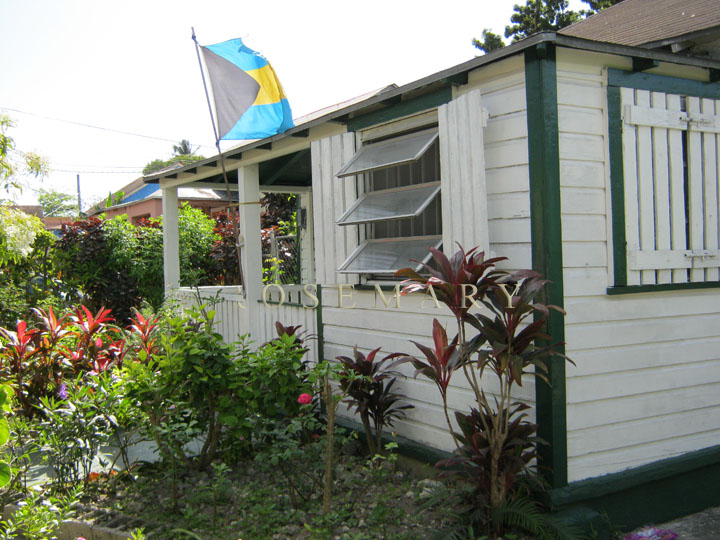
Home of Mrs. Antoinette Weech - Hercules Street / Mason's Additoin, Nassau, Bahamas

Leland always wore shirts made by his wife.   The well made shirts caught the eye of Mr. Saunders, the owner of the Nassau Shop who asked who made them and shortly thereafter Mrs. Weech became fully occupied at home making shirts for the store.    After a number of years the demand for the shirts and other garments became so great that the owners of the Nassau Shop decided that they wanted to have the garments made by factory and they opened a sewing room in the store.  However, Mrs. Weech declined the offer to work outside of her home.   Subsequently, she was hired by G. R. Sweeting & Son to close out their shoe department at the corner of Bay and Charlotte Streets before moving to the new department store in Palmdale where she worked for eleven years before going home to take care of Mary’s children when she opened her private practice.  Mrs. Weech also continued sewing for clients at home and helped the Salvation Army and hospital with sewing quilts, and other items.

When Leland and Antoinette moved into the neighbourhood, they were warmly welcomed by all.  Mrs. Weech describes the Hercules Street and Mason’s Addition neighbourhood as a place where everyone was friendly – the Halls, Maycocks, Smalls, O’Briens, Godets, Johnsons and many others, who all lived in harmony and respected each other.  Hercules Street is one of the very few Over-The-Hill where all of the homes are well kept and people continue to take pride in their surroundings.

Mr. Weech was employed at The Bahamas Telecommunications Company up to the time of his death on 24th September 1957 at the age of 42 years.

Archer Family – Anderson Street

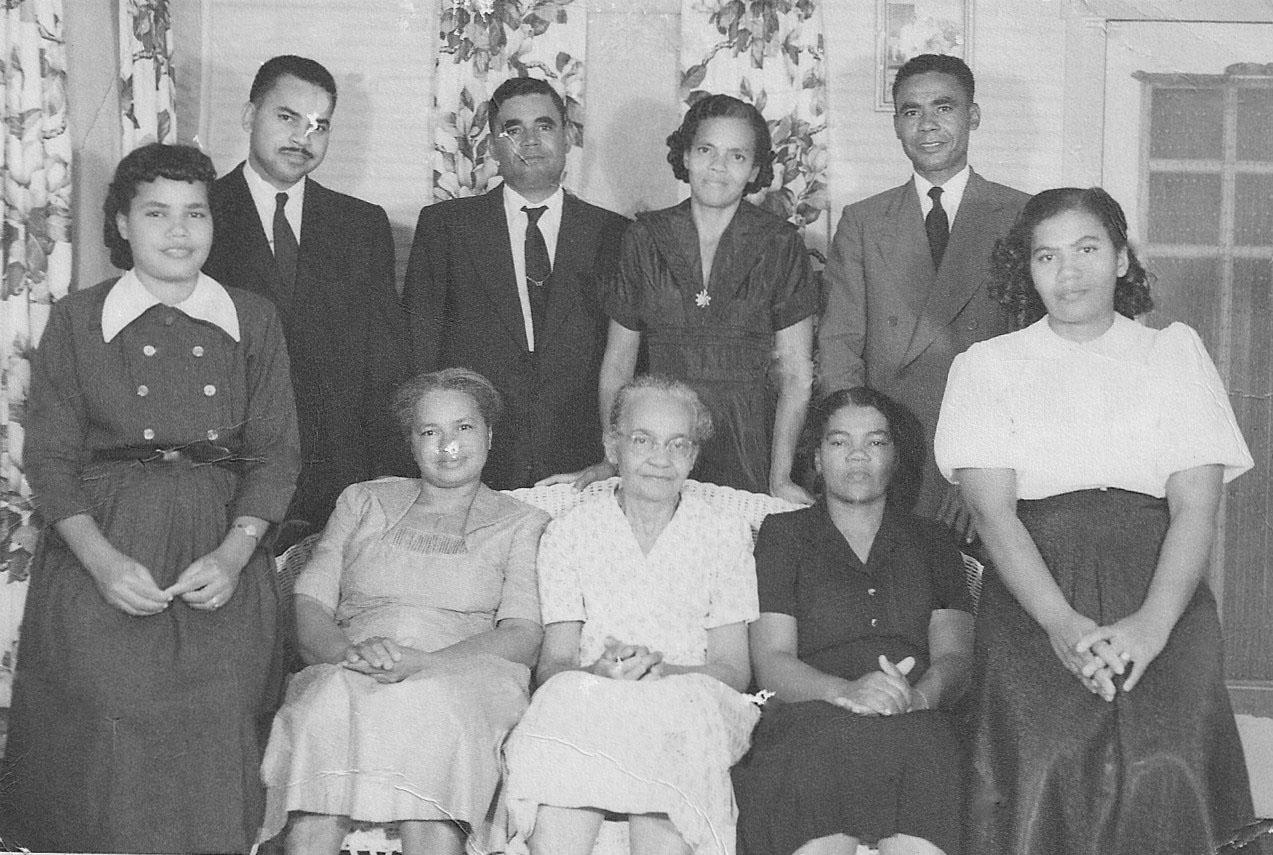
ArchersCaptain Albert Archer and his wife, the former Caroline Lightbourn, of Abaco, lived next door to Howin and Zelda.  They were the parents of Zelda, Walter, Alvord, Baltron, Annette, Mildred (Millie), Jenethia, Velma and Durward. Walter, who was a highly skilled boat builder, was married to the former Agnes Lightbourne.  Walter and Agnes lived on Shirley Street just west of Mackey Street.  As a child, I dubbed Agnes Archer as Mother’s “kissing friend” because they embraced and kissed whenever they met.  Agnes’ sister, Mildred Lightbourne-Sawyer was my godmother.  Walter and Agnes had ten children:  Gurth (deceased), Anthony, Florinda (Clarke), Valerie (Smith), Gregory (deceased), retired Rector of Epiphany Anglican Church, Delano, Persephone (McQuay), Rosemund, Angela and Lambert.   Alvord was married to Herman Bethell of Eleuthera and their children were Baltron, Joyce (Maycock, deceased), Iris (Knowles) and Philip.  Baltron and Joyce Bethell came to New Providence to attend GHS and they lived with their grandparents. Baltron Archer was married to the former Patricia Bethell and their children are: retired nurse, Melanie (Farrington), Colin, who is a Psychologist and Methodist Minister, businessman Donald, insurance executive Albert, and businessman Robert, the manager of Archer’s Nursery, adjacent to the family homestead in Chippingham.

Velma married Pastor Ed Allen and they had two children: Ferne (deceased) and Michael. Annette was married to the late Conrad Knowles and their children are Dr. Ronald Knowles, Joan Albury Archer Family(owner of The Counsellors Limited), attorney Paul, and Dr. Sonia Knowles (dentist). Millie was unmarried and lived in the family homestead on Anderson Street until her death.  Durward married Delores Douglas of North Carolina and they had a daughter, Carolynn.  He was one of the first nineteen students admitted to the Government High School, graduated from Howard University with a degree in mechanical engineering. However, as stated in his obituary, he found it difficult to find appropriate employment in The Bahamas, so he returned to the United States to teach at engineering schools in South Carolina and Tennessee where he passed the Professional Engineers (PE) Board Examination.  He was the first full black member of the American Society of Mechanical Engineers and later worked for Esso Standard Oil (Exxon) in the United States and for many years in Singapore where he was elected to serve on the board of the Singapore American Schools.

After The Bahamas attained independence Durward took an early retirement from Exxon and returned home in 1974 when he was engaged as the General Manager of the Burmah Oil Transshipment Terminal at South Riding Point in East Grand Bahama.  Upon retirement he became a consultant to BORCO Oil Refinery in and Freeport Power Company.  He was an active Corporate Member of The Bahamas Institution of Professional Engineers (BIPE) and served as a member of council of its Northern Branch in Grand Bahama.

Durward, who died in September 2011,  was involved in the establishment of the First company of Boys Brigade in The Bahamas at Wesley Methodist Church and served for many years as Chairman of the Grand Bahama Regional Branch of The Bahamas national Trust as well as on the board of the Trust.

Mrs. Caroline Archer was an excellent cook and neighbours looked forward to buying her hot bread on Saturday afternoons. Her granddaughter, Diane Dean, inherited Mrs. Archer’s culinary skills and operated a catering business.

Captain Archer’s mother, Susan Jane, was a wonderful quilt maker and she lived with the Pinders. Annette and Velma are the surviving children of Captain and Mrs. Archer.

© Copyright Rosemary C. Hanna 2013


Bruce Braynen, M.B.E. – Parliamentarian / Businessman

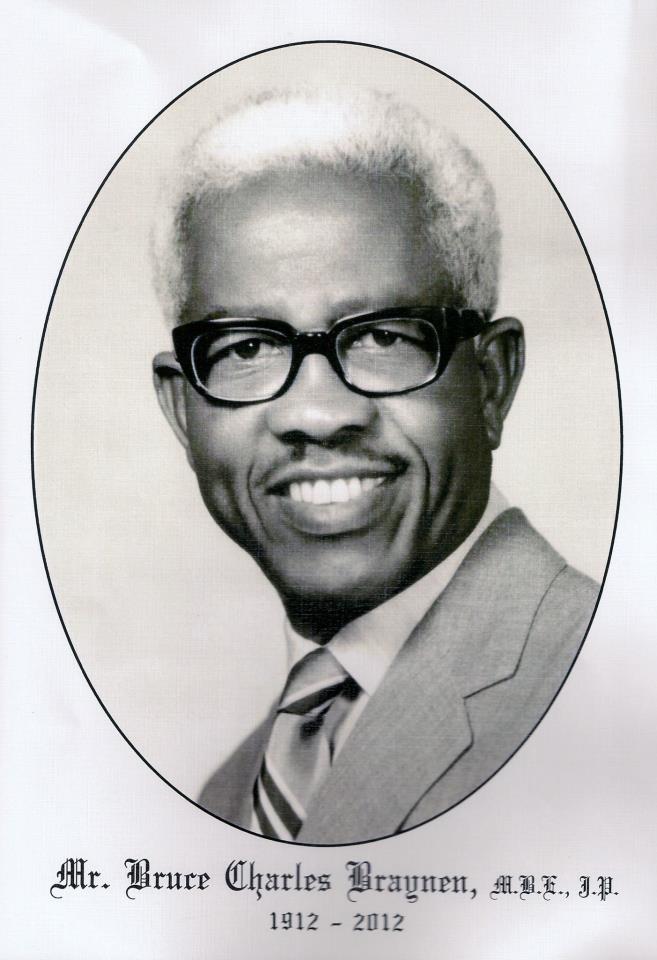
Bruce BraynenMr. Bruce Braynen, MBE, a former Parliamentarian, was born in Fresh Creek Andros on 27th December 1912.  He was the son of Lupereon and Ida Braynen.  Lupereon was a European and Ida was a black woman.  The Braynens had four other children, two sons and two daughters.  The Braynen family moved to New Providence when the children were young. Later Mr. & Mrs. Braynen and Bruce’s four siblings moved to Florida where it was easier for Lupereon to find employment and Ida worked as a dressmaker at Burdines Department Store.  However, Bruce chose to remain in The Bahamas with his grandmother, Catherine Bain, to whom he was very close.   They lived on Hospital lane south of Meeting Street.  Bruce attended the St. Agnes Day School.  The late Dr. Cleveland W. Eneas, Sr. described Bruce Braynen as a Grant’s Town Boy who liked to play with the boys from Bain Town.

Mr. Braynen lost his sight some years ago but, at age ninety-nine (99), he still had a sharp wit and fondly remembered his youthful days growing up in Grant’s Town.  He recalled when the Southern Recreation Grounds (then called the Government Yard) was bush.  Prisoners were brought down to cut down the bush and maintain the property.  Mr. Braynen remembered that he and a few other boys built the cricket pitch and planted grass on the field, which was often eaten by the horses and had to be replanted; however, the grounds developed into a beautiful place.  He also noted that Mr. Edgar Munnings (the father of Harold Munnings and Gwendolyn Munnings-McDeigan) built the steps leading to the bandstand.  The original one was a wooden structure that was “in town” (downtown) before it was moved to its present location.

Bruce chuckled when he recounted that he was a good looking boy who was well liked and allowed to get away with doing some things the other boys were not allowed to do.   I got the impression that he was a little bit peeved about the West Indian boys from the neighbourhood who he said “acted like they knew everything”.  Nevertheless, he acknowledged that many of them had a higher level of education than their Bahamian counterparts, and everyone got along well.

Braynens_1939Mr. Braynen married the former Gwendolyn Todd whose family came from Barbados.  He said that he saw Gwendolyn for the first time when she was about ten years old as she disembarked from the horse and carriage when her family arrived from Barbados; he thought to himself at the time that he would marry her one day.   They were married at St. Mary’s Church on 22nd May 1939 and had three sons, Anthony, Michael and Alaasis.  Mr. Braynen’s other children are Rodney, Barbara King and Mavis Miller. Mrs. Braynen was a nurse by profession.  She died in 1999.

Bruce learnt carpentry as a boy and he became a master carpenter.  As a teenager he built coffins and worked with local undertakers and, at his death, he still owned the saw that he used as a boy.  He was a truck driver for Kelly’s Bakery for twenty-one (21) years and continued to hone his skills in the building industry.  In 1943 he became established as a licensed builder and he eventually became a very successful building contractor.   He built the Aurora Lodge Hall at Charlotte Street North (near the steps) as well as the home Mr. Edgar Bain, on Blue Hill Road, opposite the Government House lower gardens, shown at right.

Mr. Braynen was first elected to Parliament in 1972 as the PLP representative for the St. Agnes Constituency.   He was subsequently re-elected and served in Parliament for fifteen (15) years, where he held the posts of as Speaker and Deputy Speaker of the House.   He chose not to run for election again and was subsequently appointed a Senator, serving in that capacity for ten (10) years.   He was a philanthropist and quietly helped many persons in Grant’s Town.  He served as Secretary General of The Bahamas Federation of Labour (BFL) and as Chairman of The Bahamas Electricity Corporation (BEC).  He was also a member of the National General Council of the PLP.  For forty one (41) years he operated his laundry business on Vesey Street at the site which is now the rear parking lot of the Grant’s Town Post Office.

Mr. Braynen died on 3rd October 2012.


Dean Sisters – John Road, Bain Town

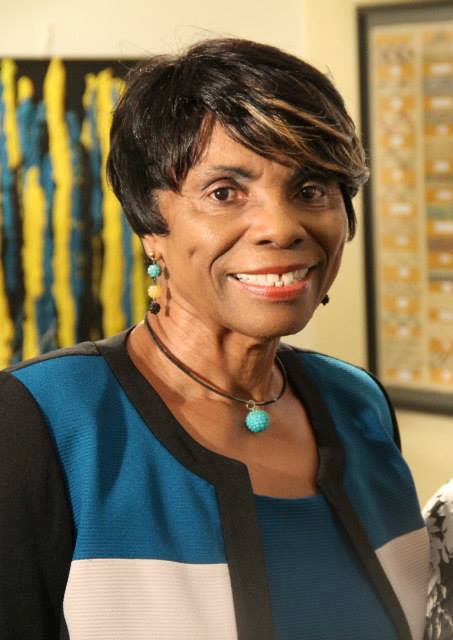
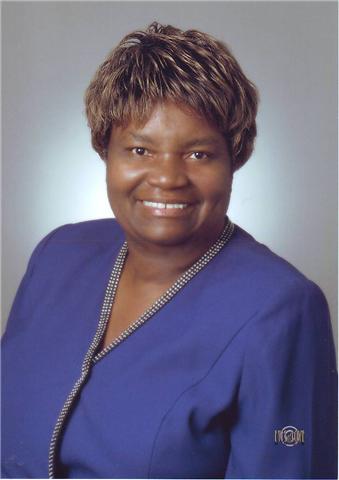
Pat BazardSisters, Patricia Dean-Bazard (Pat) and Audrey Dean-Wright, formerly of John Road, off Blue Hill Road, are the leaders of The Bahamas National Children’s choir (BNCC).  They write in an excerpt from the history of the BNCC quoted below:

“In the summer of 1990 two sisters, Dr. Patricia Bazard and Mrs. Audrey Dean-Wright, in an effort to give back to the community in which they were raised, formed a choir of twenty five (25) students from government and private schools in the Bain town area.  The purpose was to enable the children to identify with their culture, cultivate their many talents and provide opportunities for their individual development.  Students are expected to maintain a 3.0 grade point average.

“The members of the choir range in ages from five to fifteen years.  The number of choir members has grown from 25 at its inception to approximately 120 active members to date.  The choir is a complete representation of all economic levels (strata) of society.”

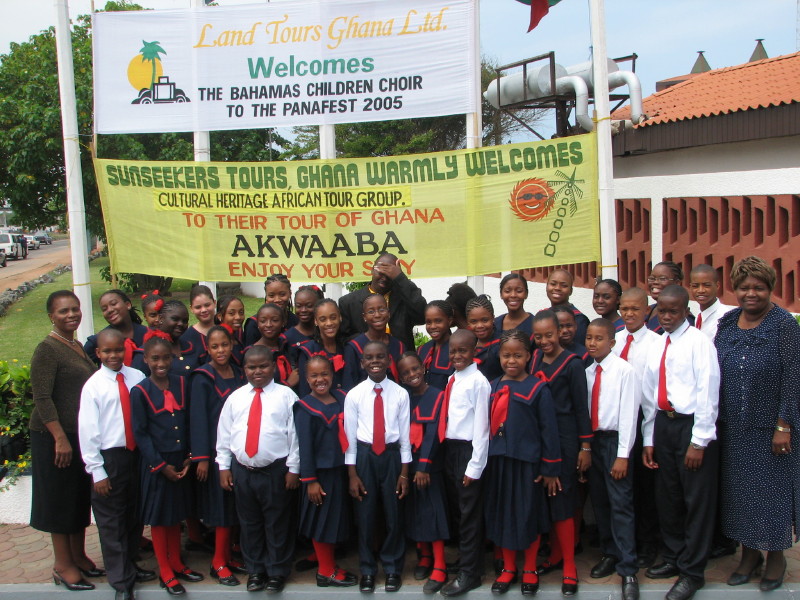
Pat and Audrey have literally taken the children of the BNCC around the world.  In addition to performing for Government and national events and other organisations in The Bahamas the choir Audreytravelled to many historic cities throughout the world. They represented The Bahamas at the Smithsonian Folk Life Festival in July 1994 in Washington, D.C. and also performed at the Martin Luther King Library; they have toured the United States on several occasions, and performed at the Thirtieth Anniversary Independence Celebrations of The Bahamas in New York, and for the opening of Harlem Week. In 2001 they took part in the First World Youth Music Festival in Russia and, again in 2004, they performed at the VIII Moscow Children and Youth International Choir Festival, where they placed second over sixty-seven countries.   The children of the BNCC have also performed in Haiti, Ghana, West Africa, on a Caribbean Cruise Tour, on two occasions in Poland, at the Young Prague International Music Festival when they won a bronze medal in 2010.  Most recently in July 2012 the Choir won a bronze medal at the International Choral Festival in Beijing, China where they competed against sixty-nine other choirs.

Pat was the first director of The Bahamas National Youth Choir (BNYC) which was established by Director of Culture, the late E. Clement Bethel, on the occasion of The Bahamas’ tenth anniversary of Independence in 1983.  Because of other commitments Pat relinquished her role of director of the BNYC and she recommended Cleophas Adderley to Mr. Bethel.  Under Cleophas’ direction the BNYC has achieved great heights at home and internationally, having won many international choir competitions, including two gold medals and one silver medal in the 2012 World Choir Games in Cincinnati Ohio in July 2012.

BNCCPatricia is married to Lucito Bazard of Haiti and they have five children and twelve grandchildren.    Audrey is married to Carleton Wright.  They have three children and two grandchildren.

Patricia has had a long career in the Civil Service having worked forty-five years.  Audrey is an accomplished musician and sought after pianist. She is an Associate Professor and Head of the Visual Arts and Performing Division at The College of The Bahamas.


Conclusion: Xenophobia

By Rosemary C. Hanna 

Too many Bahamians suffer from xenophobia which comes from ignorance of their history or the deliberate distortion of that history by some who refuse to recognize and acknowledge the contributions of many of the persons upon whose shoulders we stand.   When I was growing up under Colonialism we were taught English history and brainwashed into thinking that anything English or white was better than we Bahamians were.  I well remember the days when I was at Western Junior School when we, the descendents of black slaves, were herded down to Clifford Park to celebrate Empire Day, wave the Union Jack and sing: “Rule Britannia…. Britons, never, never, never shall be slaves!”  Then we were rewarded with a little brown bag of goodies.  At the same time, discrimination was the order of the day and blacks were not allowed to enter certain establishments or be on Bay Street after a certain time, without explanation.

It is a sad reality that in the year 2011 some people still suffer from self-loathing and are pre-occupied with skin colour by burning themselves with bleaching creams and wearing ridiculous hair weaves and extensions so that they can appear to have “good” hair.

Many of us are also unaware of the bonds that tie us to our brothers and sisters to the South in the Caribbean.  The heritage of many prominent and ordinary Bahamians of the past is rooted in the Caribbean.  Former   Prime Minister, The Right Honourable Sir Lynden Oscar Pindling’s father was a policeman recruited from Jamaica; the father of the former Deputy Prime Minister, Sir Clement Maynard was from Barbados and his wife’s parents Dr. Roland Cumberbatch and Meta Davis Cumberbatch were from Trinidad; the family of Stephen Dillett, after whom a school is named, was from Haiti; the father and mother of the current Governor General Sir Arthur Foulkes came Jamaica and Haiti respectively. The Royal Bahamas Police Force was also largely built upon recruits from the Caribbean Islands such as Barbados, Trinidad and Jamaica.

Many of the West Indians who came and established families in The Bahamas were educated people who were also proficient in other trades.   For example R. M. Bailey of Barbados, who was educated at Codrington College, was also a master tailor.  He arrived in The Bahamas in 1899 and made this his home.  It was he who pushed for the establishment of a high school for black children that resulted in the establishment of the Government High School in 1925, which started with five students, including two of his children, Millicent and Robert.   Mr. Bailey’s grandchildren include Rosemarie Thompson (widow of Archdeacon William E. Thompson), attorney Carmen Bostwick and Cleophas Adderley, attorney and composer of the first Bahamian opera “Our Boys”, who is also the Director of The Bahamas National Youth Choir. Cleophas is also a tailor.   The R. M. Bailey Senior High School is named in honour of Mr. Bailey.

Americans, Muriel Eneas and Mabel Walker were among some other prominent educators who came to The Bahamas from elsewhere.   When these women came to The Bahamas, the Colonials looked down upon American degrees as inferior to the British.   However, Muriel Eneas, Mabel Walker and others like Laura Ritchie of Jamaica gave their best to their adopted country.   Mrs. Eneas taught at St. John’s College and became Principal of St. Anne’s High School.  Mrs. Walker was Principal at the Woodcock Primary School and founder of The Bahamas Teachers’ Union.  Muriel Eneas and Mabel Walker were also founding members of the women’s suffrage movement.  Mrs. Ritchie was Principal of St. John’s Preparatory School and she opened her home to give private lessons to children.   Vincent Wilson of Barbados, who came to the Bahamas as a police recruit from Barbados, married Cloretha Munroe, a young woman from Ragged Island, whom he met at St. Agnes Church.  Vincent later became Deputy Principal at T. G. Glover Senior High School.  He was also the longest serving Police Force Education Officer.    All of the foregoing, and many others, raised beautiful Bahamian sons and daughters who are continuing to build upon the foundation laid by their parents.

The father of former Financial Secretary to The Bahamas Government, Ruth Maycock-Millar and former PLP MP, The Honourable Alfred Maycock was among a good number of fellow Barbadians who settled in and developed the Mason’s Addition area.   Many persons are also unaware of the ties between Haiti and The Bahamas, when Inagua was the hub for shipping.

Dr. Joseph Robert Love was born in Grant’s Town and he was also a member of St. Agnes Church.  He was the first black to graduate with a medical degree from the University of Buffalo and spent time in Haiti, firstly as a medical missionary, and later becoming very involved in Haitian politics.  During this time people from other parts of the Caribbean migrated to Haiti.  Dr. Love later moved to Jamaica and he influenced the great Jamaican Black Nationalist, Marcus Garvey.  There were Bahamians whose ancestors had moved to Haiti many years ago, including some Hannas, who returned to The Bahamas when the government changed in 1967 and reclaimed their Bahamian citizenship.

Many thousands of Turks Islanders also came to The Bahamas and made significant contributions to the development of the country.   I found it very interesting when visiting the Turks Islands, that they played more Bahamian music in their public places than we do in The Bahamas.

Many prominent persons, including:  Governors General, ambassadors, parliamentarians, religious leaders, educators, doctors, lawyers, businessmen, engineers, accountants and other professionals, came from Over-The-Hill and they, along with other ordinary and upstanding individuals, were the building blocks upon which our nation was built.

Researching this book has been an educationally exhilarating experience for me.  I was truly amazed by and am grateful for the positive and enthusiastic support of all of those persons who allowed me to come into their homes, told me their stories, and provided the beautiful family photographs that are pictured in the book.    However, I have only scratched the surface and there are many more stories that need to be written.  So I encourage readers to record your own stories for future generations.


Dr. Claudius Roland Walker, M.D. – Bain Town

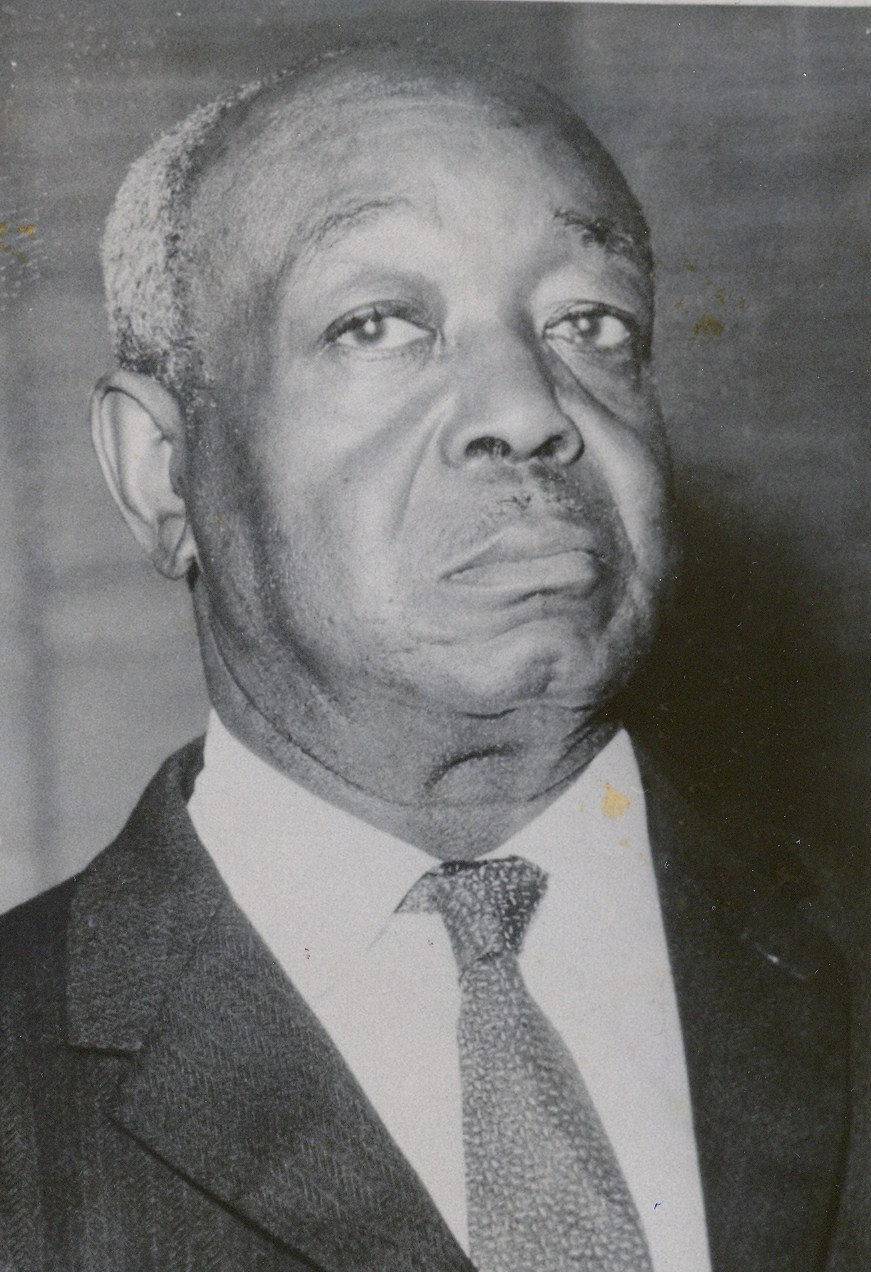
Claudius WalkerClaudius Roland Walker, MD, was an extraordinarily brilliant man who was born and lived most of his life in Bain Town.   He was born on 6th May 1897, and he was an only child.  His parents were Claudius F. and Patience Walker (nee Robinson).  He was an accomplished musician who played the organ, piano and double bass, and he was a linguist who spoke Spanish, French and German.  He also taught mathematics and established the Bahamas Technical Institute, an evening school for adults.  Classes were held at St. Agnes Schoolroom.

He attended the Boys’ Central School in Nassau and he furthered his education at the Rhodes Preparatory School and College of Liberal Arts in New York.  He obtained a Bachelor of Science Degree from Howard, Washington, D.C.   It was in a German class at Howard University that he met Mabel Holloway of Greensville, South Carolina. He subsequently entered Meharry medical School in Nashville, Tennessee and graduated in 1929.

Aside from all of his professional and academic accomplishments, Dr. Walker was also a builder and he constructed the Reinhard Hotel at the corner of Blue Hill Road to accommodate black visitors who were not allowed to stay in the established hotels because of race discrimination.  In the late thirties he moved his medical office which was located in rooms on the South side of his home. He later moved his practice to the ground floor of the hotel where there was also a pharmacy.

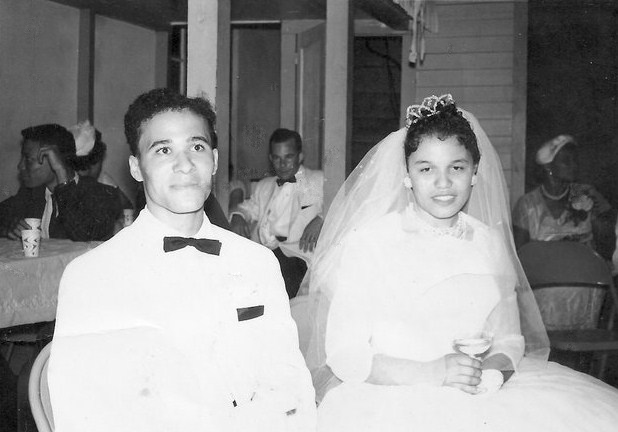
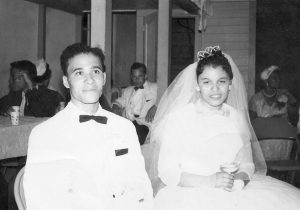
The Reinhard Hotel was also the venue for wedding receptions and other social events.   David and Annette Cartwright, who were married at St. Agnes Church, are pictured at right at their wedding reception at the Reinhard Hotel in 1961.   The hotel was also the headquarters for the Progressive Liberal party (PLP) leading up to the historic 1967 elections.  I was working in the office as a volunteer and this is where I first met Arthur Foulkes and Oswald Pyfrom who were in charge of the headquarters office. Cartwrights_Rheinhardt
In the aftermath of the Burma Road Riot on 1st June 1942, Dr. Walker was chosen by The Bahamas Federation of Labour to be its spokesman to address the Duke of Windsor’s Committee on behalf of the Bahamian workers.  In his book, “The Faith That Moved the Mountain”, Sir Randol Fawkes quotes Dr.  Walker as he spoke on 3rd June 1943:

“We Bahamians are the sons and grandsons, the daughters and granddaughters of those who arrived.  We seek to reclaim that which was snatched from us over 300 years ago – our dignity and self-respect as human beings.

“During the interval between then and now, we have become the most brainwashed people in the world.  You see, teachers and missionaries did not tell us that there was a period in ancient history when Rome was barbarous and Greece slept but Africa flourished with its own governments, economic systems, and military forces, religious and social organisations.  Indeed, in the very beginnings of mankind, the African nation of Egypt occupied a central role in world history.

“We were taught that our ancestors contributed nothing to the advancement of civilization.  Yet it was common knowledge that Africans were the first to practice agriculture – the first of the cultures – along the banks of the Niger River. Neither did they tell my people, Gentlemen, that the earliest known pottery was created in Africa more than thirty thousand years ago, during the Paleolithic (stone) age.

“…It is a psychological truism that an oppressed and rejected people soon come to see themselves through the eyes of the oppressors.  As a result, the black man soon learned to hate himself and others in his own race.”

Former Deputy Prime Minister and later Governor General A.D. Hanna describes Dr. Walker as the bravest man he ever knew considering the fact that, during the darkest days of discrimination, he fought alone against Bay street in his efforts to improve the condition of blacks in The Bahamas.  He kept the people informed by producing his newspaper, The Voice, and gave it away if they could not afford to pay.  In hindsight, AD thinks that the PLP should have embraced Dr. Walker.
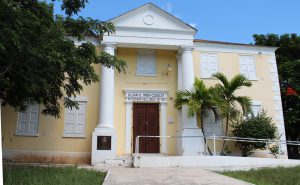
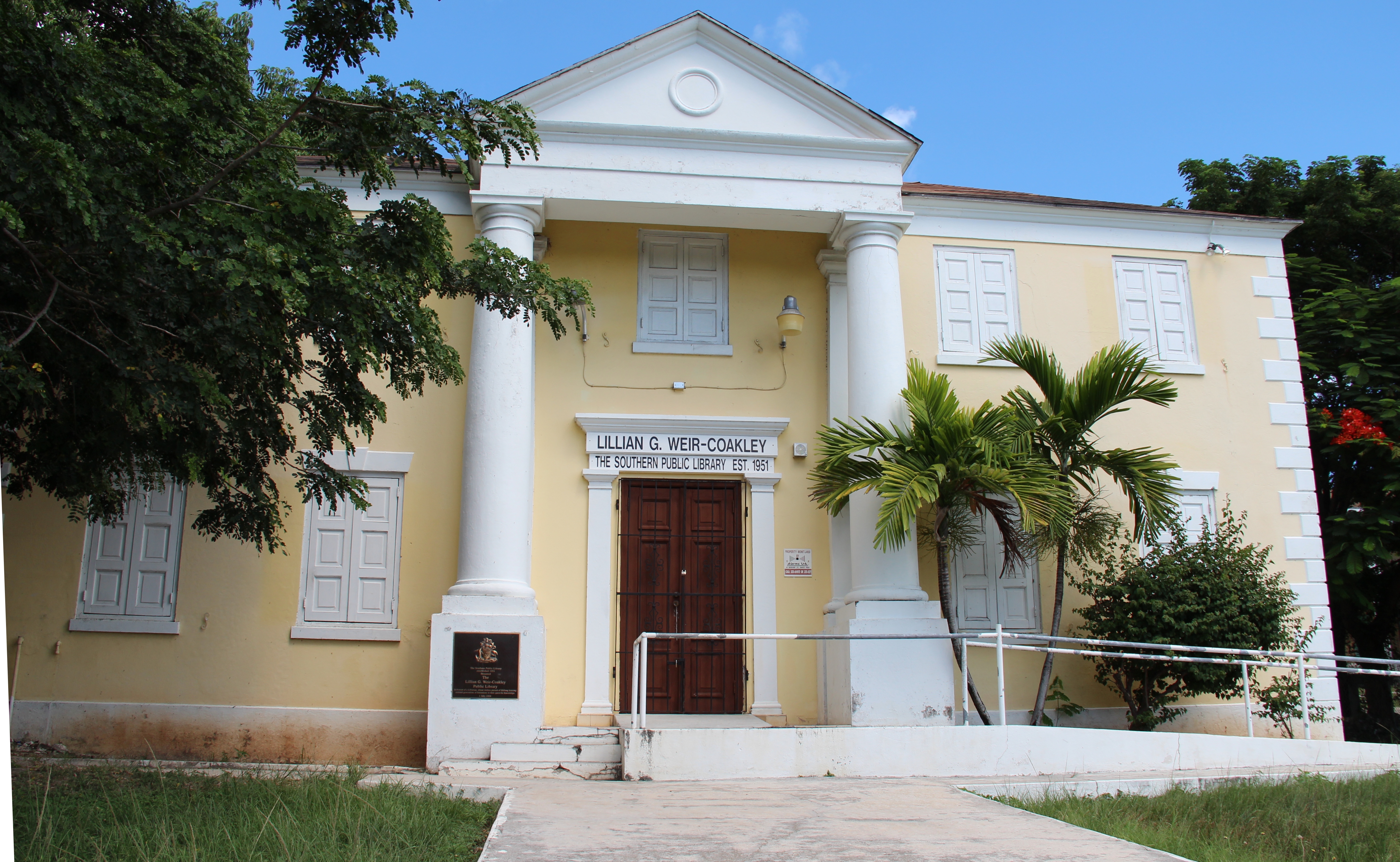
IMG_5439During the forties and fifties, Dr. Walker was one of the representatives for the Southern District of New Providence in the House of Assembly. He pushed for the establishment of the Southern Public Library which took place in 1951. The library is located on the North side of the Southern Recreation Grounds.  In 2004 the name was changed to The Lillian G. Weir-Coakley Public Library in honour of the long time librarian who assisted generations of Bahamians in their quest for knowledge.
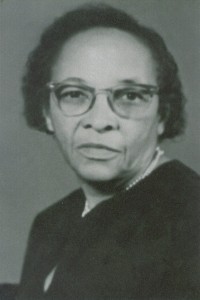
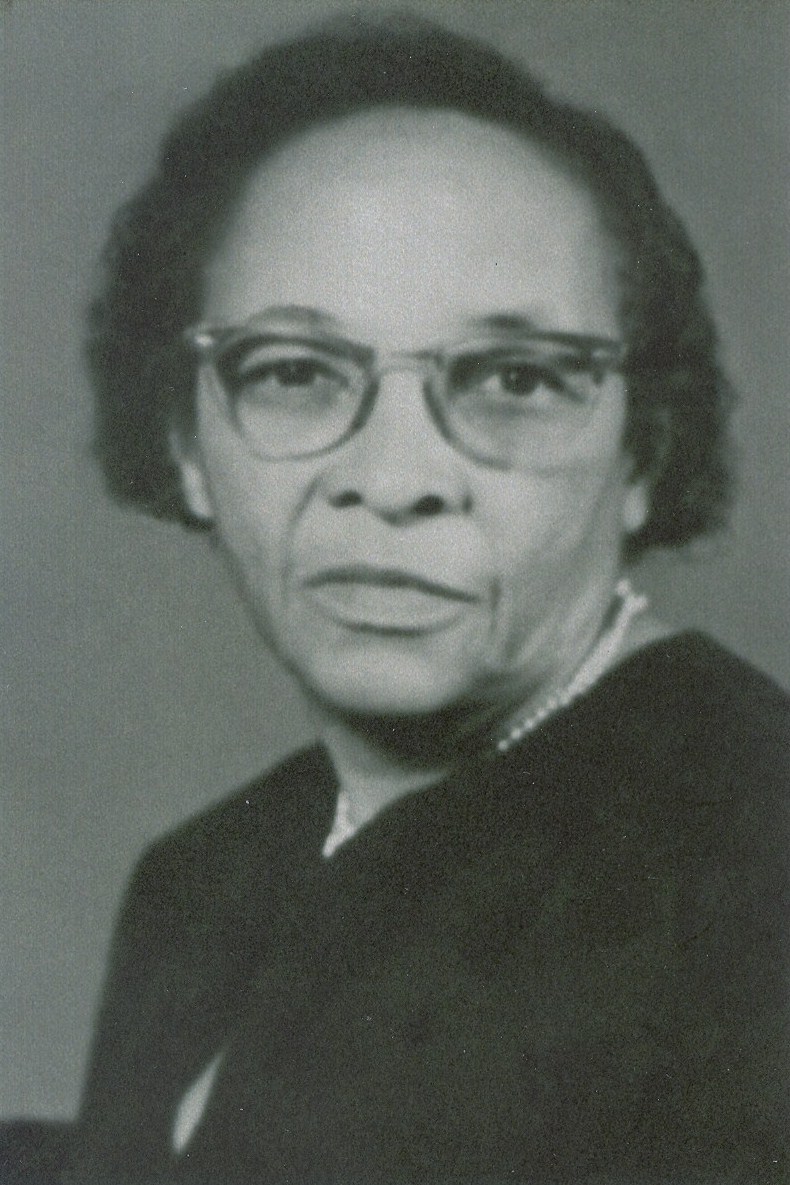
Mabel Walker_2Mrs. Walker was also an active member of and Secretary in the Elks Lodge, Curfew Temple.

Dr. Walker and Daddy were childhood neighbours and friends in Bain Town. They were both the only child of their parents, attended St. Agnes Church and played the organ, and they were known as the “Princes of Hospital Lane.”   Claudius Walker was also a tailor.  When his children were going off to college he made his sons’ suits and the winter coats for his daughters.

Dr. Walker was the leader in the redevelopment of Scottish Free Masonry in The Bahamas in 1964.  He travelled to Scotland to obtain permission to start the Lodge of St. Michael which initially fell under the jurisdiction of the Jamaican Lodge.  Some of the founding members of St. Michael’s Lodge were my uncle, Charles Butler, Ulric J. Mortimer, Sr., Lester J. Mortimer, Arthur Richardson, Mark Murray and Sidney Whitfield, the latter being the only survivor of the names mentioned.

Two schools, C. R. Walker Senior High and the Mabel Walker Primary School were named in honour of Dr. & Mrs. Walker.  The Teachers’ Union Hall is also named in honour of Mabel Walker.