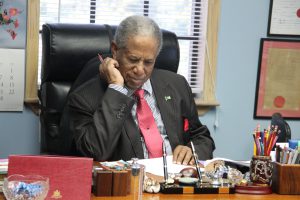
Andrew Knowles – Artist

IMG_6820 IMG_6671

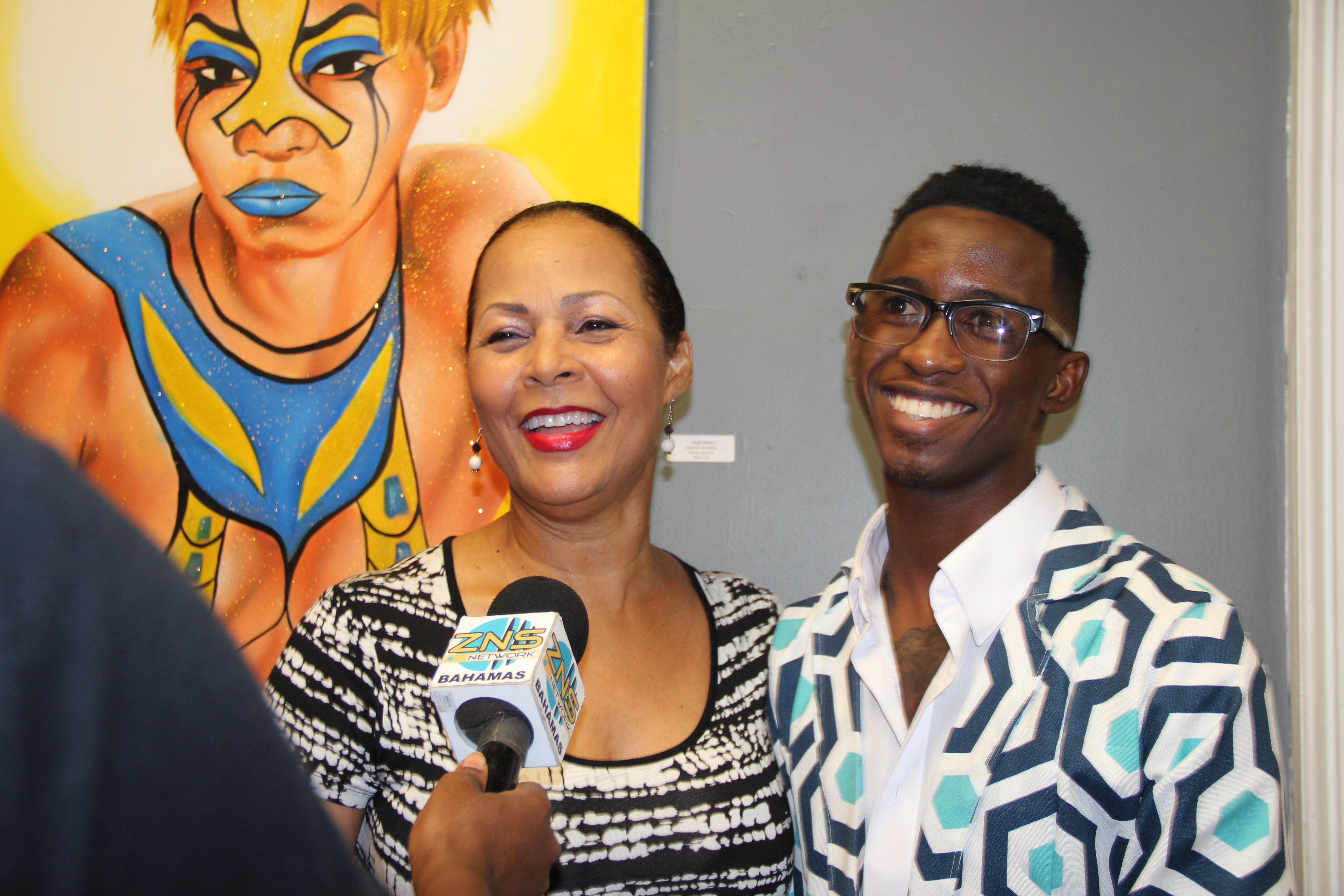
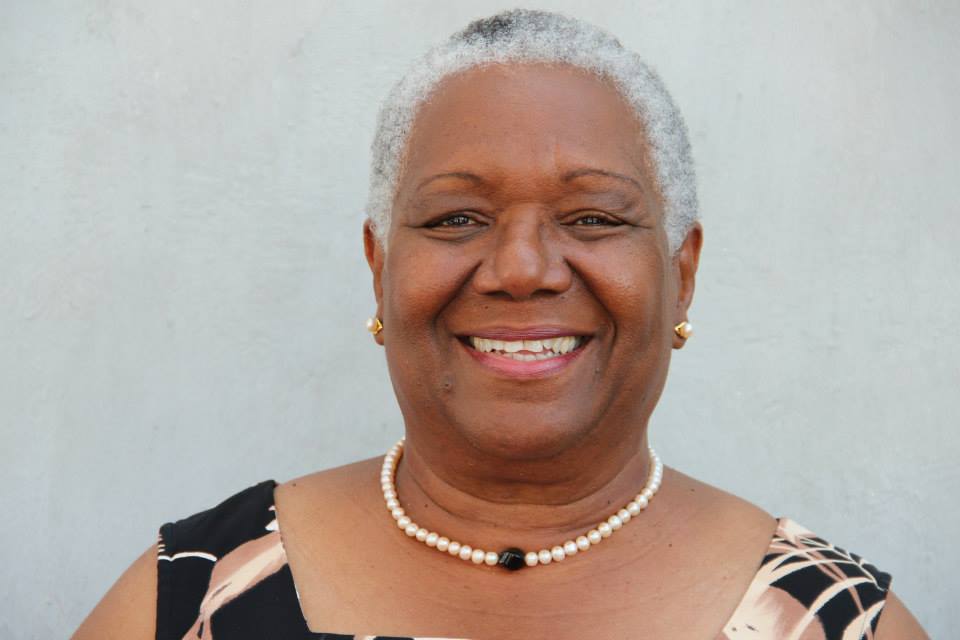
The story of Andrew Knowles, a 12th grade student at St. Anne’s School,  is a fascinating one about overcoming tremendous odds in life and being well on the road to a successful future.  With the help of friends and mentors Andrew has survived the most difficult of circumstances. He and his mother and six siblings lived with their grandmother and when she became ill and was hospitalized they were left with their mother who he says “went from pillar to post” and abandoned then 7-year old Andrew and his siblings. The neighbours called Social Services and the seven children were placed in the Nazareth Centre for Children operated by the Roman Catholic Church.  Andrew remained at that home from age 7-13 and then he was at the Elizabeth Estates Children’s Home from age 13-16, followed by a short stay at Coleby House, which could not accommodate his desire to paint as they required their residents to work. So he had to leave the home and was homeless for a week or two, until he and his brother, Livingstone, were taken in by friends with whom they are living temporarily. Andrew is most grateful for this support. This is such a beautiful example of what it means to be our brothers’ keepers and how people with challenges can make it in life if they are given a hand up. Regrettably, one of Andrew’s brothers died and another is in prison. His two sisters live with their respective paternal grandmothers.

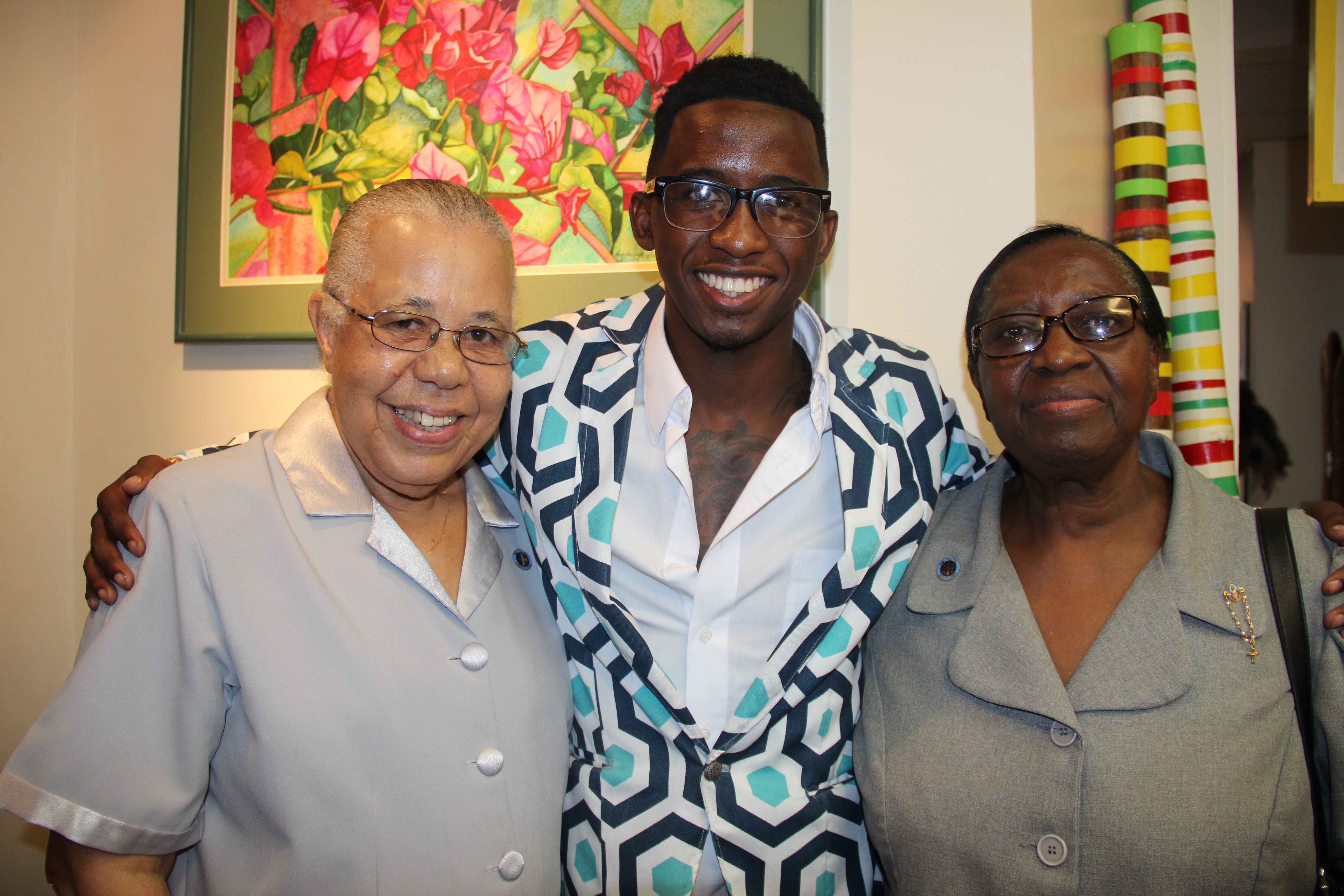
IMG_6809IMG_6728Andrew is also grateful to the sisters at the Benedictine Convent on Nassau Street where, as a small boy, he used to go to get something to eat, and was encouraged by the sisters to draw.  About three or four years ago when he was living at the Elizabeth Estates Children’s Home, the wife of the Prime Minister, Mrs. Bernadette Christie, visited the home and as she walked about and talked with the children Andrew told her of his desire to be an artist. Shortly thereafter she bought art supplies for Andrew and they have had a very close relationship since that time, with her referring to him as her son. Andrew painted a portrait of Mrs. Christie which hangs in her home.

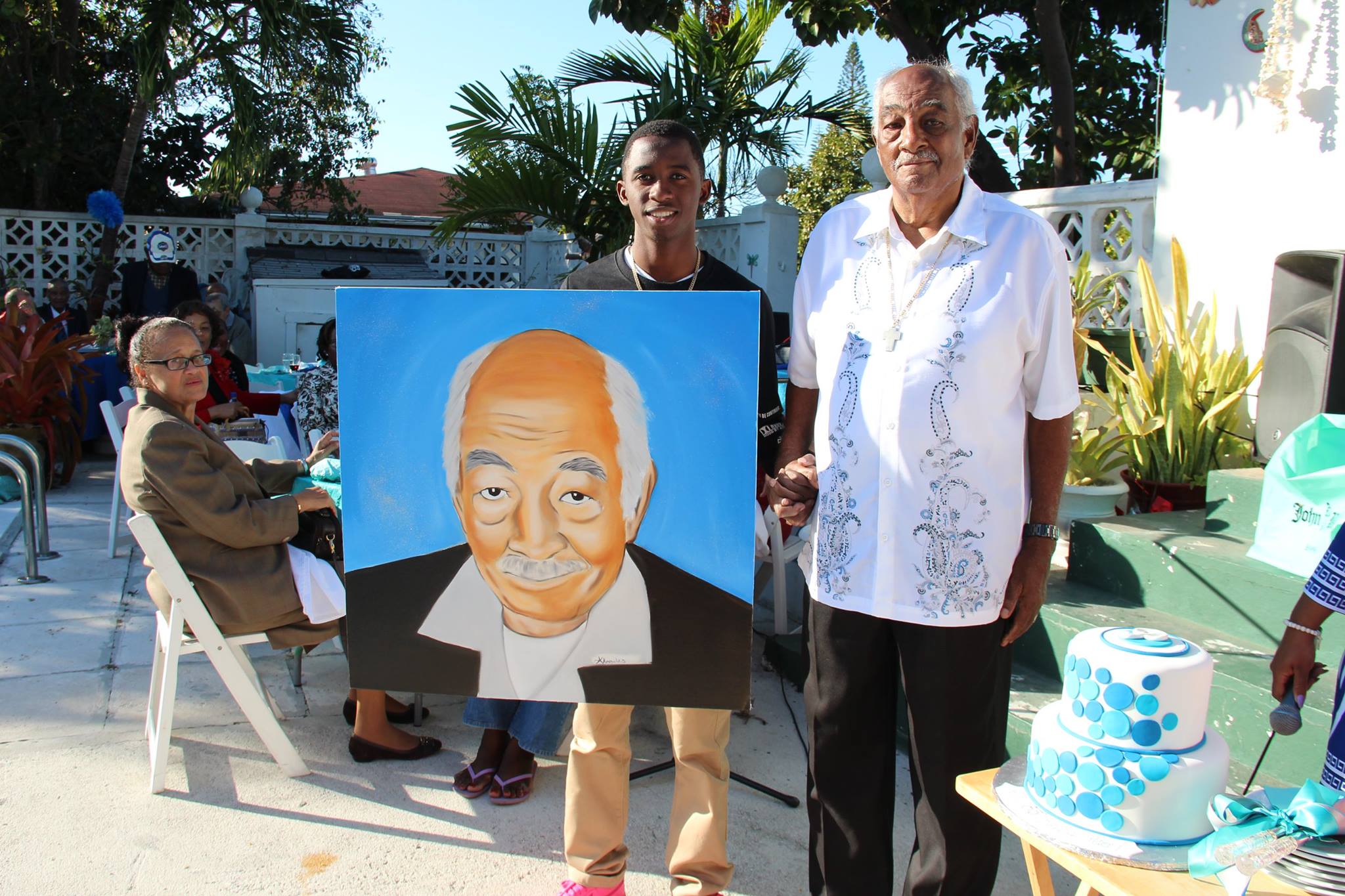
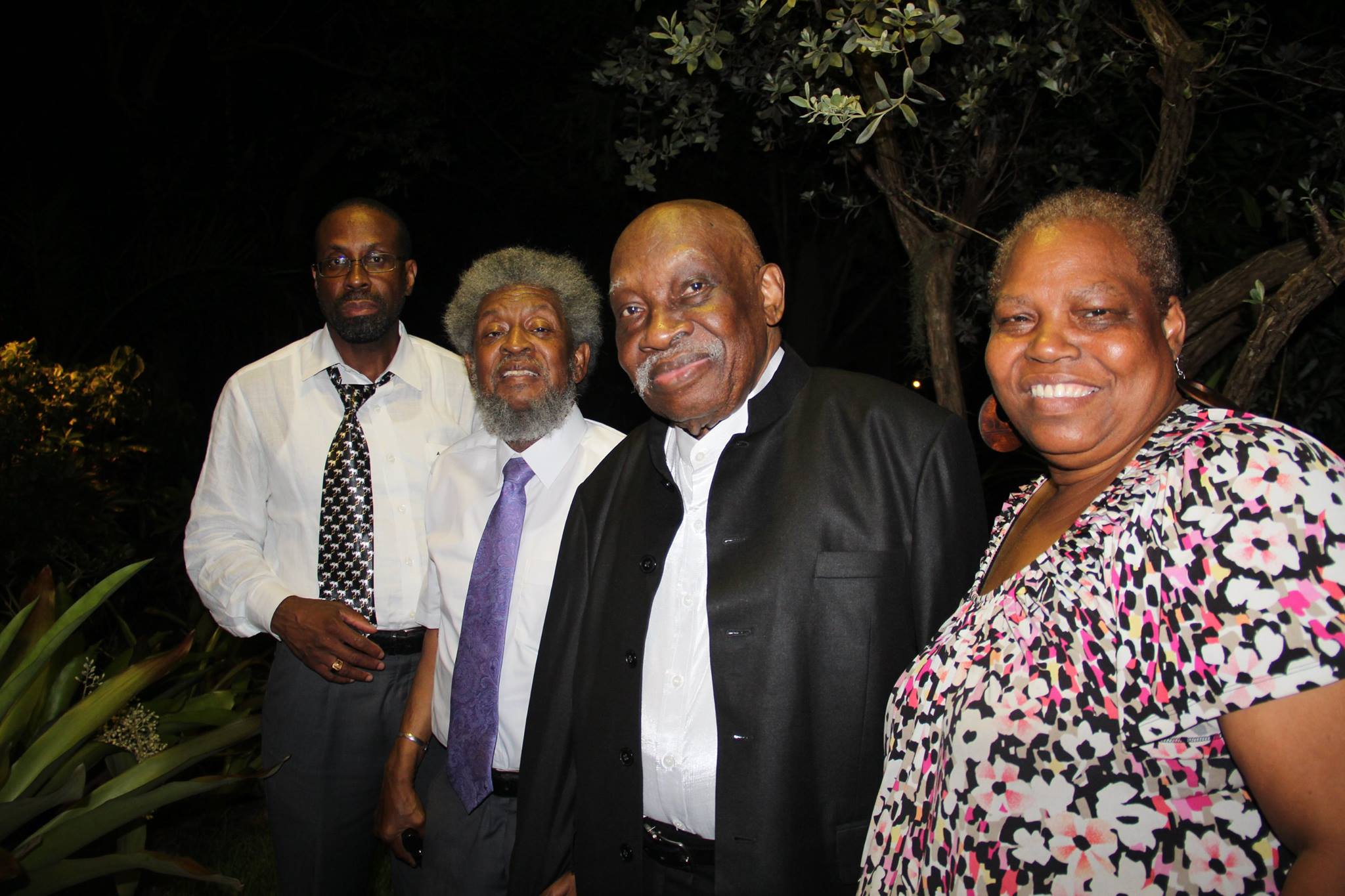
IMG_6794I first encountered Andrew Knowles in 2014 when he was one of a number of young artists chosen by Penelope Nottage to exhibit their work at Doongalik Art Gallery for her birthday charity event. She contacted Andrew online to extend the invitation. I again ran into him earlier this year at Peter Bowe’s 85th birthday celebration, during which Andrew painted a portrait of Peter that he presented to him following the birthday cake cutting and other tributes to Peter.

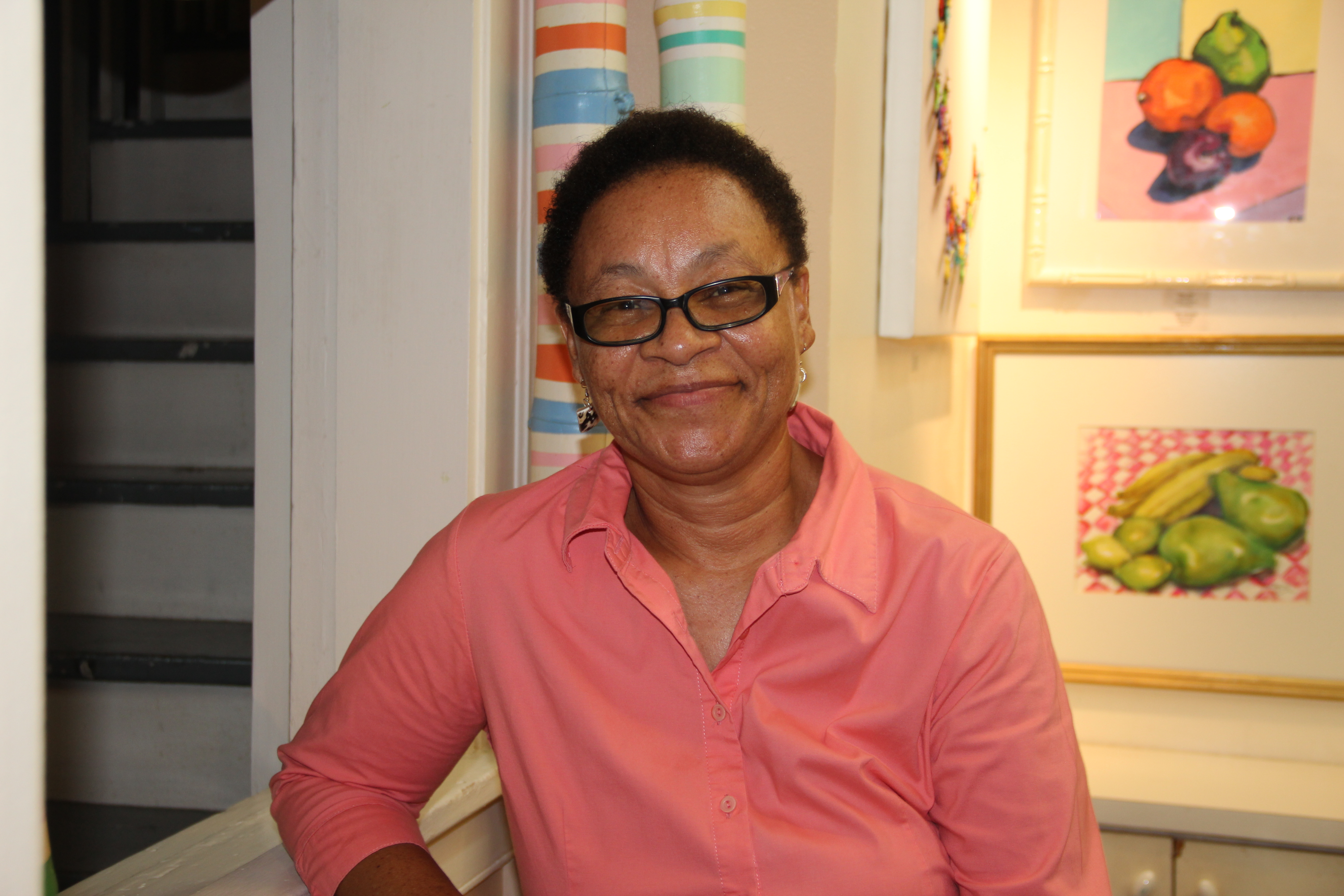
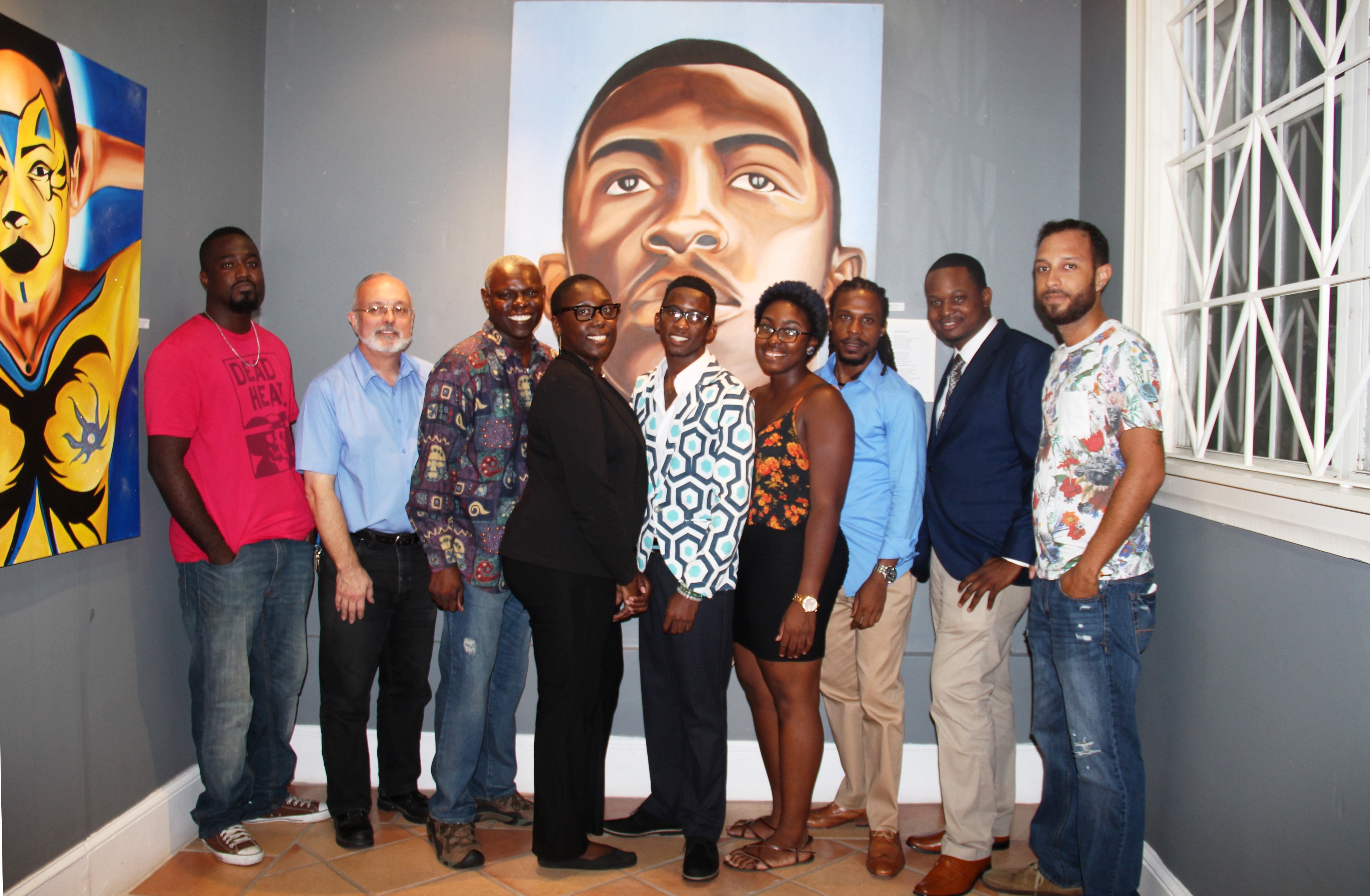
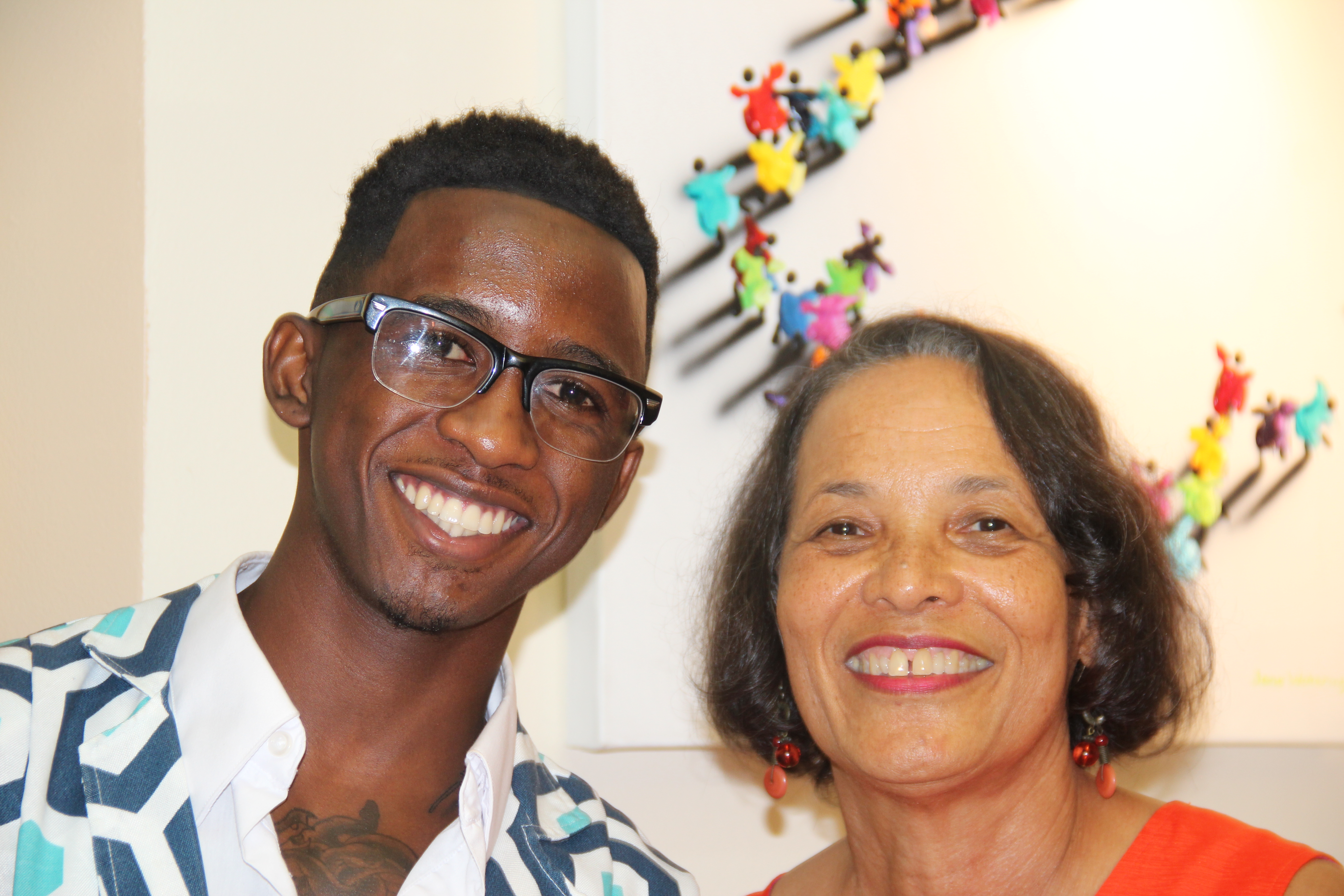
IMG_6835Andrew_Peter BoweAndrew was mentored in drawing by Canadian resident Kim Smith, a former teacher at St. Anne’s School and the proprietor of The Place For Art now located in the Doongalik Art Gallery property, as well as by Patricia Sharp, another former art teacher at St. Anne’s. In addition to Kim Smith, it was also most encouraging to see the number of well established artists who were present in support of Andrew’s exhibition, namely: Kishan Munroe, Andret John, Jamaal Rolle, Jerome Miller, Allan Pachino Wallace, Cindy Mullings, Jodi Minnis and Chris Symonette.

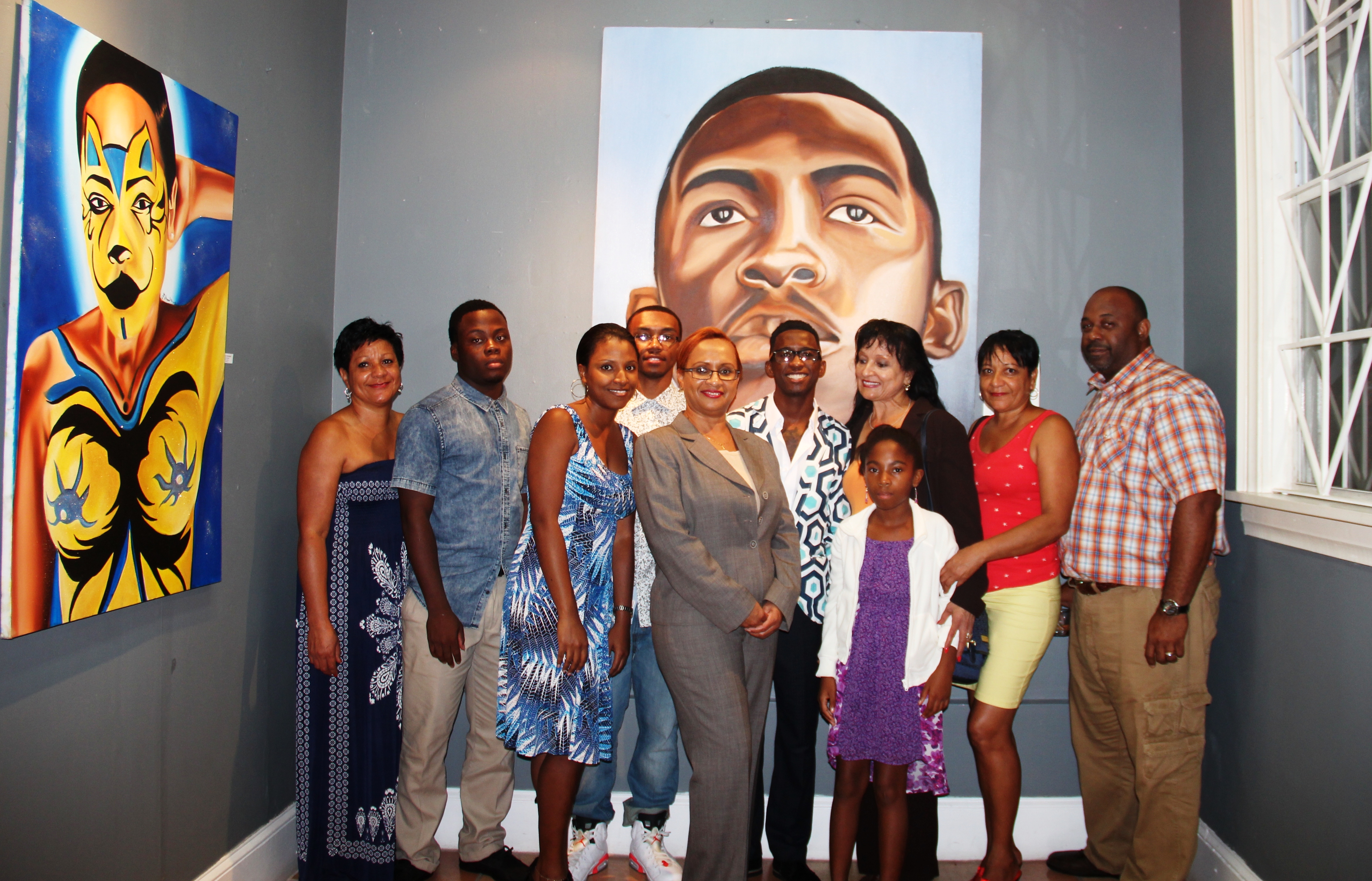
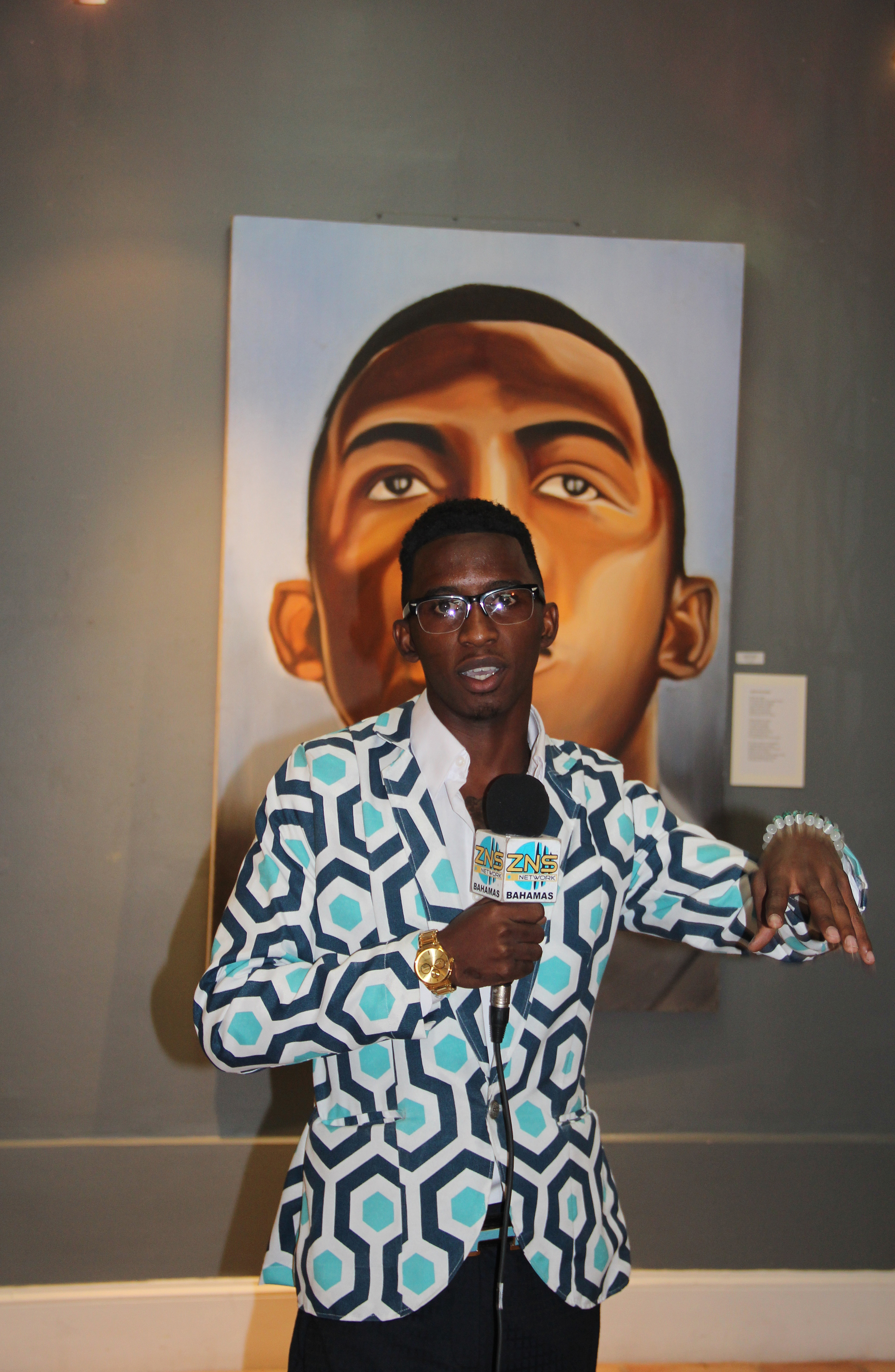
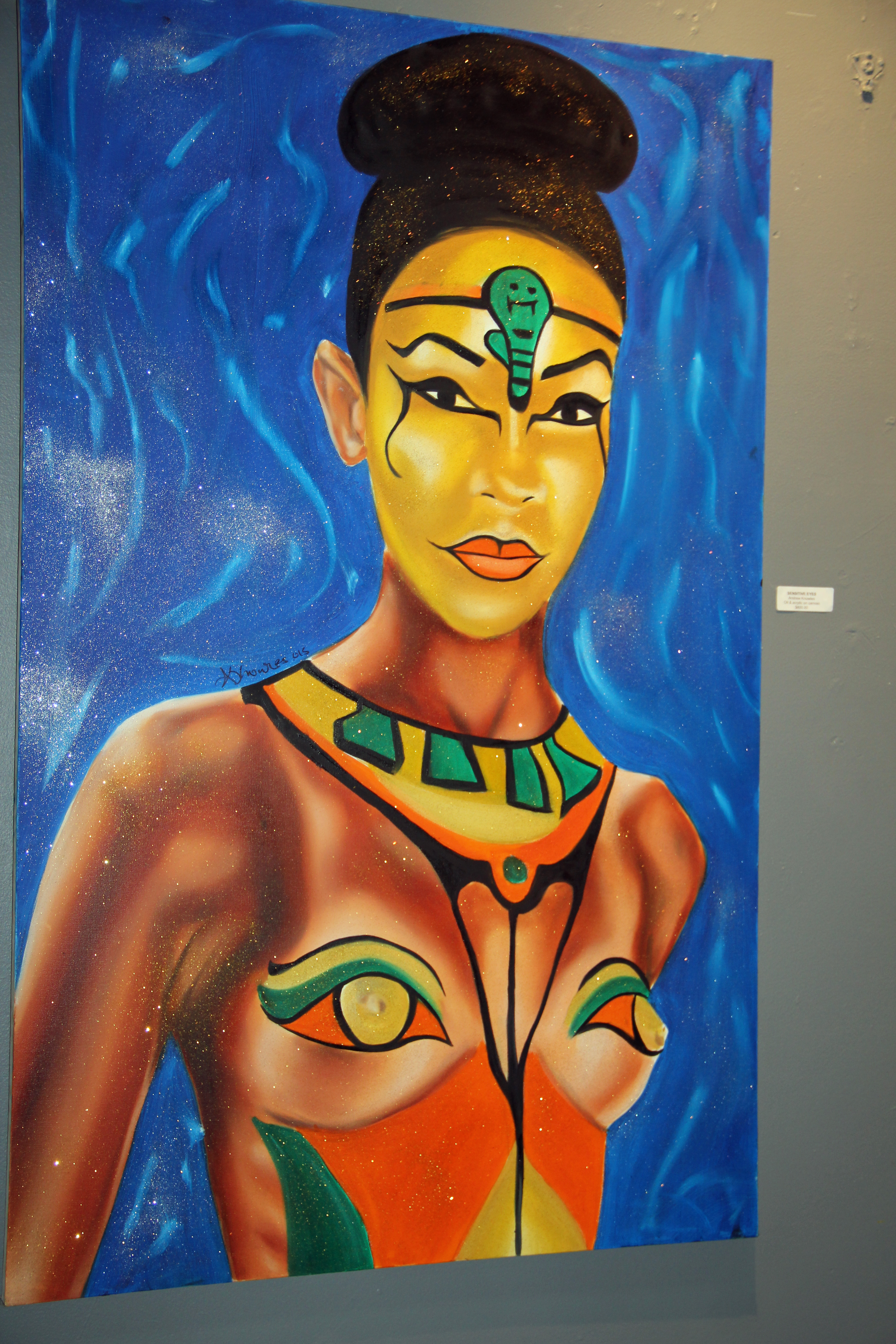
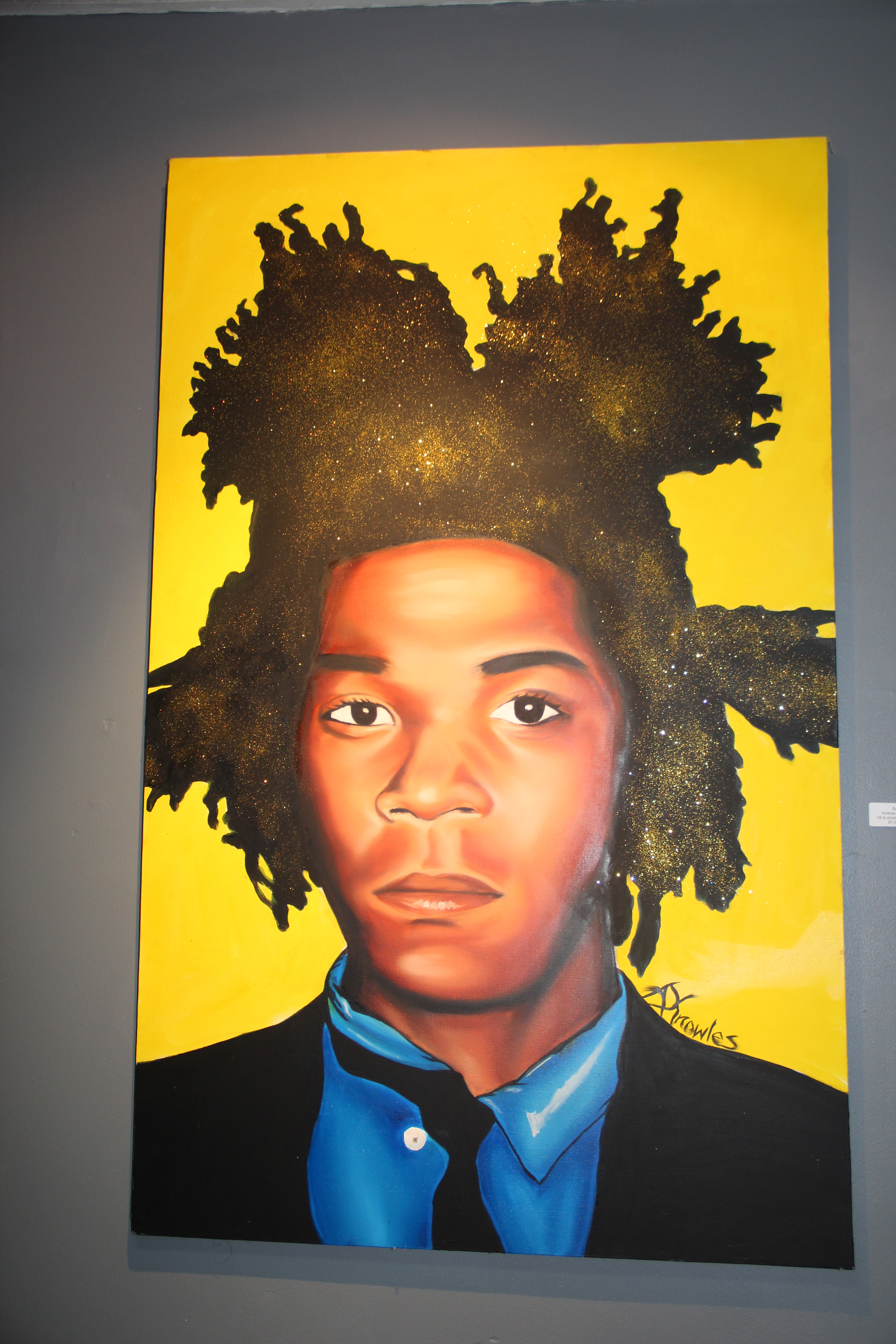
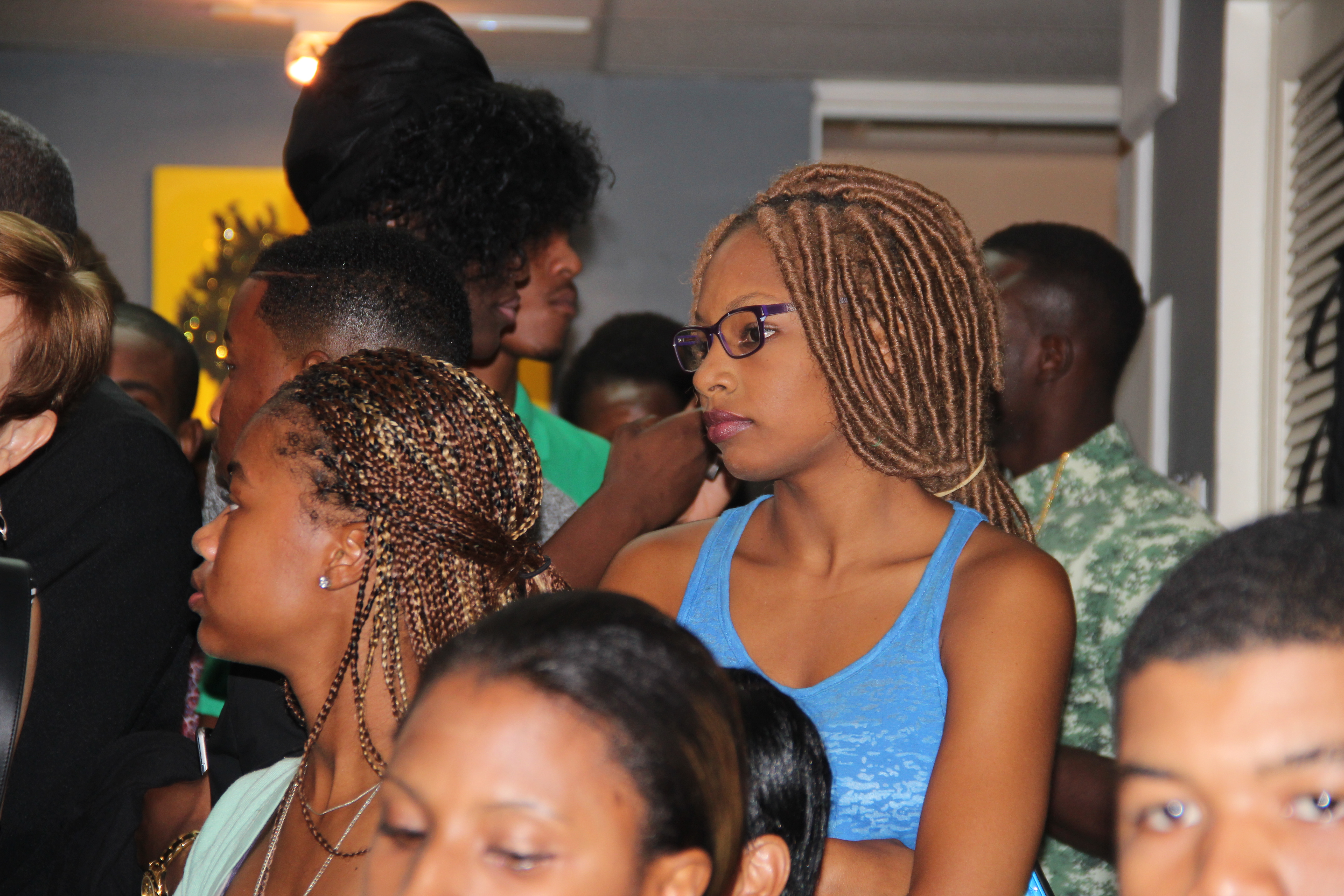
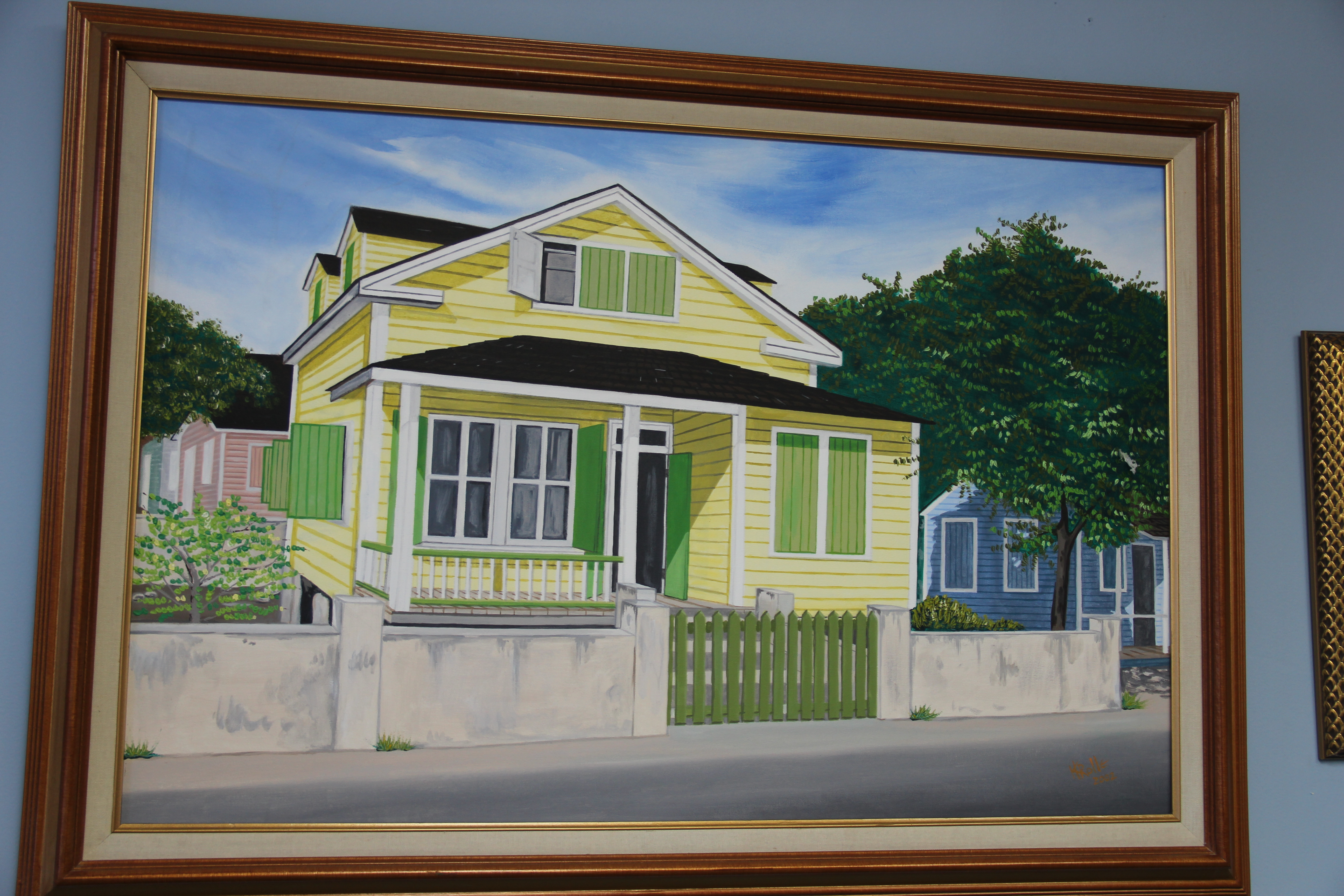
IMG_6695IMG_6742Andrew’s first solo exhibition held at Doongalik Art Gallery on Village Road on Thursday, 22nd September 2015 was a smashing success! There was a large crowd on hand to view his bigger than life and boldly colourful pieces. Andrew explains that his use of the vibrant colours help to take away some of the pain he feels inside. He also writes poetry to express himself.

The exhibition will be up until 14th October 2015. You are encouraged to view the show and, most importantly, to support this wonderful young artist by purchasing his work.IMG_6765IMG_6805


Email address: andrewknowlespaintings@gmail.com

© Copyright Rosemary C. Hanna 2015


New Yorkers who came to buy the Book

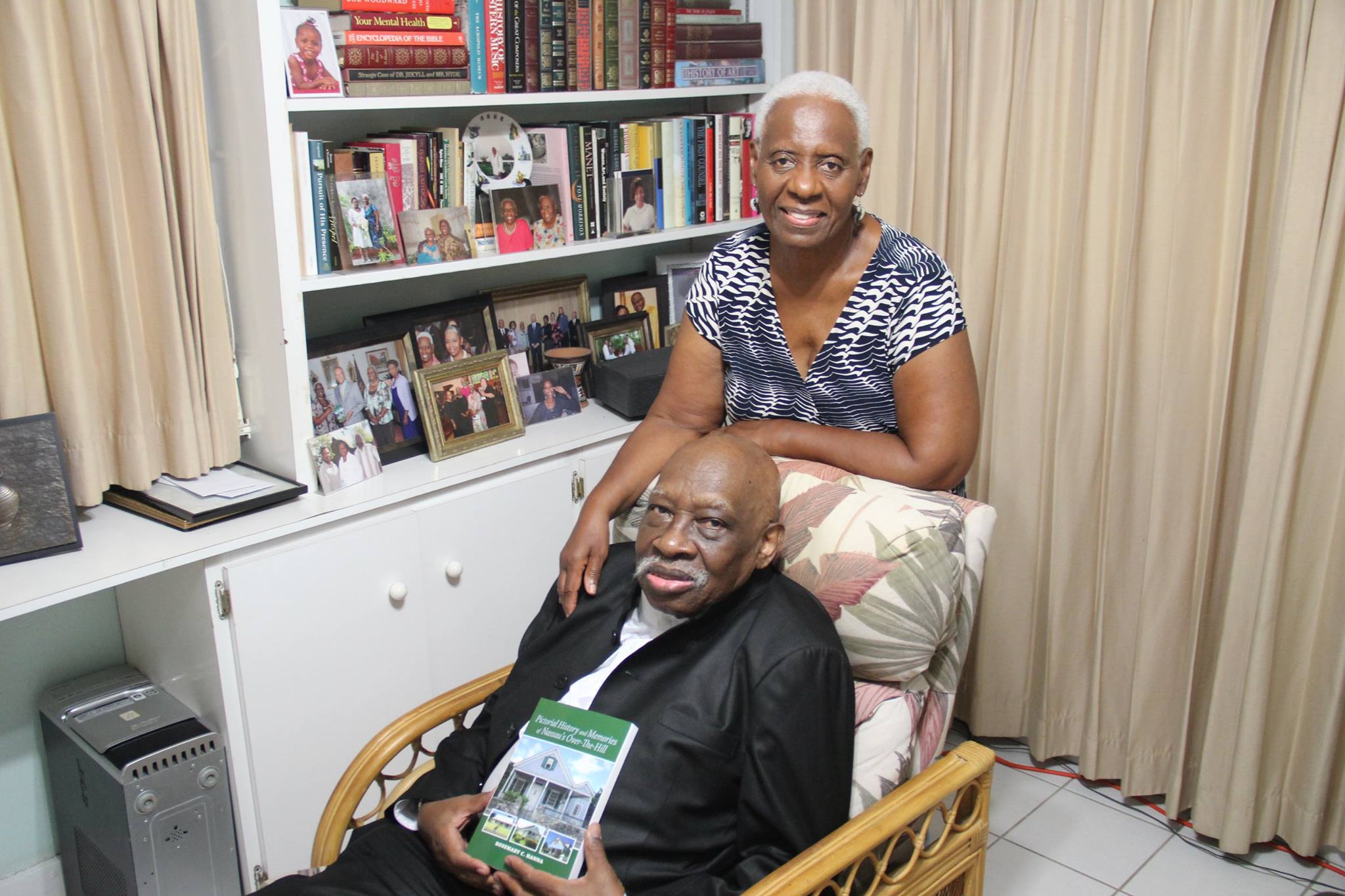
New York Visitors_2Recently I received a telephone call from Marva Moxey, daughter of the late former Parliamentarian, musician and Bahamian cultural icon, Edmund Moxey, who was searching for my book “Pictorial “History and Memories of Nassau’s Over-The-Hill” for her uncle, Dr.Emil Moxey and his friends (Messrs. Hugh Knight and Andre Springer)  who were visiting from New York and were returning the following morning.

Emil Moxey_RCH New York Visitors_3I was happy to accommodate them at home which turned out to be a memorable occasion, not only because they bought several copies of the book, but because I learnt that Dr. Moxey had been a close friend of my deceased brother Perce. Furthermore, because of our meeting I was able to put Dr. Moxey in touch with his and Perce’ s mutual friend, Christopher Francis. Pictured l-r in the bottom photo are: Andre Springer, Hugh Knight, Emil Moxey and Marva Moxey.

Tribute to Edmund Moxey by Anthony A. Newbold


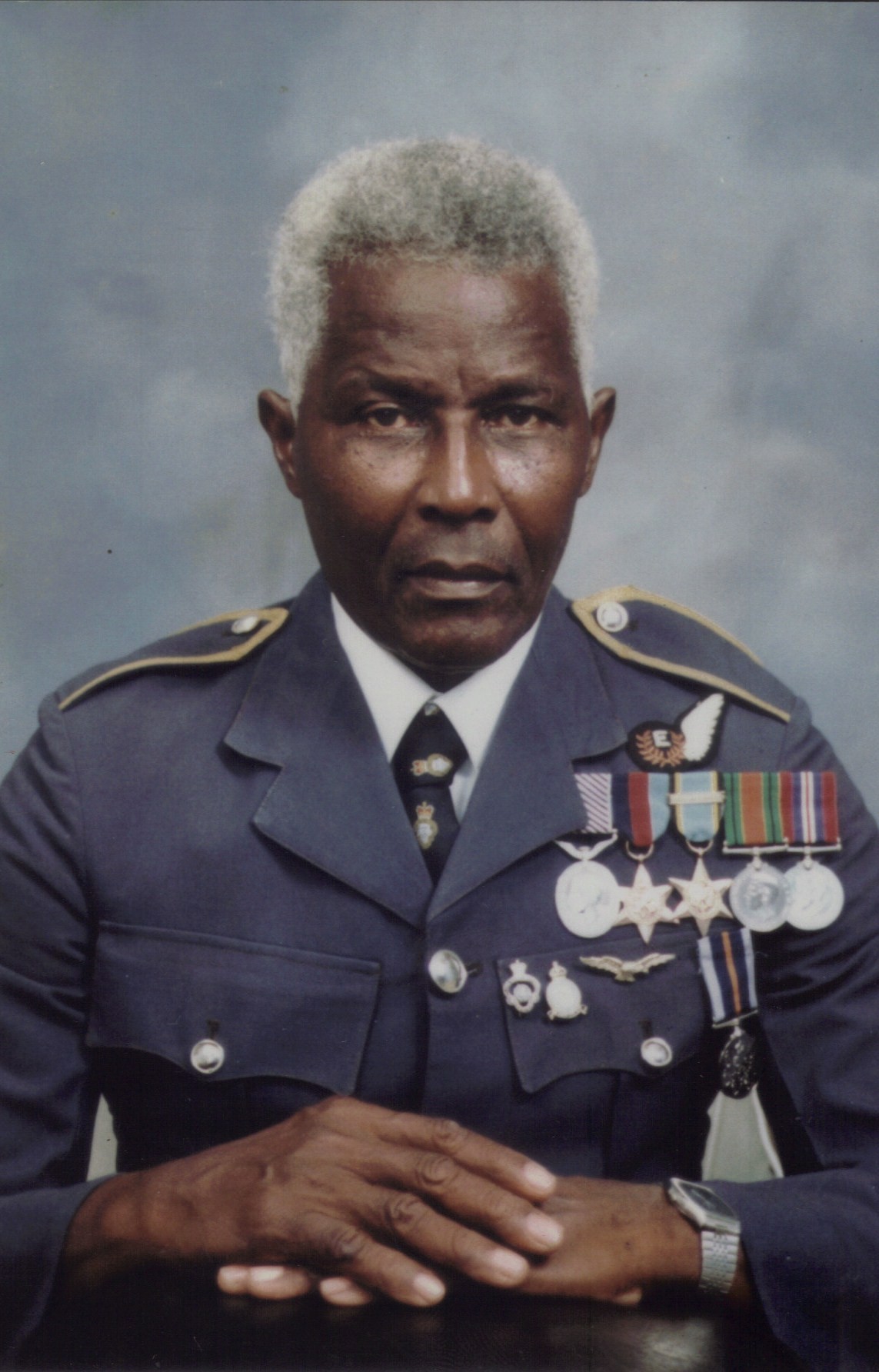
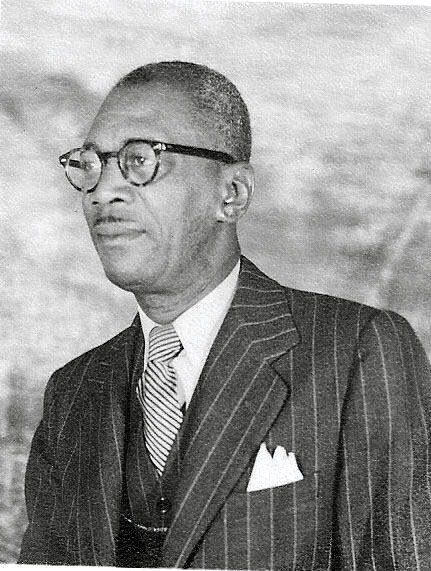
Basil Lawrence Ivan Johnson, CBE, BFM – WW II Hero

Basil Johnson

Basil Lawrence Ivan Johnson, CBE, DFM, was a lifelong faithful member of St. Agnes from his christening day shortly after his birth on 1st February 1920, to his final going home on 21st April 2005.

He attended St. Agnes Day School where his mother, Mrs. Florence Johnson of Hay Street, was a day school teacher and throughout his life he served St Agnes. He was a member of the St. Agnes Anglican Church Men and in January 2000 received an award for long and dedicated service to St. Agnes.

In June 1993 he was named in the Queen’s Birthday Honours as Commander of the British Empire for his service during World War II, his leadership skills and his active involvement in civic and religious services to his country.

In February 1999 he was named as one of the 100 Most Outstanding Bahamians of the 20th Century by Jones communications for his war service and his work with The Bahamas Branch of the Royal British Legion.

A World War II Veteran, he served with distinction in the British Royal Air Force Voluntary Reserves between 1941-1946 where he rose to the rank of Warrant Officer in the Pathfinder Force and was awarded the Distinguished Flying medal in recognition of his high sense of devotion to duty.  He was the President of The Bahamas Branch of the British Legion for forty years, and championed the Legion’s Poppy Day activities for forty-three years.

An engineer by profession, Mr. Johnson was employed at the Bahamas Electricity Corporation from 1936 to 1980.  He was married to the late Eunice Johnson and they had four children.

Reflections on “Over-The-Hill”

IMG_6537

By Orville A. Turnquest (A Grant’s Town Boy from Over-Da-Hill”)

The story of “Over the Hill” is the story of the history of a proud and aspiring people.    It is the story of freed slaves from West Africa who settled in a new land across the Atlantic Ocean. It is a story of the preservation of many aspects of an ancient culture, and the acquisition of modern skills, and quality education, in order to achieve success in a new land.   It is a story of an entire area in the centre of this Island which was a distinct Settlement known as Grant’s Town, and which was once the mecca of future leaders, builders, educators, politicians, business and professional people, as well as ordinary artisans and workers, all of whom lived there and developed a fine record of black families and developing neighbourhoods.

But that reputation has changed in recent decades, as “Over the Hill” is, sadly, fast becoming a symbol of the deterioration of those same neighbourhoods “Over the Hill”. And so it is important that we do not forget from whence we came. It is also important that as we recall where we have come from we should reflect from time to time on who we are.

The Nassau Guardian, one of our two daily Newspapers, was founded in 1844; and 5 years ago, in the year 2004 when that Newspaper celebrated its 160th Anniversary, I was invited to comment on the organizational history of that Newspaper, which had operated in the down-town City area since 1844, but moved to its present location “Over the Hill” some 45 years ago.   I stated at that time that when the Newspaper was founded by Edwin Moseley in 1844, only about one-quarter of the Island’s total population could read and write – and the very large majority of them were from the white community, comprising the more privileged and economically elite white residents, who lived and worked and socialized in the Town of Nassau.  Indeed, it was only a decade earlier that these white residents of Nassau had been legally deprived of their right to own slaves, with the coming into effect of the Emancipation Act of 1834.  These white folk never came “Over the Hill” – or, at most, hardly ever; and they were, for the most part, the employers of the “ova-da-hill” crowd, who therefore remained generally docile and subservient to the folks uptown.

And so it was in those early days that if you lived or hailed from an area like Grant’s Town “ova-da-hill”, you were not only a black or coloured person but also underprivileged, and attached with an automatic badge of social inferiority and subservience.   Hence, one frequently was dismissed with the assessed and rhetorical condemnation, adapted from the age-old biblical question, “Can any good thing come out of Grant’s Town?”

Geographically, in 1844 when The Guardian was first published, specific areas of New Providence were identified by their districts and separate settlements, each with its own boundaries, its special indigenous features, its particular segment of the population, and its historical origins.  The Guardian, like all other business establishments of the day, was then located to the North of the hill range that formed a ridge parallel to the Harbour of Nassau, providing a natural southern and protective boundary to the area of land which then comprised the Town.   Indeed, a section of this hill range was the site of Government House, the official residence of the Governor, bearing the rather pretentious title of Mount Fitzwilliam.

All official buildings – starting with Government House, as well as the City’s only bank at the time, all the government offices, the commercial shops, professional offices, the electrical power plant and public works department – all were located north of the hill. Any enterprising resident of “ova-da-hill”, with a flair for trading or artisanship, who decided to go into business for himself, and established his work-place in his neighbourhood, had to contend with being designated by his peers and potential customers as having merely a “petty shop”.
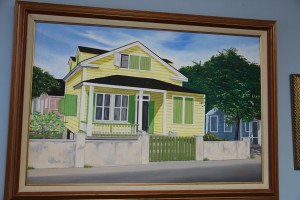
IMG_6535As a proud product of Grant’s Town, where I was born and lived until marriage, my earliest recollections go back to the mid-1930s, and many of the residents “ova-da-hill” were by then generally literate – even if not well-read. There were still only three or four primary schools in the entire area, and all but one of these were then operated by Churches.  Woodcock School (which later became Western Preparatory #2) in Hospital Lane south, and St. Agnes “Copper-bread” School at Market and Lewis Streets, were both operated by the Anglicans; and Our Lady’s School further south on Young Street was operated by the Roman Catholic Church, which also catered to children from “ova-da-hill” at its other day school on the grounds of St. Francis on West and Delancy Streets.   The only public school “ova-da-hill” operated by the Government was the Quarry Mission School – Western Preparatory – on Nassau Street.  The two other Government Schools which accommodated children from “ova-da-hill”, were “Smith’s School (or Western Junior) and “Central School” (or Western Senior, as a successor to the “Boys Central School”).

Apart from being the business and civic hub of the Island, the Town of Nassau was also the residential area of the white and mulatto population, as well as a middle-class minority comprising the racially mixed and most of the then affluent coloured population.  As the population grew, these city dwellers correspondingly extended their residences eastwards and westwards from the City limits, along or near the northern waterfront of the Island, but never southwards over the hill ridge…. no, never “ova-da-hill”.

The several distinct and clearly defined neighbourhoods of the mass of the black population also expanded, as their numbers increased, into areas outside the original “ova-da-hill” neighbourhoods into what became known as the new subdivisions.  In my boyhood days the different townships of the Island were Grant’s Town, Bain Town, Englerston, Contabuta, Delancey Town, Chippingham, Mason’s Addition, Fort Fincastle, Freetown, the Pond, the White Ground, Poitier’s, Okra Hill,  Kemp Road, See-me-no-more, Congo Town, Fox Hill, Sandilands Village, Headquarters (or Carmichael), Gambier, Delaporte and Adelaide Village.

All the well-known, newer, subdivisions of today were later developments of the 1940s and ‘50s …..such as Coconut Grove, Shirley Heights, Culmersville, Sears Addition, Centreville, Westward Villas, Greater Chippingham, Sea Breeze Estates, Pinedale, Nassau Village and Pinewood Gardens.  Of the many villages, settlements and towns, those concentrated in the central section of the Island, south of the ridge on which Mount Fitzwilliam was located, collectively comprised the geographical area known and always referred to as “ova-da-hill”.  So that “ova-da-hill” was a geographic description — but it was also a culture, a concept, an identity, a heritage, and a way of life.
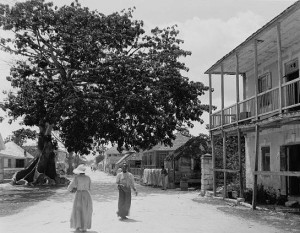
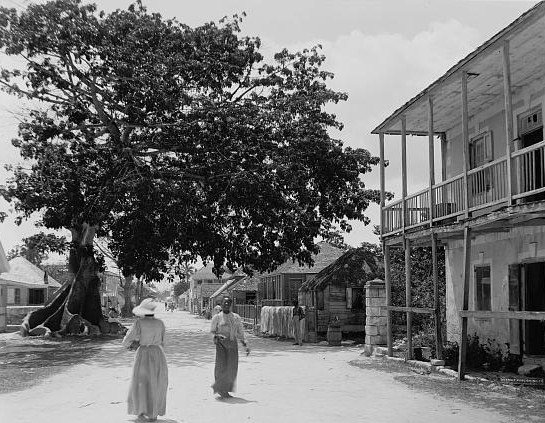
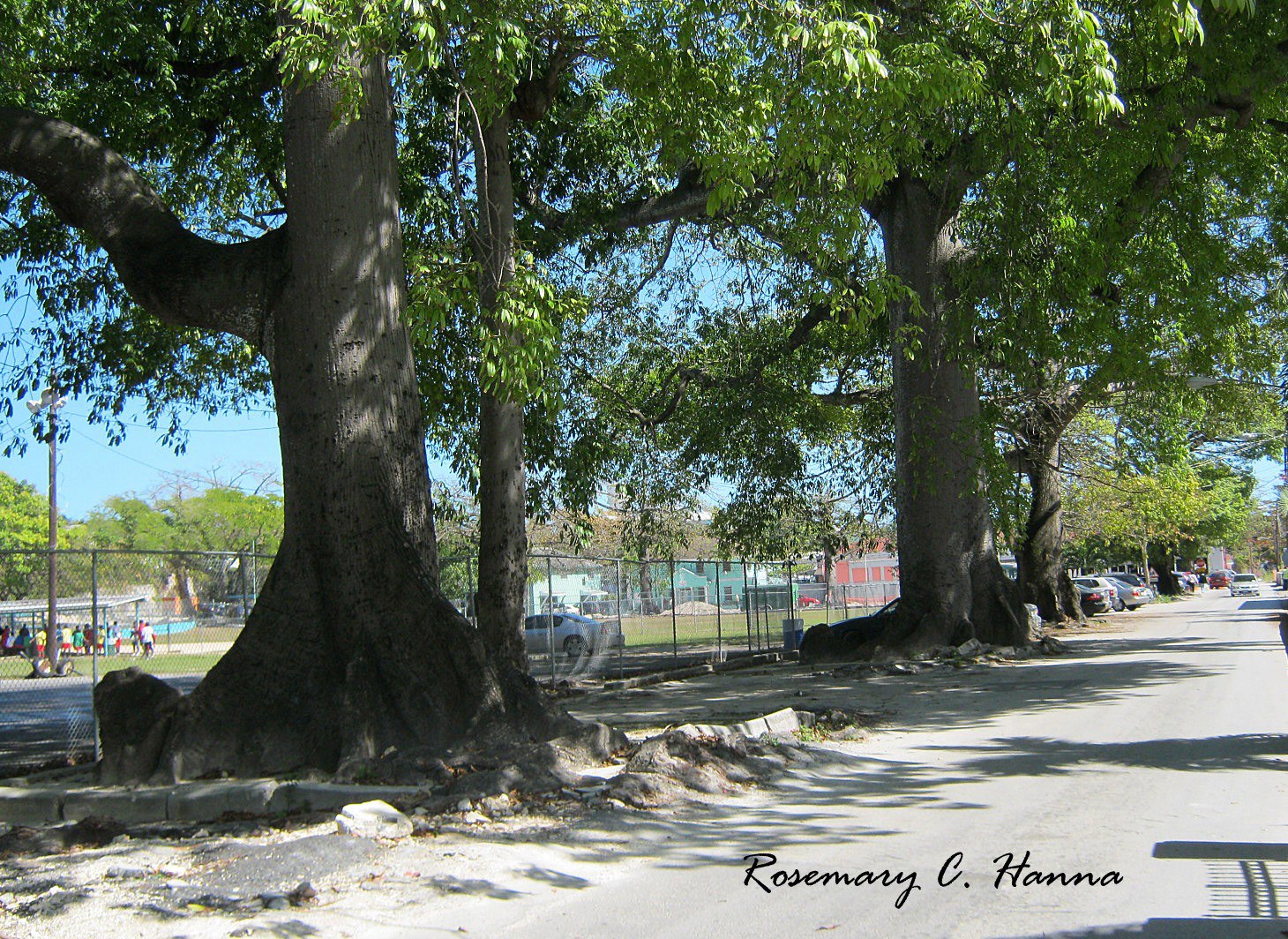
Street in Grants Town_2“Ova-da-hill” was the area to which the majority of the population returned at the end of their work day, to their homes and their recreation. It was the location of their Churches, their bars and rum shops (or “bar-rooms” as they were called), their petty shops, their lodge halls and, most significantly, their cotton trees. Huge silk cotton trees lined the side of the main roads leading from the northern hill range southwards to the Coconut Groves and to Big Pond; so that in Grant’s Town as one proceeded southwards from the Southern Recreation Grounds at the foot of the hill, there were not less than seven or eight such giant landmarks, standing as silent sentinels at regular intervals down the eastern side of the road.    The only silk cotton tree remaining along Baillou Hill Road today stands at the corner of Cockburn Street, just outside St. Agnes Church.   There used to be a popular one, a regular rendezvous, just in front of the “Biltmore Shop”, a general store at the corner of Cameron Street, owned by Mrs. Minna (Frances) Thompson, one of the more affluent women of substance of Grant’s Town.  Indeed, “Minna” Thompson, Mrs. Letitia Curry of Hay Street, and Mrs. Lee Laing of Market Street, were the only three ladies “ova-da-hill” who owned motor cars in that era, and they were chauffeur-driven.

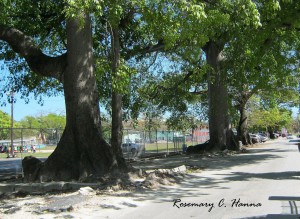
In a sense it is a great pity that these majestic cotton trees, towering over Market Street, Baillou Hill Road, Hospital Lane and West Street, had to be taken down for road widening in later years; for these imposing giants served several purposes in addition to the stately aura which they provided to the area.   They were regular assembly points for men of the district, particularly after Church, where discussions on every topic took place, and solutions were given for every current political issue or local problem.  Shoe shine boys set up their stands on Blue Hill Road, under the cotton tree outside the Biltmore Shop, to earn their livelihood. The grandeur of the cotton trees gave authority and credence to “cotton tree justice” which was dispensed from these venues, for the traditional tribal practice was still prevalent in that period whereby the respected elders of the district dealt with reported neighbourhood wrongdoing.   They received the complaint, heard the evidence of the various witnesses and persons concerned, and handed down their summary judgment which was always accepted, otherwise neighbourhood ostracism was the penalty. The trees pictured below are on Cockburn Street on the southern border of  the William E. Thompson Baseball Field.Silk Cotton Trees
There is not much heard about “cotton tree justice” these days, but it was quite a feature of “ova-da-hill” life in times past.  Young boys, in particular, who where caught, or reported, for cursing, pilfering, ill-manners to their elders, or other such bad behaviour, they were summarily dealt with under the cotton tree, receiving the appropriate number of strokes with a belt or switch.   And frequently they begged their chastisers not to report the infraction to their parents, lest they afterwards receive a double dose of punishment at home.   Quite a contrast from the culture en vogue today, where even teachers are hesitant to apply any form of punishment to children in their classrooms, lest they themselves be charged with abuse, or risk worse at the hands of angry, permissive parents.

Generally speaking, a reference to “ova-da-hill”, as a means of identity, was a method of describing the background and social strata of those who lived south of the hill, between Nassau Street on the west, and Collins Wall on the east.   Within those boundaries were contained the huddled bulk of the black community of the Island.   The area was densely crowded, both with its residents as well as their petty shops, barber shops, cafes, bar rooms, tailors and dressmakers, hairdressers and road-side fruit stands.  All the houses were small wooden dwellings, seldom more than two bedrooms, plus a dining room and a “front room” or “parlour”, but there was always also a porch on the front, which was the family’s communal area every evening after work or school.

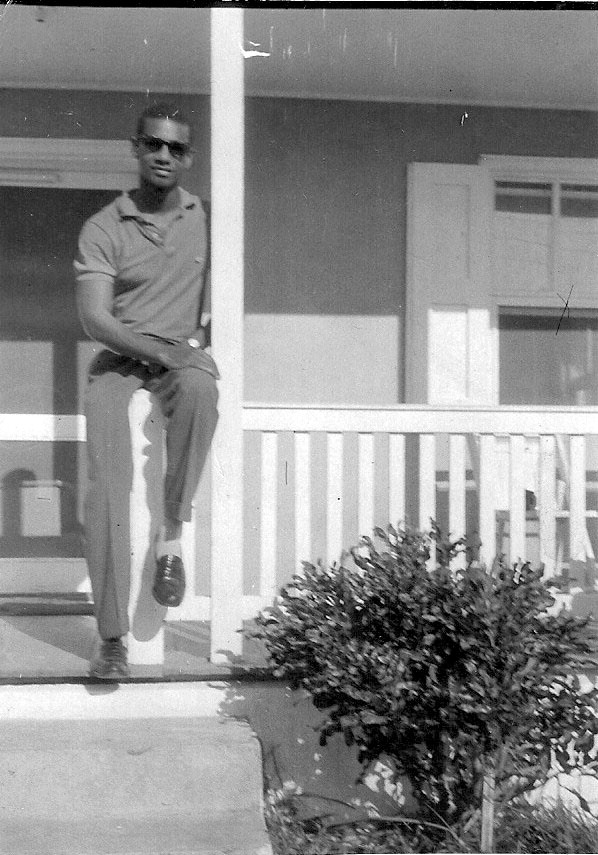
Perce HannaThe elders of the homes socialized on the front porch with their neighbours from next door or from “through the corner”, while the youngsters did their home-work assignments from school, or played games of hop-scotch, marbles, rolling hoops, flying kites, spinning tops, telling ole’ stories, and ring-play, until time for bed.     The houses were erected on small lots for the most part, sometimes two houses to a lot; each site was never more than 30’ or 40’ wide by 50’ deep, with its own small out-door toilet in the backyard.   On the side of each house were a clothes line, and a sunken well, that provided all the family’s water needs for drinking, cleaning and washing.   In whatever yard space that was left, a small garden always existed with the usual patch of vegetables, some flowers, and two or three fruit trees.    The entire area was remarkable for its fertile soil, and one could always find a supply of locally grown guineps, ju-ju (jujubes), dillies (sapodillas), tamarinds, guavas, mammies, hog plums and scarlet plums, star apples, mangoes, citrus, almonds, coconuts, gooseberries, sea grapes, sugar apples, sour-sops, and banana.

“Ova-da-hill” was also a wonderful source of typical Bahamian food.   Many of the regular dishes indigenous to the “ova-da-hill” district were really native dishes perpetuated by home-makers from their African forebears.    Many of those dishes are hardly seen today, but as a boy I regularly feasted on Foo-Foo, okra soup, accara, coconut jimmy, crab and dough, guava duff, pig’s feet or sheep-belly souse, yellow corn meal, aggidi, stew fish, and scorch’ conch.    Not many of our residents could afford to eat in the few native restaurants that then existed, but for the “more affluent” waiters, truck drivers, mechanics, artisans and government workers who earned steady salaries, the small but legendary restaurant, such as that operated only on weekends by Mrs. Effie Cambridge, at the corner of Baillou Hill Road and Cambridge Lane, was renowned for its outstanding delicacies in native dishes.

“Ova-da-hill” was not an economically vibrant neighbourhood during my youth, but those residents who were not permanently employed “out town”, or were not tradesmen or mechanics, were usually innovative in making a living as street-side or itinerant vendors.   Fish vendors purchased their supplies from the main fish market on Bay Street, or from nearby sloops moored west of the Prince George dock.   They packed them in wheel barrows which they carted “ova-da-hill” from street to street, heralding their arrival by shouting “Fish man! Fish man!” as they walked along pushing their supply of fresh fish and conch for sale.  In the same way, some enterprising women would walk through the district carrying large trays of vegetables on their heads, making daily sales to house-owners who had not gone out to the market.  Others carried on their heads huge bundles of dried grass, tied in a bed sheet, as they moved through the neighbourhood shouting “Bed grass!  Bed grass!”, which was regularly purchased by persons who could not afford regular mattresses and utilized this native material to make home-made mattresses for their beds.

The entrepreneurial spirit was even prevalent amongst the youth.  Newspaper deliveries to subscribers, as well as street sites were handled by teenage boys who went through the streets of the area every evening delivering newspapers to their customers, or making sales. Young boys also earned a livelihood by selling hot peanuts from box-carts, which they made from small wooden crates mounted on wheels, with a burning coal stove in the bottom compartment to keep the peanuts warm.
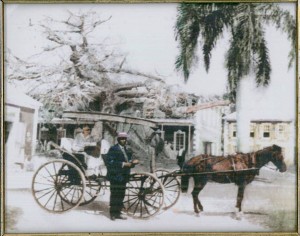
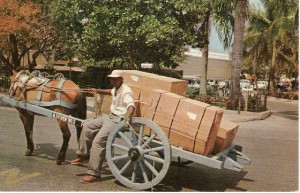
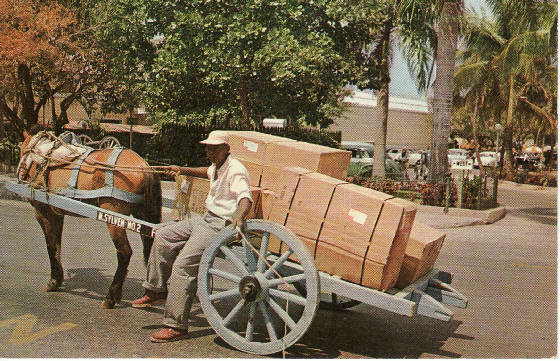
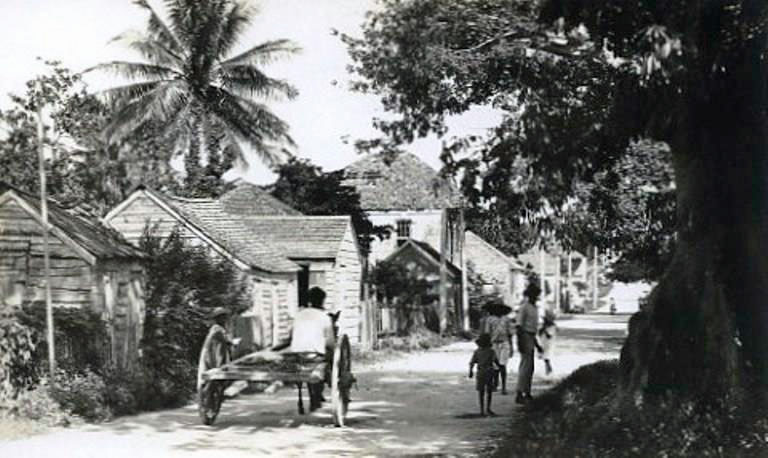
Charles Turner Butler_2NativeTwoWheelCart.jpg.w560h361 Main Streeet, Grant's Town_Old BahamasOf course, the regular means of transport were horse drawn carriages (now only a tourist attraction), horse-drawn drays and donkey-carts for transporting wholesale freight and large supplies being delivered to retail establishments “ova-da-hill”. Individuals either rode bicycles or walked wherever they had to go.   There were comparatively very few motor cars; but of course in those days the usual destinations were all within walking distance.

In those early years Religion was a dominant feature of life.  The majority of the early settlers were Anglicans, Methodists, Roman Catholics, Baptists and Church of God.   Prior to the 1940s, there were only one or two Churches of each such denomination.  St. Agnes and later St. Barnabas were the Anglican Churches which served Grant’s Town and Bain Town.   Grant’s Town Wesley was the only Methodist Church “ova-da-hill”, while Our Lady’s and St. Joseph were the Church homes for those Roman Catholics who did not wish to make the trek up the hill to St. Francis on Delancey Town.

The Baptist Churches were “Metropolitan” on Hay Street, “Transfiguration” at Market and Vesey Streets, and “St. Paul” through Bias Street, although many Baptists went up on Delancy Town to Bethel, and to St. John’s on Meeting Street.   The first Church of God was established by the late Bishop W.V. Eneas, father of the late Dr. Cleveland W. Eneas.   This congregation first worshipped on a site in Hospital Lane south, then moved to Eneas Jumper Corner, until they relocated the present Cathedral at the junction of East Street and Lily of the Valley (Red Lion Bar) Corner.

Apart from the Churches, which have certainly multiplied in abundance over the last 50 years, the social life of the “ova-da-hill” community was fully supplied by the lodges, friendly societies, nightclubs and sporting organizations. The more entertaining form of after-work activity was provided by the nightclubs which were legendary.   Strangely, none of them now exist.  There was Weary Willie’s at the corner of Baillou Hill Road and Bias Street, which was a three-storey structure with a restaurant and shops on the ground floor, hotel rooms on the second floor, and a nightclub on the top floor.    The Silver Slipper on East Street, the Zanzibar on Baillou Hill Road, and the Cat’n Fiddle on Nassau Street South, operated almost on a nightly basis, both as dance halls and nightclubs, and also as fund-raising venues for charities and social organizations which did not have access, as they do today, to the hotels and white establishments to which black and coloured patrons were at that time racially barred.
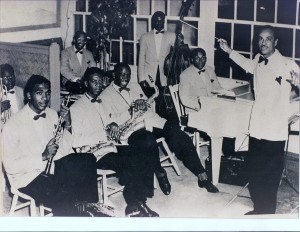
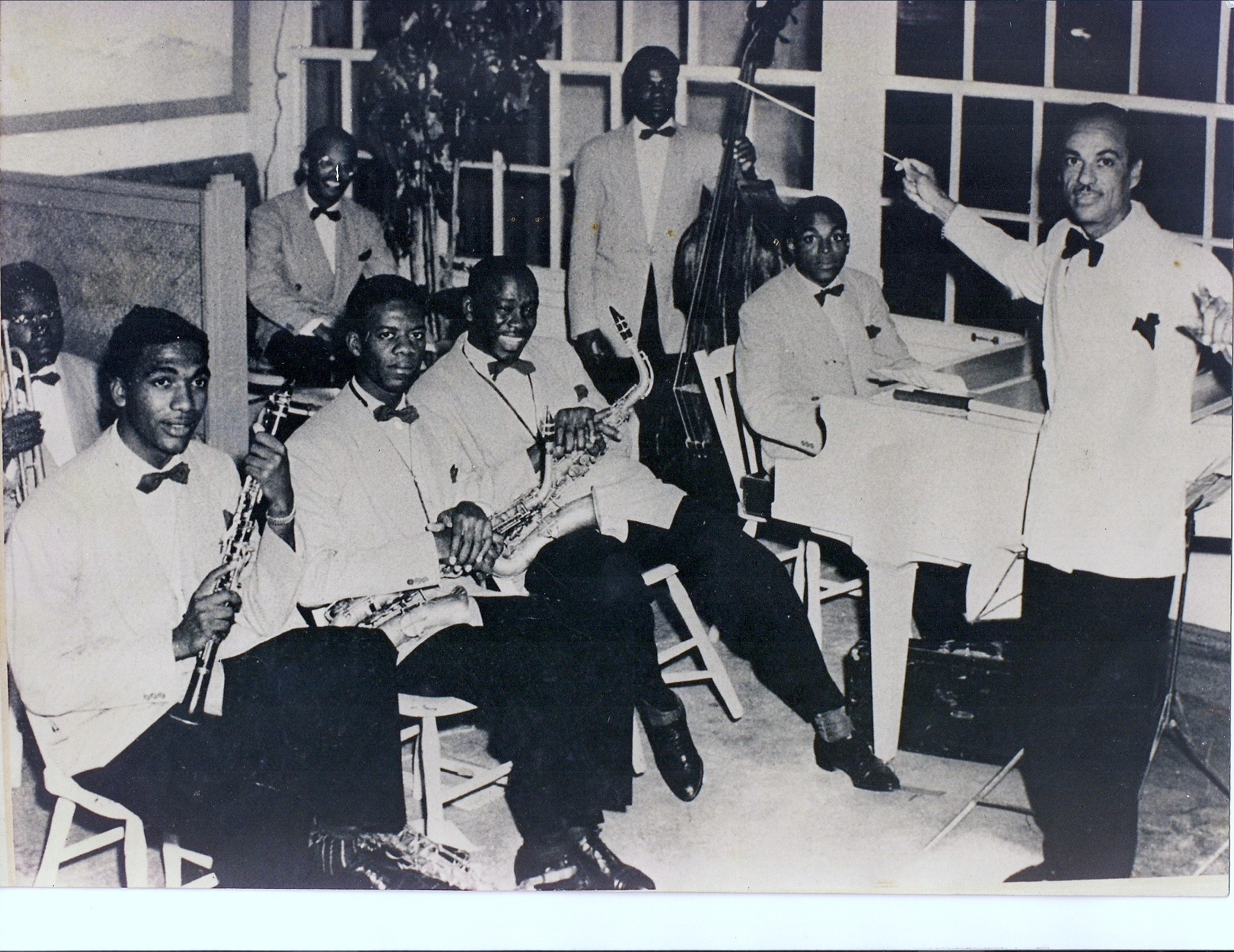
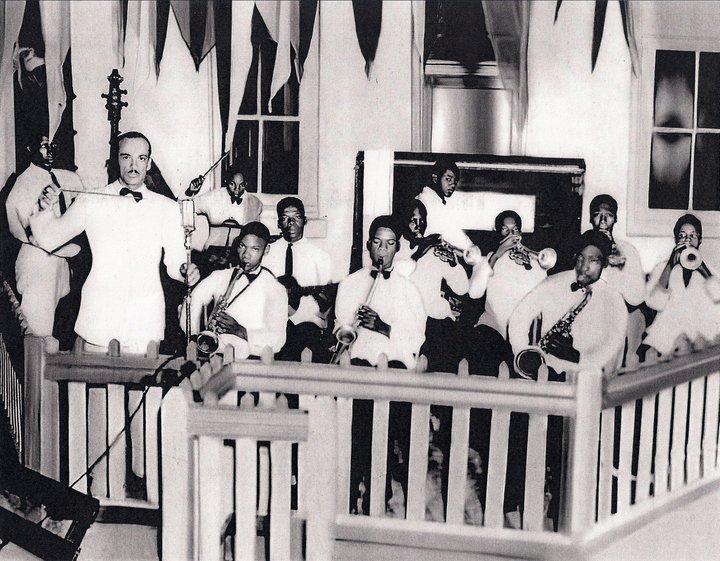
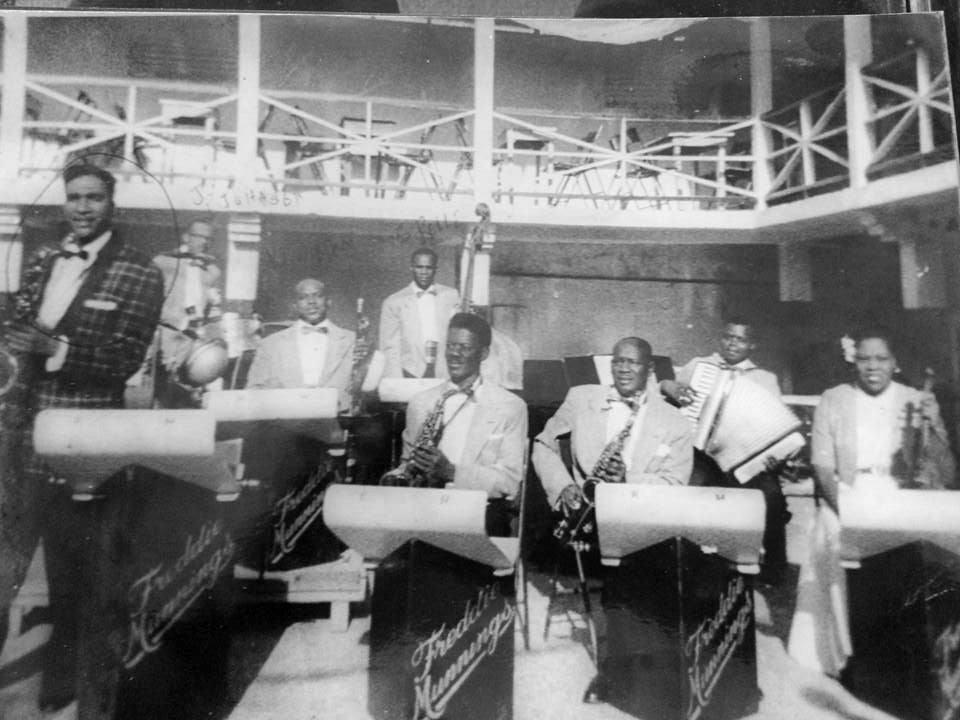
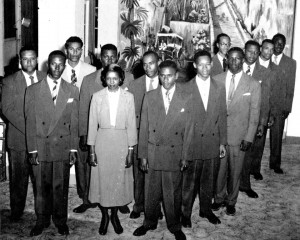
WilliamsBand2Music was a predominant feature of the day-to-day life “ova-da-hill”.   Practically every child went to “music lessons” in addition to the regular day school attendance, to study music and to learn to play the piano, violin, saxophone or some other instrument.   The teachers were usually a Church organist, member of a band or orchestra, or some other accomplished musician in the district.   And there were many.   Names that immediately come to mind are Charles Weir, Bert Cambridge, W.A.G. Bain, Blanche Horton Stuart (later Wright), Charles Carey, Nat Bosfield, “Bulla” Roberts (who was also the father of Persis Rodgers),  Rudy Williams (pictured at right with his band), Freddie Munnings, Sr. (clarinet player at left in picture), Eric Cash, Maurice Harvey, Eric Russell and “Sir Buck” Marshall.   There were also many musical performers in the entertainment field, such as Sidney Wood, Eloise Lewis, Joe Lord, Maureen Duvalier, Charlie Adamson and “Joe Billy” Rolle, who was renowned for his Saturday night “jumpin’ dance” sessions in the Cat Island Association Hall through King Street.Bahamas Choraleers - Copy
Another form of entertainment was provided by the neighbourhood movie houses.   The Palace Theatre was in existence from my earliest recollection.   It was situated in Grant’s Town at the foot of the hill opposite the Southern Recreation Grounds and was owned by Mr. Louis Duvalier who lived on Market Street.   Years later, in the 1940s, the Cinema Theatre was established at the corner of East and Lewis Streets; and in the 1950s Mr. Percy Pinder built and operated the Hill Side Theatre at the corner of East Street and Mason’s Addition.   This was followed by the Capital Theatre which was built on Market Street opposite the Southern Recreation Grounds.   None of these movie houses exist today.

Sport was a pervading outlet for the energies and interests of the young people of the community.   Cricket was the national sport, with soccer and rugby the popular winter interests.   Everyone either played cricket or was a knowledgeable enthusiast.   Each district in the Island was represented by a senior team, all competing for an annual championship trophy.   There was St. George’s for the Eastern District, St. Alban’s for the West, The Wanderers for the Police and St. Michael’s (later St. Agnes) for “Ova-da-hill”.  In later years, there were additional teams like St. Bernard’s for the Catholic community, the Vikings, and the Westerns.  Of course, today, the youngsters from “ova-da-hill” excel in all forms of current popular sport, including track and field, baseball, softball and basketball.  They stand, symbolically and proudly, on the shoulders of many former “ova-da-hill” champions in all disciplines of Bahamian sport.

Importantly, however, were the many leaders in commerce, industry, education, government and the professions who came from humble beginnings “ova-da-hill” and, despite many obstacles of opportunity and financial means, went on to become the Bahamian legends of the present and past generations who were the prominent “ova-da-hill” merchants of yesteryear.

Many of today’s lawyers, doctors, dentists and other professionals have their roots “ova-da-hill”, but they were rare specimens 50 years ago.   Dr. C. R. Walker was probably the first, followed by Dr. Cleveland W. Eneas from Bain Town.   I was acclaimed as the first lawyer from “ova-da-hill” when I was called to the Bar 56 years ago.    In fact, the late Justice Maxwell J. Thompson, although born in Inagua, grew up in Mason’s Addition and could certainly claim to have been an “ova-da-hill” boy when he was called to the Bar seven years earlier in 1946. Serving the entire area was a single Police Station, and fire engine, which provided the police and emergency needs of the “ova-da-hill” community in the early days.   The first Southern Police Station was in fact destroyed during the infamous Burma Road Riot of 1942.   It was then located on the western side of Baillou Hill Road, at its junction with Bias Street, opposite which was the two-storey building at Vesey Street which housed the Post Office on the ground floor and the Grant’s Town Public Library on the upper floor.   Here, many of us, as students, went to do our home-work under the helpful eye of Miss Lily Weir, the Librarian.  It is interesting to note that her niece, Mrs. Lillian Weir Coakley, was later appointed a librarian after the library had been later relocated to its present site, nine years later in 1951, when the present Southern Public Library was erected on the Southern Recreation Grounds after much parliamentary and governmental difficulty sustained by its promoters, Dr. C. R. Walker and Mr. Bert A. Cambridge, the MPs for the District.
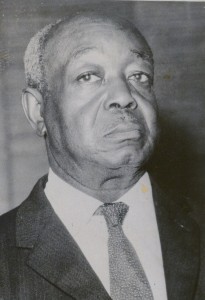
Claudius WalkerIn those early days the community leaders were the few professionals and the more successful merchants, teachers and artisans who stood out and were relied upon for guidance in all the public and civic occasions.  They were also the officers in the Churches, in lodges, burial societies and the fledging credit unions, some of which were not more than Asues.   The late Dr. C. R. Walker was the only medical doctor who set up his office over-the-hill.   He had first established a consulting office on the hill-top, on Meeting Street opposite Bethel Baptist Church; but he later built the Reinhardt Hotel at the corner of Baillou Hill Road and the Tin Shop Corner, and moved his office and a small pharmacy on the ground floor of this building, which he himself designed and constructed.  He also published a weekly newspaper, “The Voice”, from this building.  Immediately to the South of the Reinhardt Hotel was the Grant’s Town Market, which was an adjunct to the main fish and vegetable market on Bay Street. The Bay Street Market was a venerable old Spanish-type building on the North side of Bay Street, opposite the Northern end of Market Street, bounded on its western side by the Government Ice House which daily manufactured ice for the entire Island in those days, prior to the advent of refrigerators in homes.  On the Southern side of the Grant’s Town Market there was a small area to which ice was delivered daily from the factory “ice house” on Bay Street, and “ova-da-hill” residents could purchase their daily ice requirements from their own ice depot each morning.   A corn mill was also located in this Grant’s Town Market, where residents took the corn grown in their own fields “over Blue Hill”, or in their own backyards, to be ground into grits or meal for their personal home use.

And so life went on.  Over the past generation, most of the old families from “ova-da-hill” have expanded in numbers, in affluence, and in importance in the Country.   They have become some of the Country’s main “movers and shakers”. Grant’s Town and Bain Town which produced the achievers of yesteryear still provide homes for the under-class, mostly the present-day less privileged who have moved into the area from outlying Family Islands, and immigrants from Haiti and other Caribbean Islands.   Meanwhile, as “ova-da-hill” expands, large commercial and industrial establishments continue to base themselves in this popular and historic sector.

This year, as we celebrate 36 years as an Independent Nation, those of us who hail from “ova-da-hill” must look back with pride to our roots and to this area from which we came.


Old street scene photos courtesy of Bob Davies http://www.oldbahamas.com/

Rudy Williams orchestra courtesy of his daughter Carolyn Bartlett

Dr. C. R. Walker courtesy of his daughter Juliette Barnwell


February 2009
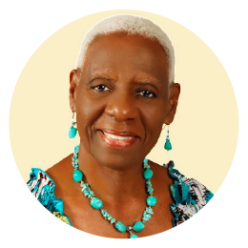
Dr. Andree G. Hanna, MB BS, FRCP(C) – A Trailblazer in Her Field

Andree SmilingDr.Andree G. Hanna is the first Bahamian Pathologist and the first female Head of Department of the Princess Margaret Hospital (PMH).

Like most Bahamian children of her era, she was born “Over-The-Hill” in Nassau. The last of seven children, she was blessed with supportive siblings, a mother who taught her to strive for excellence in all that she did, and a father who taught her that there was no limit to what she could achieve.

Andree attended public schools in Nassau, completing her secondary education at the Government High School (GHS), before entering the University of the West Indies (UWI) where she studied Medicine. She graduated from Medical School with the MB BS degree, two months before her twenty-fourth birthday. Upon graduation, Dr. Hanna did her Internship at PMH and then worked at the Public Health Department before going off to specialize in Pathology on an In-Service award. After Pathology residency training at the University of Western Ontario, Canada, she returned to The Bahamas with Specialist Certification in Pathology from the Royal College of Physicians and Surgeons of Canada and admission as a Fellow of the Royal College. While serving as consultant and later Consultant head of the Pathology and laboratory Department of PMH, she enrolled in the University of Miami’s Nassau programme and graduated “Magna cum Laude” with a Masters of Business Administration degree.

AndreeAndree’s professional affiliations include: Fellow of the Royal College of Physicians and Surgeons of Canada, member of the Canadian Association of Pathologists, Member of the American Society for Clinical Pathology, member of the Clinical Laboratory management Association, and Member of the International Association of Cytology.

She served initially and for many years as Pathologist in charge of Hematopathology and performed all of the bone marrow aspirates in the hospital. Additionally, staffing constraints soon made it necessary for her to also serve in Surgical Pathology, Cytopathology, Autopsy Services and, at various times, all areas of Clinical pathology.

During her tenure at the Department of Pathology and Laboratory Medicine, Dr. Hanna is credited with modernizing and reorganizing the Department. She spearheaded the continuous provision of state-of-the-art equipment, a Satellite laboratory in the Out-Patients Department, implementation of a modern Stat Laboratory in the Accident and Emergency area, a shift system in the Blood Bank, renovation and modernization of the Rand Laboratory autopsy suite, the Surgical Pathology and Cytopathology Sections, the temporary relocation of several Sections of the Department to Collins Avenue when the existing infrastructure could not accommodate the required new equipment, and an automated laboratory Information System.

An important facet of her contribution was staff development. Continuing education programmes and staff rotations were implemented. Many staff members were given In-Service awards and returned with degrees and certification in Medical Technology. Two other Pathologists were trained through In-Service awards.

Andree’s contributions also included service to much hospital, Ministry of Health, national and regional committees. She was the first Chairperson of the hospital’s Environmental Safety Committee which focused on safety monitoring, safety protocols and procedures, and safety training for all levels of staff. She was an active member of the hospital’s Medical management committee, committees devising protocols for the establishment of the Public Hospitals Authority (PHA), and the Terms and conditions of Service for Physicians at the PHA.

She has been honoured for professional achievements by Academy of Medical Sciences and by women in Sciences and Technology.

A long term objective of Dr. Hanna’s was certification of the laboratory to international standards, so she was delighted to be seconded in April 2004, to the Ministry of Health, to head the National medical laboratory Strengthening Project, with ultimate goal of attaining certification for public and private laboratories in The Bahamas.

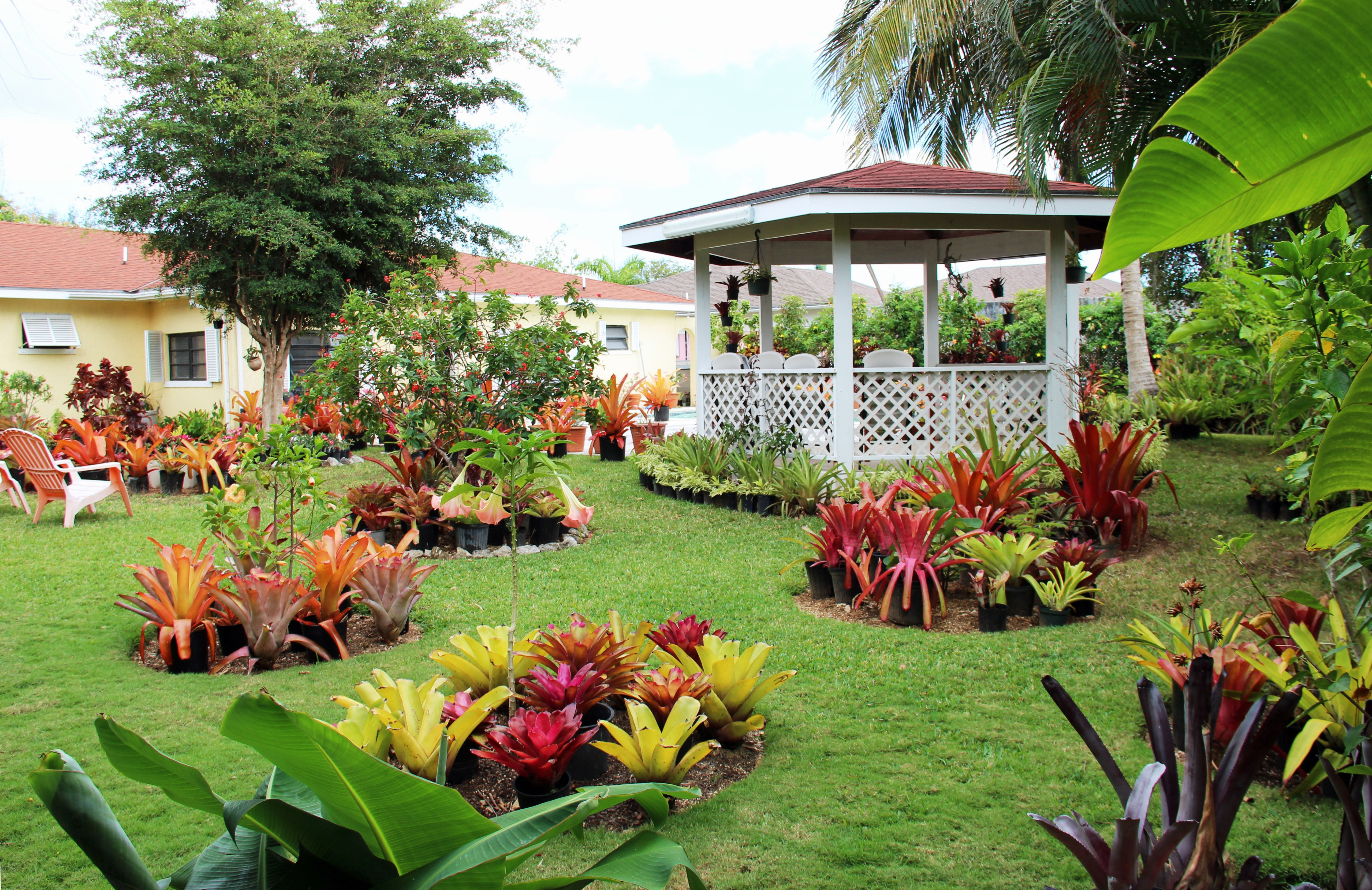
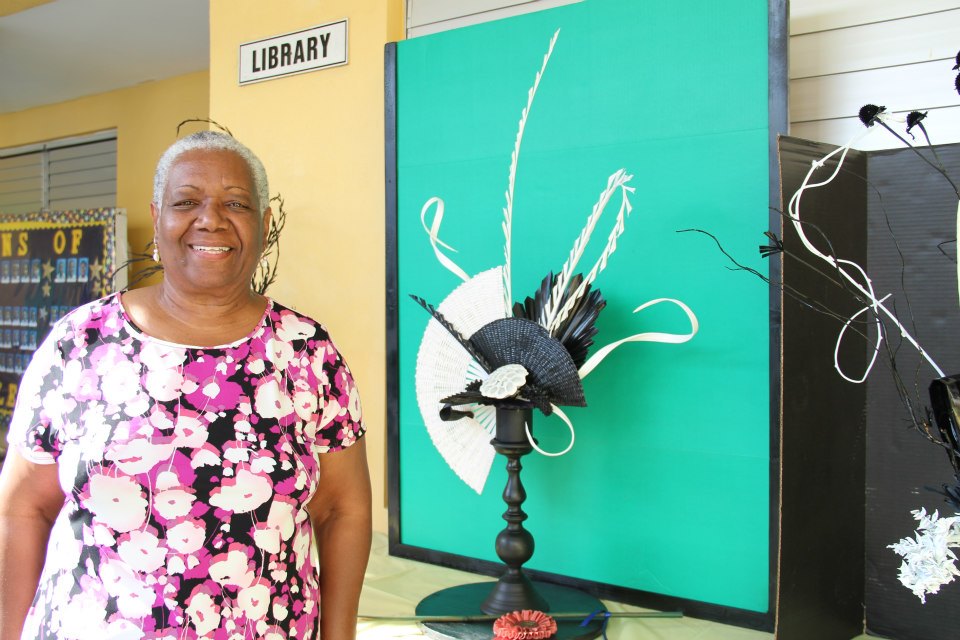
IMG_9509Andree_Best in ShowAndree balances her professional life with church, family, friends and hobbies. She is a member of St. Agnes Anglican Church where she sings in the choir. She was a charter member of the Zonta club of Nassau; she is a member and past president of the Carver Garden Club and is a member of the Horticultural Society of The Bahamas. Her hobbies include floral design, gardening, traveling, swimming, racquet games and reading. She also enjoys regular gatherings of her extended family with the group of known as “The Lime”. She is now happily retired.

Andree is divorced and has two daughters, Tracy and Gina Stubbs and a granddaughter, Grace Eneas.

© Copyright Rosemary C. Hanna 2015

Wake Up Bahamas!

This letter was published in the press 29th October 2013

The Editor

Dear Sir:

Wake Up Bahamas!

Recently, I was appalled to hear that a young person claimed that in the 60s all Bahamians lived in the “ghetto”! What absolute nonsense! That ignorant young lady and whoever fed her that nonsense need to be enlightened. This is the sad legacy of not making Bahamian history mandatory in all schools, both public and private.  Wherever you go in other parts of the world, that country’s history is taught in its schools. When I was growing up I was taught all about the Boer War, India and other places that meant absolutely nothing to me.  In many ways we are still working in that same antiquated mode and the school curriculum needs to be revised.  I spoke to a COB history class recently and when asked if they had been were taught Bahamian history in high school those who had said that it was not in depth. We also need to stop trying to plug square pegs into round holes by forcing children who are not academically inclined to take BGCSE examinations, which is yet another big disaster that ought to be done away with.  Those students who are not academically gifted must be taught other subjects that will help them to earn a living and function in the real world when they leave school.  We are backward in so many ways.  I often shudder when driving around after school hours to see and hear the manner in which so many of our children conduct themselves, including foul language from both boys and girls.

While on this topic I extend congratulations to Mr. T. Edward Clarke for what he is doing to rescue some of our at risk boys through his L.E.A.D. Institute and also to Mr. Ricardo Deveaux for the tremendous work he is doing through The Bahamas Primary School organization which recognizes excellence in primary school students.  This is the level at which our children need to be taught about the rich historical heritage of The Bahamas.

Around the time that The Hon. Paul Adderley died, ZNS TV played a number of his speeches and I was particularly struck by one in which Mr. Adderley stated that when he was in charge of The Ministry of Education and tried to introduce certain aspects of Bahamian culture into the curriculum he encountered obstructionist senior civil servants within the Ministry and among some school Principals.  Fr. James Moultrie, who served as Junior Minister under Mr. Adderley at the time, confirms that there were many who resisted the teaching of authentic Bahamian history and that he shared Mr. Adderley’s frustration and disappointment. While there were a few cosmetic changes, a comprehensive curriculum on Bahamian history and culture never materialized. I also recall attending Marion Bethel’s showing of her documentary Womanish Ways and the following panel discussion.  Among the panelists were the direct descendents of the women who were at the vanguard of the women’s suffrage movement in The Bahamas namely, Alice Ingraham Rolle (daughter of Mary Ingraham who was the founder of the movement in The Bahamas), Wallis Lockhart Carey (daughter of Eugenie Lockhart), Andrew “Dud” Maynard (son of Georgina Symonette) and Shirley Sands Johnson (sister of Dame Dr. Doris Johnson).  During that discussion Mr. Maynard cried when he related how when they tried to get the information concerning the movement introduced into the school curriculum, they were  told by a senior Ministry of Education official, although not called by name (a Reverend Gentleman who is still alive today) that they were trying to indoctrinate the children.  What a shame!

My book Pictorial history and Memories of Nassau’s Over-The Hill came about precisely because of my disgust at the rot and decay in that and many other areas all over the Island of New Providence.    It’s important for the uninformed to know that many of the nation builders and others upon whose shoulders we all stand came from Over-The-Hill. Grant’s Town, Bain Town, Mason’s Addition, Anderson Street, Lewis Street, McCullough Corner, Market Street, Vesey Street, Hay Street, McPherson Street, East Street, Fort Fincastle, Nassau Street, Chippingham Meadow Street, King Street, Ross Corner and other areas and that they were not the “ghetto”.  These were the areas where our nation builders were born and lived. We never knew the word “ghetto”, which has been imported from elsewhere in more recent times, and everyone took pride and kept their surroundings clean.

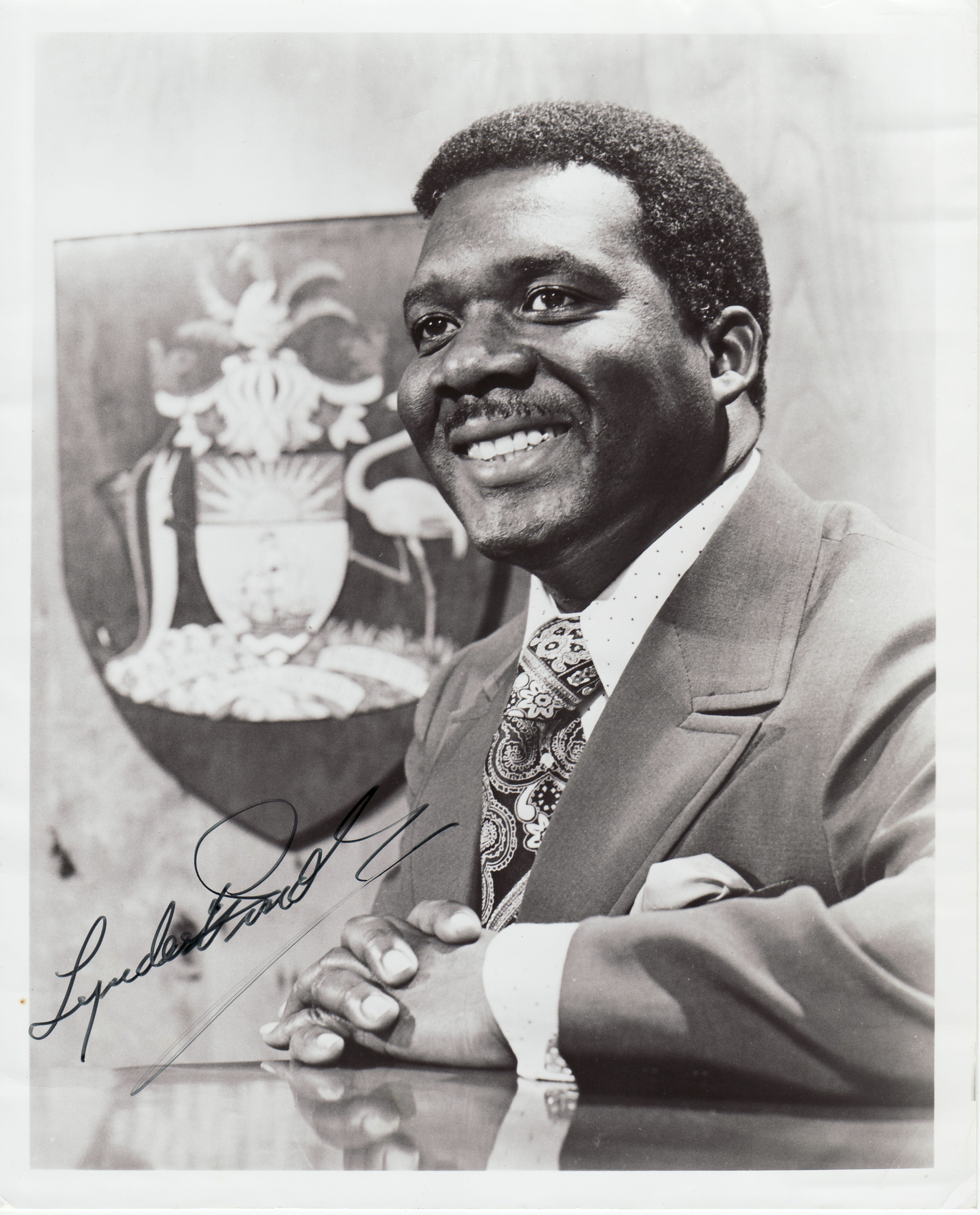
SirLyndenPindlingSir Lynden Pindling (pictured left) was born in Mason’s Addition and grew up on East Street;

Donad DavisCivil Servants such as Marina Greaves, Ivor Donald Archer, former Financial Secretary Ruth Millar and her brother the Hon. Alfred Maycock came from Mason’s Addition. So did Rose Hall-King and her son, former Chief Justice Sir Burton Hall, outstanding educators Dame Dr. Doris Johnson, Rev’d Carlton Francis, Donald W. Davis (pictured at right) and a number of Poitiers, as well as the current Director of Archives Elaine Toote and her siblings Dr. Vanria Rolle and Lewis Colebrooke. Mason’s Addition also produced Rev’d Earle Francis and medical and academic doctors Baldwin Carey, Eugene Newry, Manny Francis, Pandora Johnson, Junkanoo leader Percy “Vola” Francis, international movie star Calvin Lockhart and Ambassador Basil O’Brien, as well as successful business persons like the Wallaces, Thompsons and others.

Ross corner produced Franklyn Wilson and his siblings, Dr. Kenneth Alleyne, Kayla Alleyne Burrows and Kalfani (Lisle Alleyne, Jr.). I’m happy to see that Dr. Alleyne is now refurbishing the family homestead.  Hopefully others will follow his example and that of Dr. Roger Weir who has done a beautiful job with the Weir homestead on West Street. The Coakley house on Lewis Street has also been beautifully restored by its new owner Mr. Gibson (formerly of Vesey and Market Streets).

Gaol Alley and Anderson Street produced Monsignor Preston Moss, Mildred Johnson Bowe, Verna Elcock, Leslie Johnson, educators Luther and Margaret McDonald (later Ambassador) and their children Donna smith and Luther, Jr. the Sweetings, Gibsons, Bostwicks, Bowes, Adderleys, Allan, Ivan, Perce, Paul and Dr. Andree G. Hanna, Velma Archer Allen, Annette Knowles, Durward Archer, the Pinders, Seymours, Mitchells, Beryl Barnett, renowned artist Kendal Hanna and his brother Leslie and siblings, and Michael “Sarge” Hanna.  On Lewis Street there were the McCartneys, Coakleys including Sylvia Matthew Hyacinth Saunders, Alma Cartwright, Marina Thompson Sands, John, Wyatt Johnson, Stephen and Ellen Serville, the Tinkers, Johnsons, Darvilles, C.A.P. Smith and William Cartwright.

Sir Randol Fawkes was born at Fort Fincastle and later lived on McPherson Street, Justice Jeanne Thompson’s family and the family of Timothy Gibson, the McCartneys and Coopers also lived there. Archdeacon William Thompson and his brothers Bishop Gilbert Thompson and Dr. Philip Thompson lived at the corner of Hay and Market Streets. Sir Orville Turnquest’s family lived on Hay Street, Dr. & Mrs. Jackson Burnside’s family lived at Fort Fincastle where Mrs. Burnside still resides, The Coakleys, Smiths, Johnsons and McCartneys lived on Lewis Street; Dr. & Mrs. C.R. Walker lived and worked in Bain Town and their daughter Juliette Barnwell still lives there. Many of our schools are named after outstanding persons who came from Over-The-Hill: Cleveland W. Eneas, C. R. Walker Mabel Walker, S.C. McPherson, Carlton Francis. Doris Johnson, Donald Davis, Sadie Curtis, Thelma Gibson and the list goes on.

I get annoyed every time I hear Craig Flowers on TV talking about being born in the “ghetto” and he should know better because when he lived there Quakoo Street was clean and he and his brothers, like everyone in the area, were always well groomed and were taught manners. Over-the-Hill and other areas of this Island did not look the way it does now with all of the filth.   Mr. Flowers is seen on TV picking up a piece of paper from the immaculate lawn on his property on West Bay Street.  I would urge him to use his influence to encourage some of the Quakoo Street residents with whom he is seen shaking hands and patting on the shoulders to clean up the nasty environment that they have created instead of sitting around under the trees in the midst of the filth.  This is to the detriment of other people like the Storrs and a few others who keep their properties in clean and pristine condition, as was the case when Mr. Flowers grew up there.  Everyone in the neighbourhood from the humblest to the more successful, like Mr. Flowers’ father, kept their surroundings clean, and it was definitely not a “ghetto”.   We all lived by the adage that “Cleanliness is next to Godliness”.  Perhaps a part of the reason for the current state of affairs is that so many of our people are Godless while others just pretend to be Godly and are more concerned with all of the material trappings of being self appointed Pastors, Apostles, Reverend Doctors and Bishops.

Self-pride is sadly lacking in so many of us. On the one hand we complain about the foreigners and want to blame them for everything that is wrong in the country while on the other we are quick to copy the most negative aspects of some of those other cultures.  I don’t want to see your dirty underwear! At the same time some of our so-called “entertainers” pick up a fake Jamaican accent as soon as they put a mic to their mouths.  Wherever they go in the world Jamaicans, Americans, British and other nationalities never lose their identity or accent, but we Bahamians, the ultimate copy cats, pick up accents after only being away from The Bahamas for brief periods.  We are such “pretenders”!   We also need to get away from the notion that Junkanoo is the only thing that defines our culture.  We are much more than that.

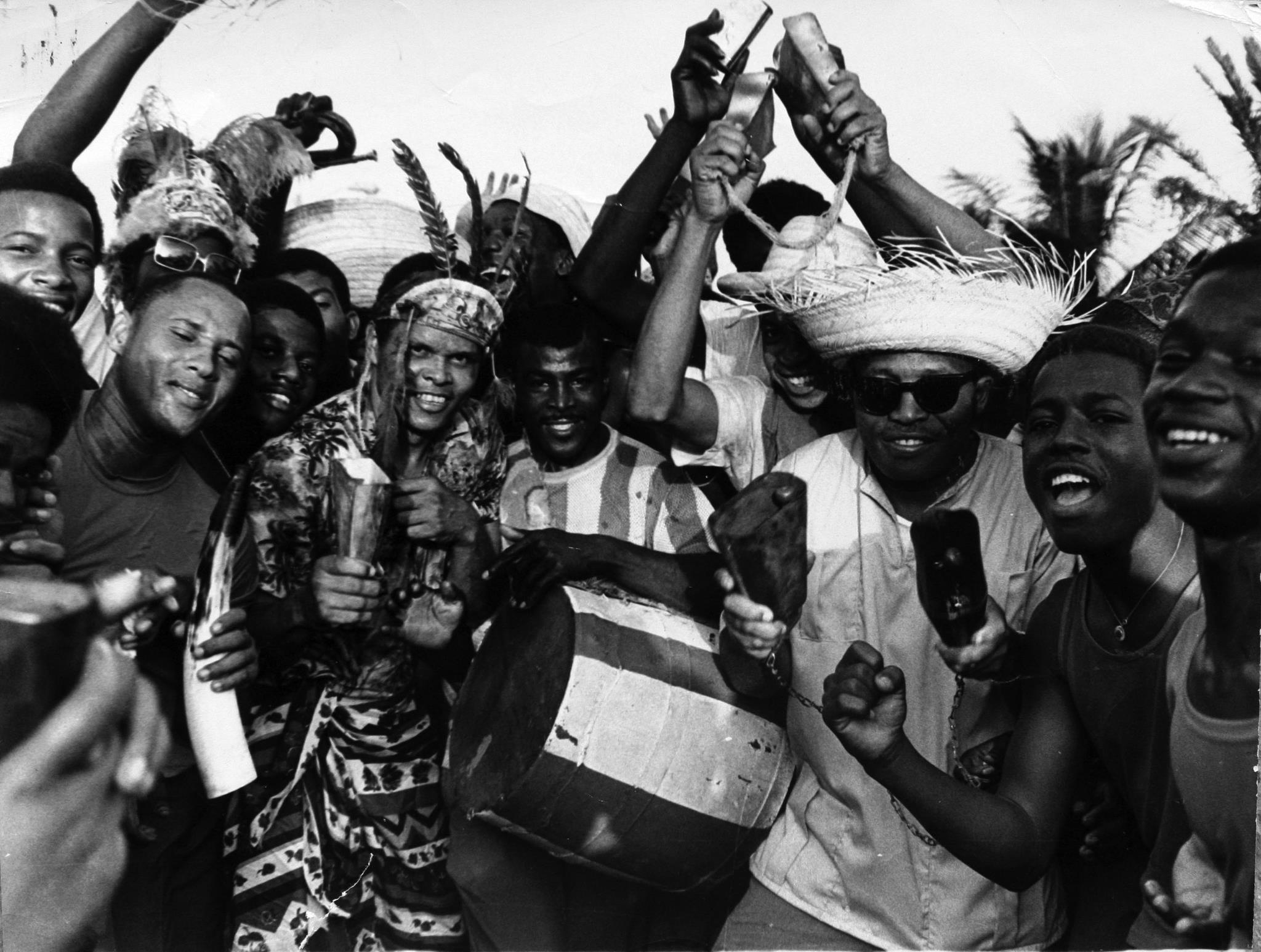
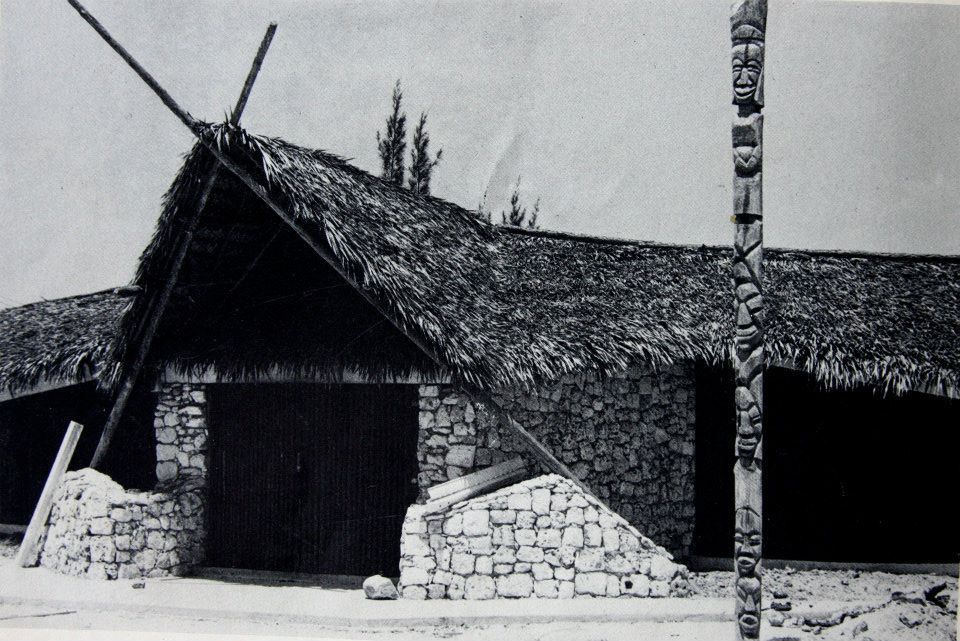
Jumbey Village Festival Jumbey Vilage Art and Craft CentreI think that one of the worst things to happen in this country was the deliberate dismantling of Jumbey Village which was the brainchild of Mr. Edmund Moxey.  The Village was located at the site where the National Insurance building now stands, and featured every aspect of our culture including Junkanoo, art, straw work, music, live entertainment.  When Mr. Moxey fell out of grace he was ridiculed and Jumbey Village was dismantled.  James Rolle can attest to the fact that he was sent abroad to train as a curator for the art gallery and that when he returned home the Village was no more.  I also highly recommend Mr. Moxey’s documentary: “The Price of Being a Man” which documents the history of Jumbey Village.

Every Bahamian should be required to read Sir Randol Fawkes’s book The Faith that Moved the Mountain and learn factual historical information about The Bahamas.

Wake up Bahamas!  We need to educate and enlighten the uniformed and yes “indoctrinate” them with what is Bahamian.  I make no apologies for that.

Yours sincerely,


Rosemary C. Hanna


St. Agnes Architectural History

Blue Hill Road, Grant’s Town, New Providence, The Bahamas

By Jackson L. Burnside III (1949-2011)

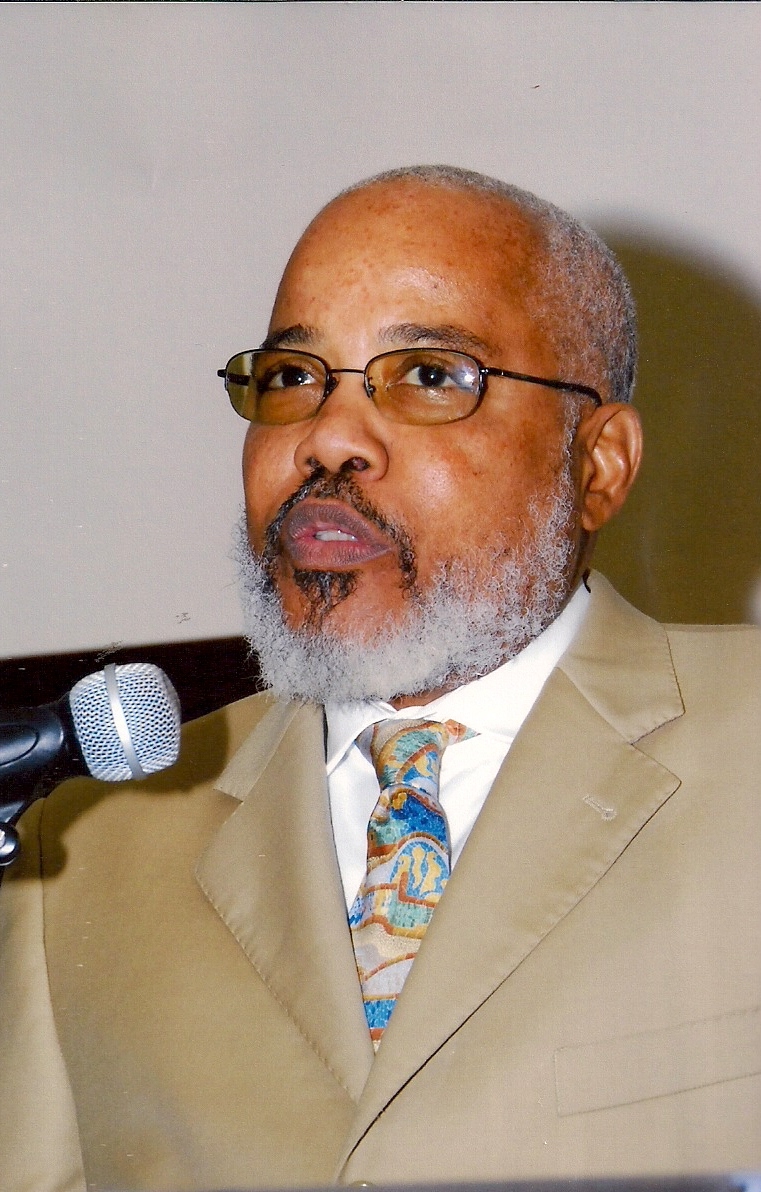
Jakson Burnside_01If only walls could talk the historic church of St. Agnes Parish of Grants Town would tell a fascinating story of the Bahamians who settled in the Over The Hill area of Nassau in the Bahamas.

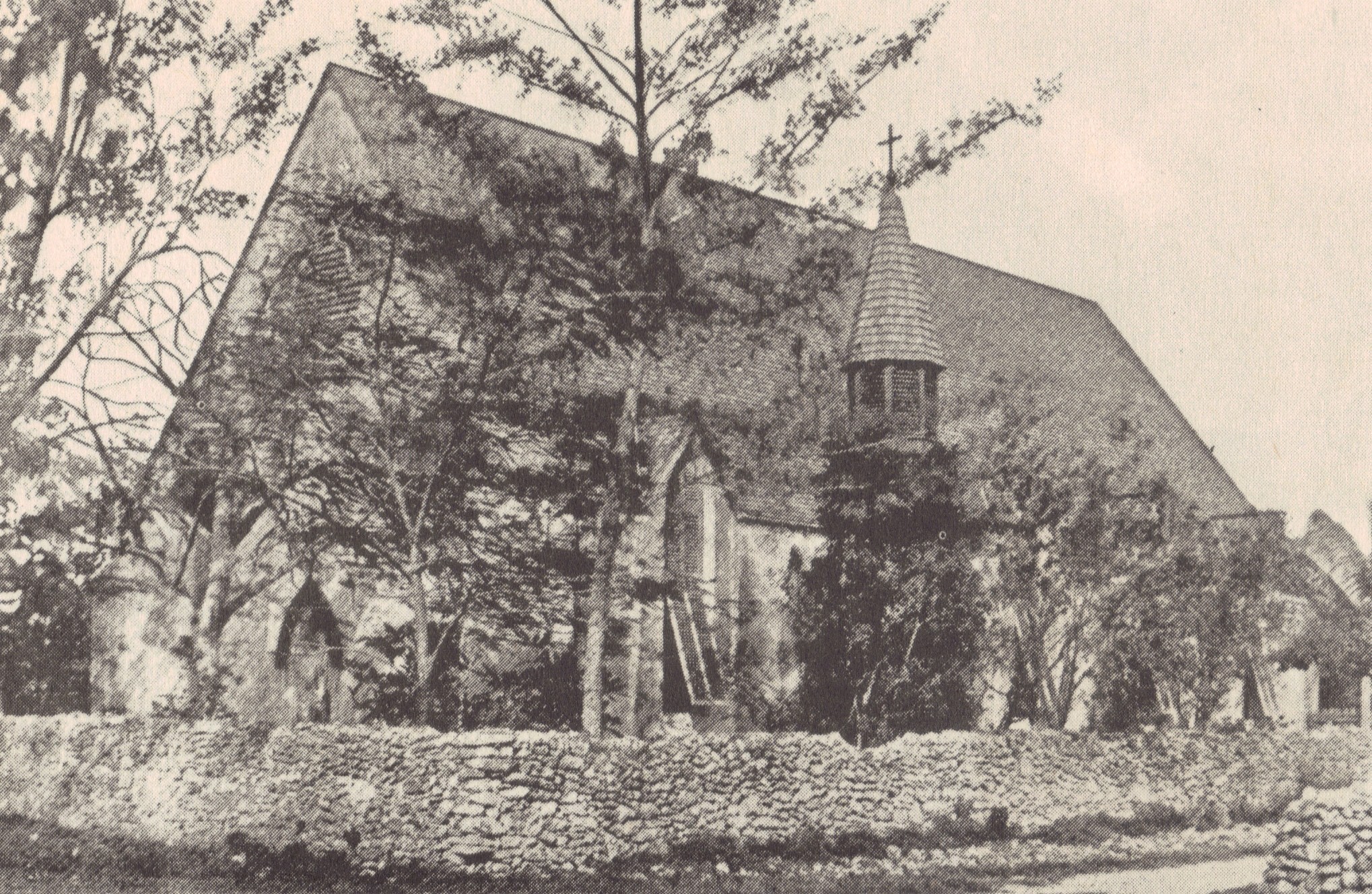
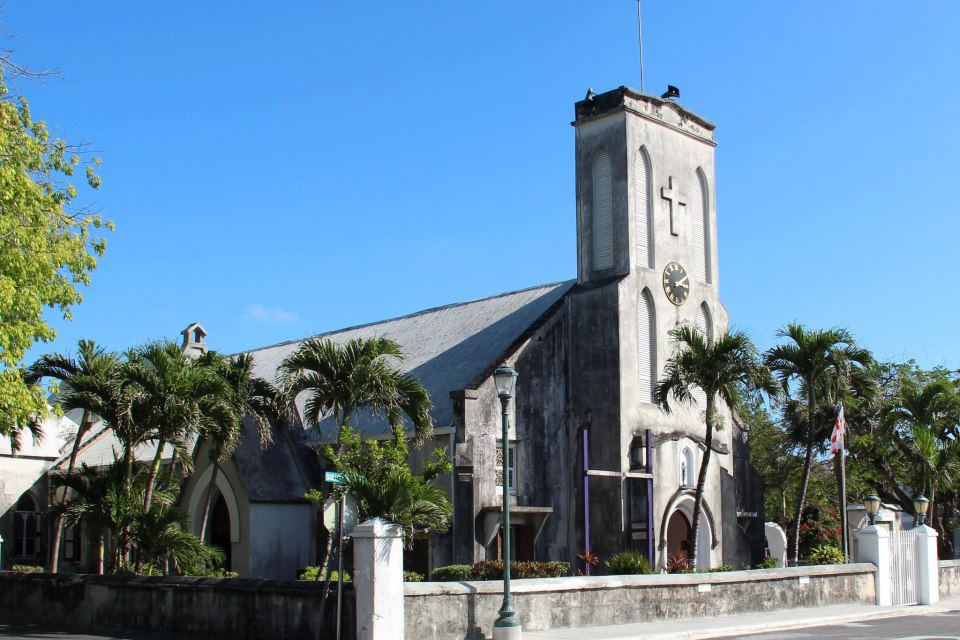
The Architecture of the modern St. Agnes Church, Grant’s Town, is a classic example of the 19th century Gothic Revival that emerged, in England and throughout the colonies, with the then new technologies of steel and reinforced concrete. Though the St. Agnes worship space is not as ornate and finely detailed as the Christ Church cathedral, St. Matthew’s, or St. Mary’s churches, this “cathedral over the hill” is a proud adaptation and modification of the classical themes of Gothic Architecture of the European continent.

Grant’s Town itself emerged as an African settlement on land considered of “no value” just behind the ridge that separated the city of Nassau from the rest of the island of New Providence. This segregation was deliberate, because by the mid-1800s the African population, which swelled with the coming of the Loyalists, overtook the European population and the colonial power felt it necessary to separate the African presence from the town.

St. Agnes Church1With this physical separation also came separation of worship, and the churches of the Nassau community became established in Grant’s Town. The Baptists came first followed by Wesley Methodist, and then when the Anglican Church could no longer tolerate separate services at the cathedral for the Europeans and the Africans, St. Agnes was established over-the-hill. In 1845 during a visit by Bishop Aubrey Spence, “an old African school room which had been used for divine worship was consecrated under the title of St. Agnes”. Three years later in 1848 Bishop Spence returned and consecrated the new District Church of St Agnes a day after a similar service was held at St. Mary’s Church.

Under the leadership of Father James H. Fisher, a new structure built of limestone masonry was erected with a steep, “high pitched roof covered with corrugated zinc”, large enough to accommodate four to five hundred worshippers. Bishop Addington Venables consecrated St. Agnes on July 12th, 1868. By 1901 the congregation of St. Agnes had outgrown the existing structure, and a new Chancel was called for by Archdeacon Churton. The corner stone ceremony for the new Chancel and Our Lady’s Chapel followed on June 6 1905, and was conducted by the then Bishop Henry Norris Churton.

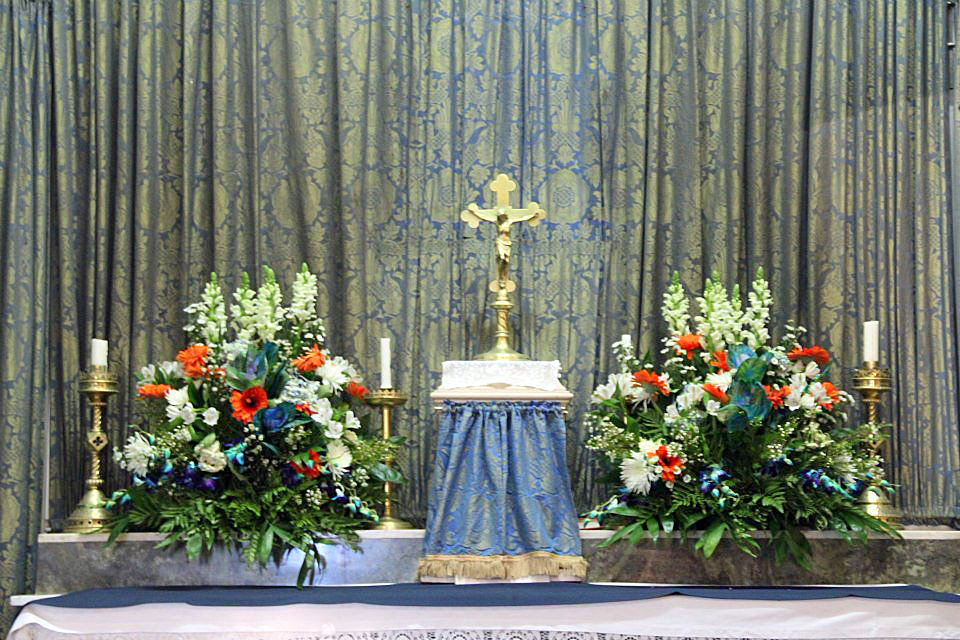
12 - Lady Chapel 2 - (small corner) JUNEThe following year, on St. Agnes Day, January 21st 1906, the intricately decorated chancel, new Altar and our Lady’s chapel were dedicated along with a new vestry. This addition was dedicated by Bishop Wilfred Bird Hornby as a memorial to Bishop Henry Norris Churton who drowned off Ragged Island on January 20th 1904.

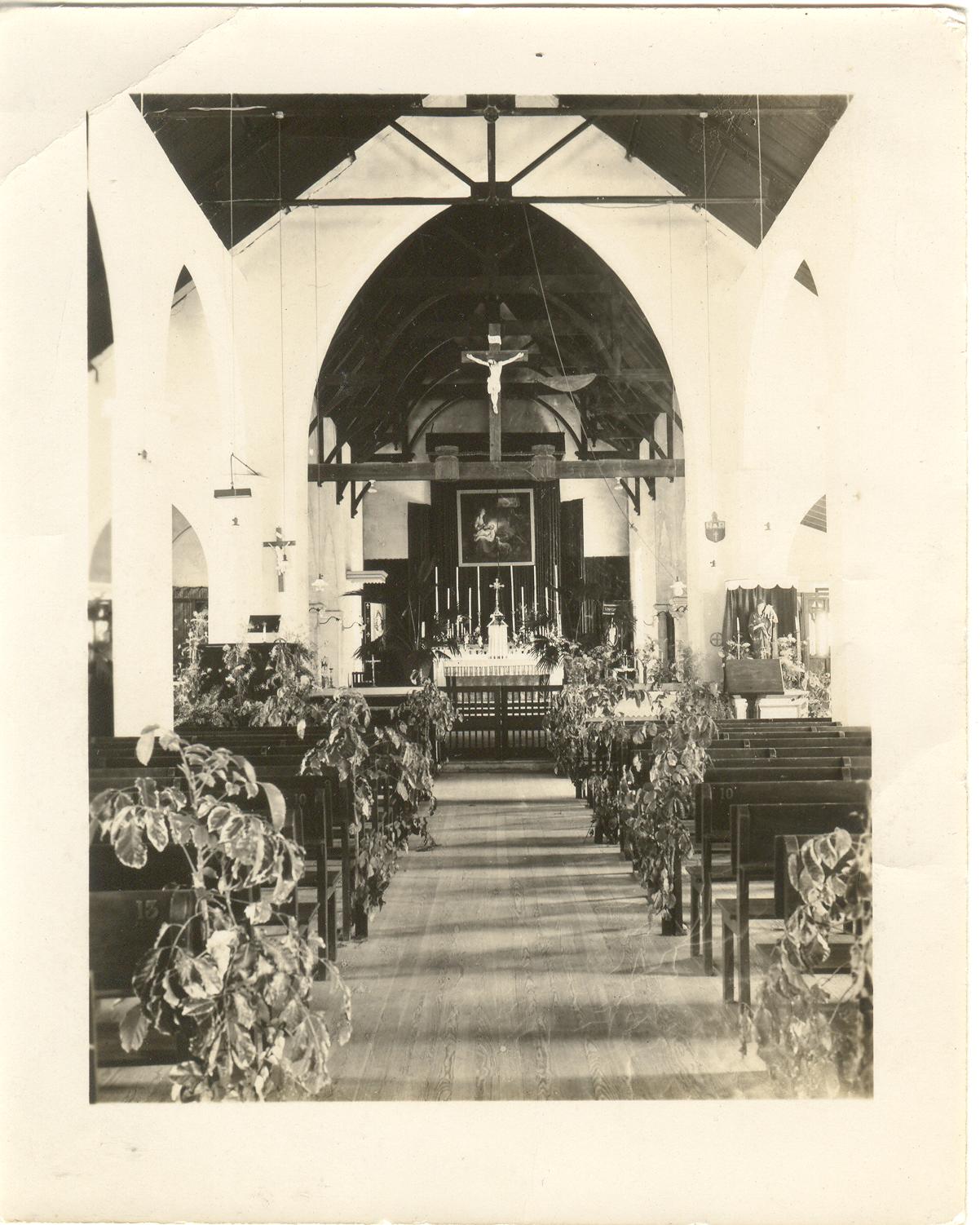
St. Agnes Interior c.1952The chancel is separated from the nave by a grand Gothic arch of reinforced concrete. The sophisticated timber “hammer beam trusses”, typical of 14th Century English churches, make a Ceiling worthy of the purpose of the holy space it protects. It is interesting to note that St Mary’s Church, Virginia Street, has the same truss and decorative detail in its chancel. The Altar is of Connemara and Carrava marble with jewels of lapis lazuli and red marble. Two oil paintings were installed above the altars, a nativity scene above the High Altar, and a depiction of the Blessed Virgin and Child over the Lady Altar.

OLYMPUS DIGITAL CAMERA

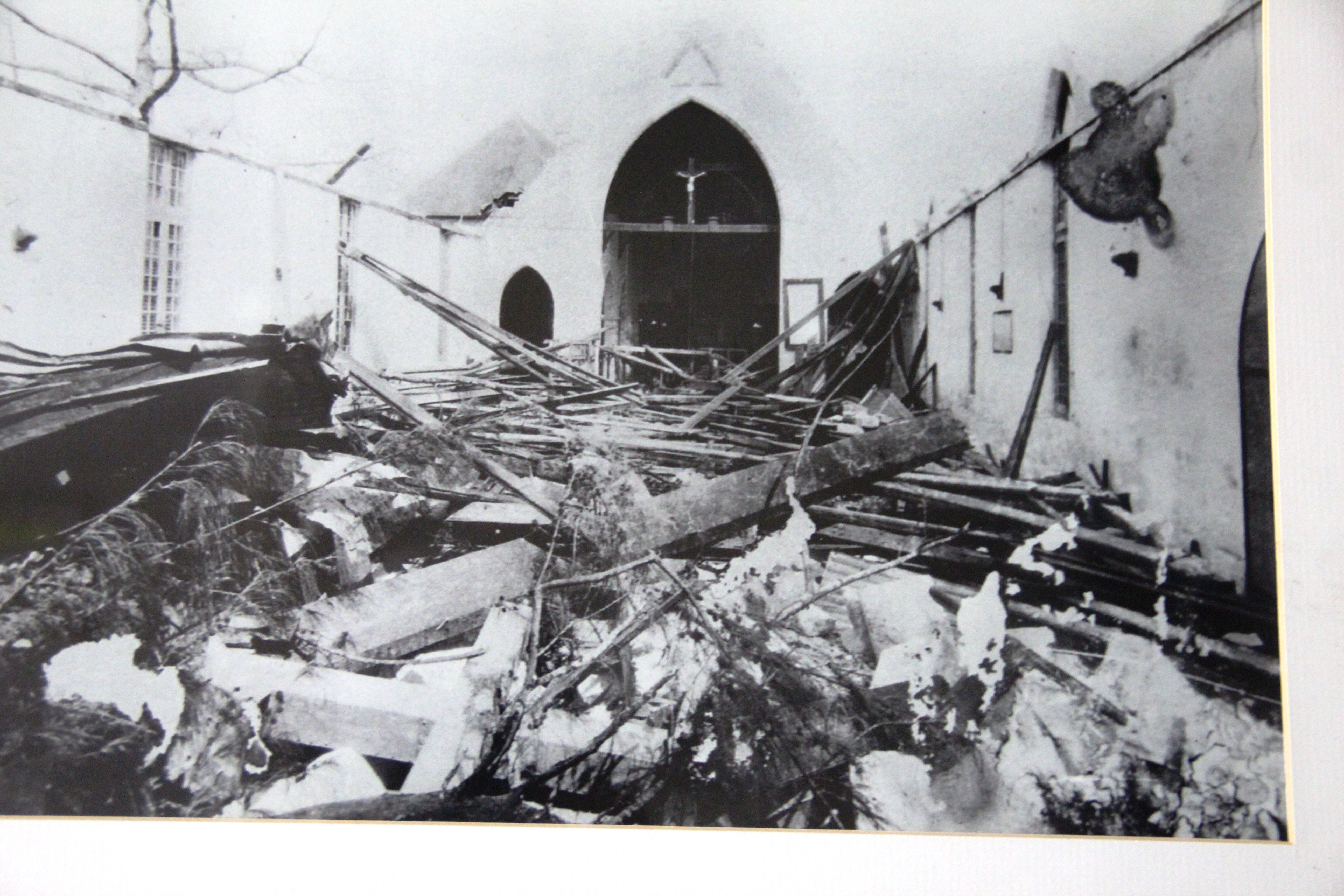
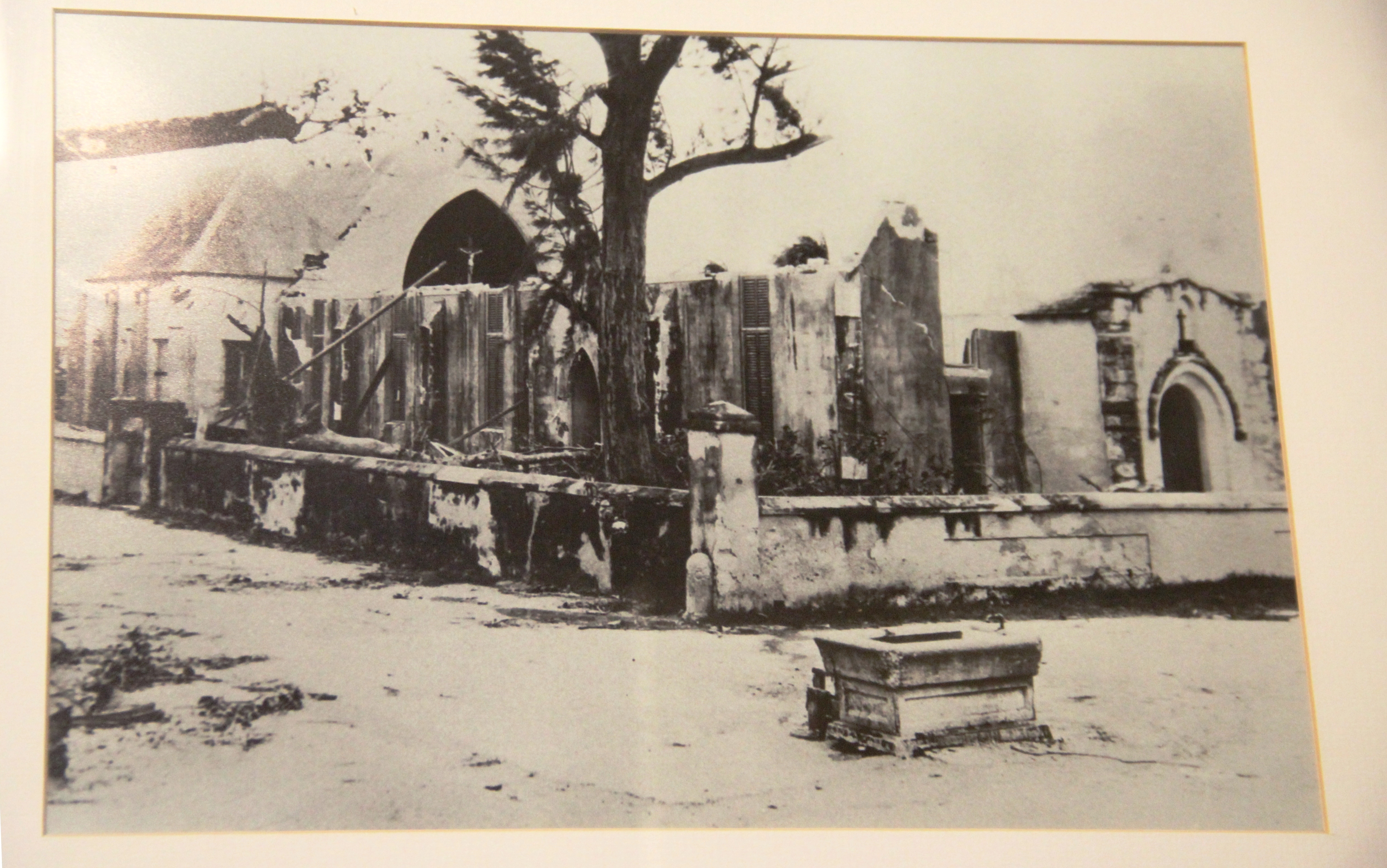
Early twentieth century photographs show a rose window on the Western Elevation above the Main door of the church. This, it is believed, was added in 1916 when the Western porch was built to celebrate fifty years of service of Father James H. Fisher. According to Canon Herbert George, it was this “large rose window” that took the full fury of the 1928 storm and blew in causing the entire roof to collapse. Only the side walls though badly damaged, and the foundations of the Western porch remained.IMG_8616 IMG_8623

A Mr. A. L. B. Plunkett, a Government Engineer, and a Mr. Langlois redesigned the nave of the Church and reconstruction began the following February 1929. The North and South walls were reinforced with buttresses, and reinforced concrete beams were added to the top of the walls to receive the new steel girders that replaced the timber rafters. On the interior, four pairs of stout hexagonal reinforced concrete columns were installed between the nave and the aisles. Above the columns are large semicircular Roman arches of reinforced concrete. This line of arches ties the chancel arch to the Western wall, and divides the roof structure into trusses above the nave, and rafters above the aisles. The pitch of the roof was considerably lowered from the original structure, and proved to be much stronger as it withstood the even more devastating 1929 hurricane that destroyed many structures in New Providence.

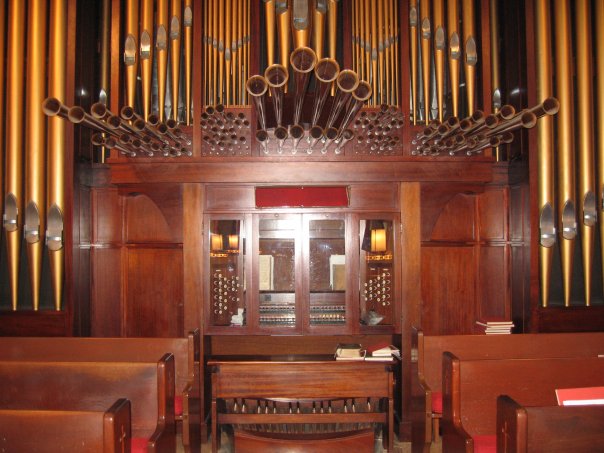
StAgnesChristmas09_Kim_0216 - Hig altar (small corner) - AUGUSTSeveral additions were made to the structure in the more than thirty years of Archdeacon William Thompson. Archdeacon Thompson benefited greatly from the service of organist Percy Hanna, who was also a pioneering 20th century Bahamian Architect. Mr. Hanna, along with his son Engineer Paul Hanna, designed the Bell tower over the Western Gate which was dedicated on July 12, 1970.The father and son Hanna team also designed the Choir Loft and in 1982 this addition was dedicated when the new J. W. Walkes and Sons, England, organ was completed. The structure was erected by Carl G. Treco Contractors, and Lloyd M. Toppin & Co. was responsible for the finish mahogany woodwork.

Later in the early 1990’s, Archdeacon Thompson commissioned the design of the Northern and Southern Porches of the church. He enlisted Architect, Jackson Burnside, the Great Grandson of Herbert Burnside who was a member of the first vestry of St. Agnes, and Da Costa Williams was responsible for the construction of these additions. Mr. Williams also donated the larger Southern porch in memory of his parents, Mr. and Mrs. Cardinal Williams of McCollough Corner.

New mahogany doors for all entrances were built by Mr. Lloyd Toppin and donated by parishioners. The Main Entrance, door at the West was donated by Basil Johnson and family in memory of Mrs. Johnson. The Gay family donated doors in memory of their parents, Mr. and Mrs. John Gay and their daughter Claire Gay Newbold of Gaol Alley. The Coakleys of King Street donated doors in memory of the late Mr. and Mrs. Roderick Coakley. The Toppin family gave a door in memory of the late Mr. And Mrs. Milton Toppin of Baillou Hill Road. Shortly after this period air-conditioning was added and the historic plain glass wooden casement windows were removed in favour of modern stained glass windows. The new statue and grotto in the Southern garden donated by Da Costa Williams, was included in the dedication of the doors on July 19th 1993.

OLYMPUS DIGITAL CAMERA

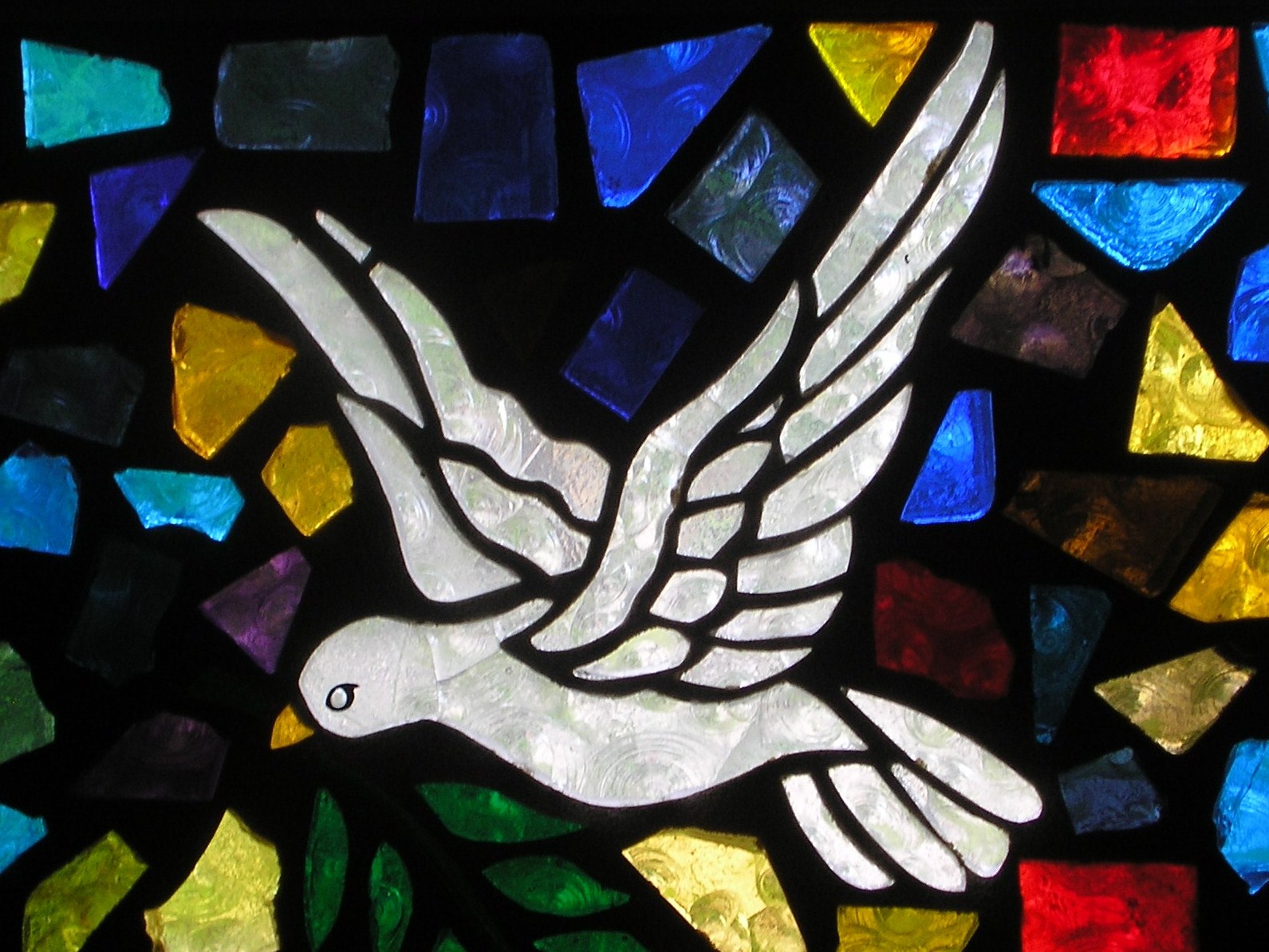
Also in July 1993, modern stained glass windows in metal frames were installed in the original masonry openings. These abstract depictions of the seven sacraments of the church were donated by the family of Samuel Glasgow and Cornelia Williams in their honour. Though built by the Stateville Stained Glass Co., USA, Mr. Lloyd Toppin and Matthew Simmons prepared the necessary woodwork. The pointed arch characteristic of Gothic window openings was blocked in to receive the square frames of these new units.

St. Agnes Church Eterior 2012The Anglican Church is an important part of the Bahamian legacy. St. Agnes Church has for almost 200 years played a significant part in the continued development of the distinct African, European and other diverse cultures of the population of our Islands. The description of the stones and sticks of this tangible Grant’s Town worship space should provoke the ongoing search by others to mine the rich and valuable stories of our “goodly heritage”.


This article was written by Jackson L.Burnside III (1949-2011) in June 2007 and is recorded here by kind permission of his widow Pamela Burnside.


Musicians and Entertainers Over-The-Hill and Where They Worked

ST. AGNES ANGLICAN CHURCH 150th  ANNIVERSARY – LECTURE SERIES

By Ivan A. Hanna – 20th September 1995

 IvanAlbertThis is a very wide subject and, although I will eventually get into the meat of this exciting topic, there are a few preliminaries I must pass through first.

THE ONE-MAN-BAND

During the forties, there was the One-Man-Band, a contraption built on wheels consisting of drums, different sounding horns, cymbals, tambourines, etc.  This gentleman plied his talents throughout the Over-the-Hill area and, for a penny, you could stop him at the side of the street and he would play your requests.  He was a popular figure at children’s parties.  He resided at Cameron Street. 

THE CONCERT SCENE

This particular form of entertainment was very popular through the fifties, and concerts were held very frequently.  The main venues for these concerts were:  Grant’s Town Wesley Church and Schoolroom, Bethel Baptist, St. John’s Baptist, The African orthodox, St. Agnes Schoolroom, Zion Baptist, and many others.  And, of course, we must not forget the musical evenings from house to house.  Some of the performers that come to mind are: Naomi Blatch and Dot Sands with their poems or “recitations” as we called them, Sir Randol and his saxophone, my eldest brother, Jim and his trumpet, Mrs. Juanita Poitier and her saxophone, the late Charlie Adamson and his Hawaiian guitar, the late Corporal Butler from Hospital Lane and his string guitars, the late Sidney Woods, Percy Hanna, Bert Cambridge and George Moxey, Mrs. Persis Rodgers, Gwen McDeigan and Earlin Smith.  These are but a few, but one lady that stands out, is Miss Vera Love, in her heyday, a superb soprano who did all of the soprano solos and led the chorus during the four hour performance of Handel’s Messiah at St. Agnes Church by the People’s Volunteer Group, under the direction of t he late Charles Fisher, with Pearl Williams on Piano and Percy Hanna on the organ.

During the mid-forties through the fifties, I was an integral part of this group.  While rehearsing a trumpet solo, my father told a story about the late Bulla Roberts, my tutor for the trumpet and his daughter at Wesley Schoolroom.  The piece we were rehearsing was the same one Bulla Roberts was playing with his daughter at the piano.  She turned two pages instead of one, so you could imagine the chaos, the two of them playing different pages. But first, let me explain how they got on the Wesley stage.  Bulla Roberts was living in Miami; previously he was a policeman in Nassau, and led the Police Force on a strike for more pay, hence he had to leave town.

During the twenties, there were regular excursions between Miami and Nassau and this was one of those occasions – the big event, the grand concert at Wesley.  Bulla was dressed in his three piece tuxedo with tails and there he was on stage messing up in front of a packed hall with the Governor and wife in attendance.  “Why the hell you don’t watch your damn music”, he shouted, and his daughter responded likewise. After the late Charles Fisher was able to calm them down, Bulla shouted:  “Take it from the top” and, when they were finished, they received a standing ovation led by the Governor and his wife.

MARCHING BANDS

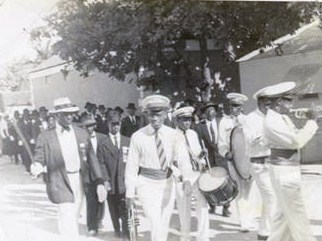
i_hanna2They were the Southern Band, St. Agnes Band, Catholic Band, Eastern Band (and I will explain the connection) the Police Band.  The Eastern Band by comparison was so weak that they joined up with St. Agnes and was allowed to retain their identity by turning out on alternate occasions as the Eastern Band.  Then came Empire Day 1945: one of my first big days as a musician.  Mr. Ted Glover wanted the band for Western Senior, Mr. Donald Davis wanted the band for Eastern Senior, and so you can guess what happened, the Eastern Band folded.  The Southern Band, under Bulla Roberts, played for the Roman Catholic processions and one occasion, a few of the men accused Fr. Quentin and Bulla of pocketing money from these processions.  It was at this point that Fr. Quentin assisted by Bulla Roberts started the Catholic Band.  The catholic Band never attained the popularity of the other bands, but produced some giant musicians, whom I will name later.  All of these bands have disappeared with the exception of the Police Band and they almost went under also.  Like the Eastern Band, they needed trumpet players to fill the void, and civilians were recruited.  So, teenagers Freddie Brown and Ivan Hanna donned police uniforms to play in the band.  These marching bands were the first dance bands also and just as they were hired for parades, they were hired for special occasions, just as the Police Band is today.

THE REAL ORCHESTRAS

Bert Cambridge - CopyRudy Williams Band_1The time came when real orchestras were introduced and, of course, the men from the marching bands became core members – i.e., those who could handle the transition.  Special dance halls were the Aurora Hall at the top of Charlotte Street, where the high society blacks went and the second floor of the Elks Hall which was also a peculiar place.

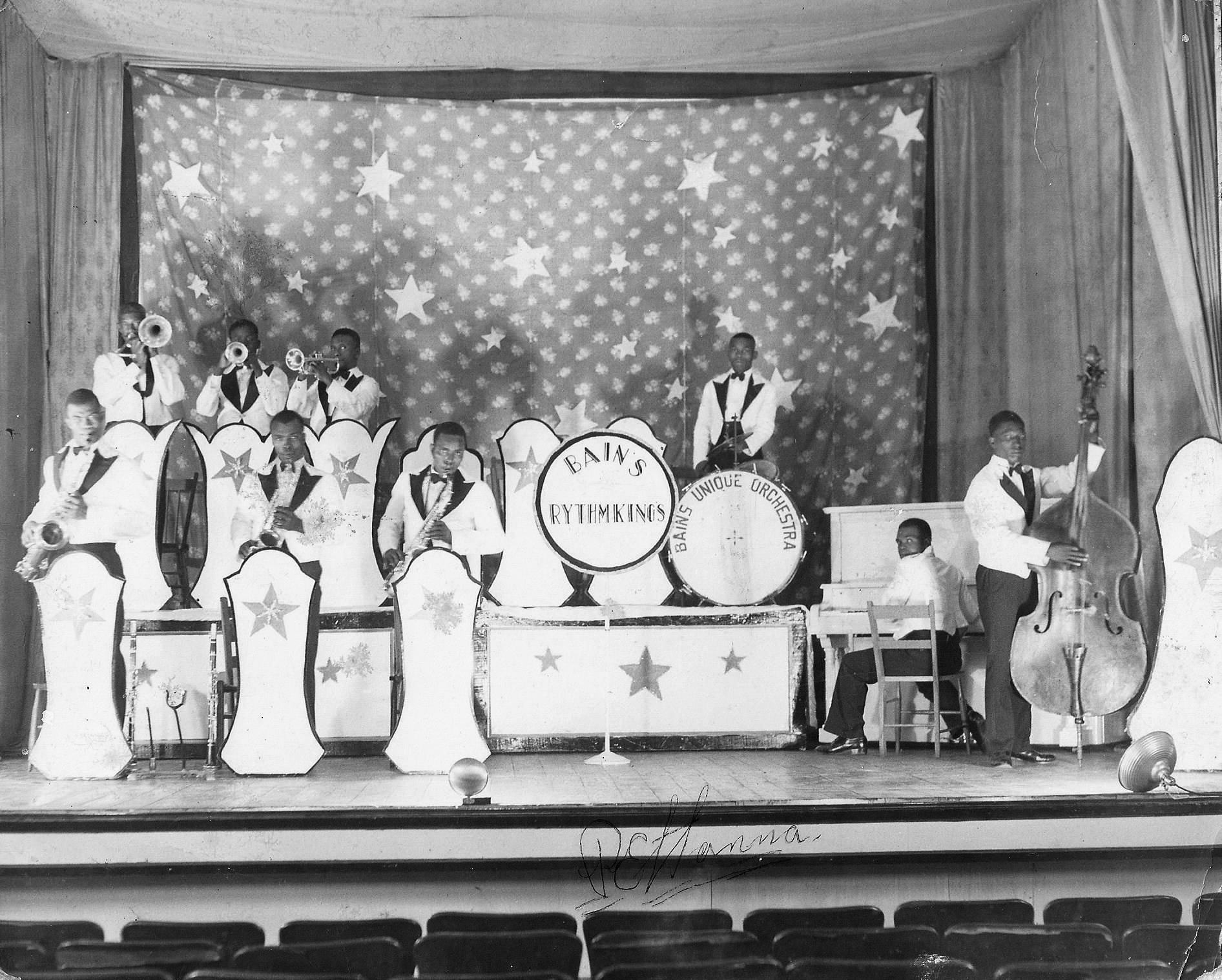
Bain's Band_2During the twenties and thirties, undoubtedly the best orchestra around was the Bert Cambridge Ensemble.  After living in new York for a time, Mr. Cambridge returned home and revolutionized commercial music.  This, ladies and gentlemen, was the genesis of the real thing.  The only surviving member of the grouping is Mr. Maxwell Thompson, a saxophonist.  Musicians who remember speak with reverence about the magnificence of the Cambridge band.  Since that time bands from Over-The-Hill that made their presence felt were the Bain’s Orchestra, The Rudy Williams Orchestra, the Lou Adams Orchestra, which is the longest surviving band, the Re-Bops, led by the late Irwin Gibson, the Carl Saunders Orchestra, the Joe Lord Orchestra, the Jimmy Thurston Orchestra, just to name a few.  These bands, for the most part, played at tourist functions during the off season.

THE PEOPLE’S THEATRE

Built by Mr. Eustace Duvalier, this large wooden building was on Baillou Hill Road, where the serve around is now located, opposite the Baillou Hill Road clinic.  It was a movie theatre, a sports arena, a dance hall, a meeting place, and the main activities place of its time.  It was the home, for instance, of the “Elite Social Club”.  This building was destroyed by fire some time after the 1942 riot.

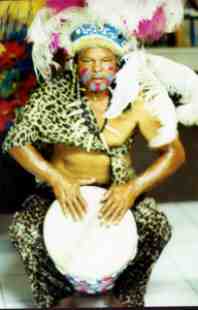
Chippie_-_goombay_drummerThree blocks south stood the Weary Willis Hotel, built by the late William Willis Neilly.  I understand that after completing such a large there-storey building, he was so weary that he named the building the “Weary Willis”.  After his death, the building was taken over by his son-in-law, Archibald Brown.  The third floor was the entertainment centre and in later years, john Chipman held some entertainment there as he prepared for his role in the music field.  By the fifties, it had lost its glamour as a dance club and operated mainly as a bar and rooms.

St. Paul’s Baptist church was built practically against the Weary Willis and there were lots of conflicts between the spirits.  Rev. Colebrooke would send the sexton to complain that the music was disturbing divine worship, but a half pint of the sexton’s his favourite beverage would take care of that.  As a youngster, I well remember the police coming to the third floor where we were playing to deal with complaints from the church; sometimes Rev. Colebrook came himself.  This building fell into disrepair and was taken down in the early sixties, much to the jubilation of the church and the property was bought by them and is now their parking lot.
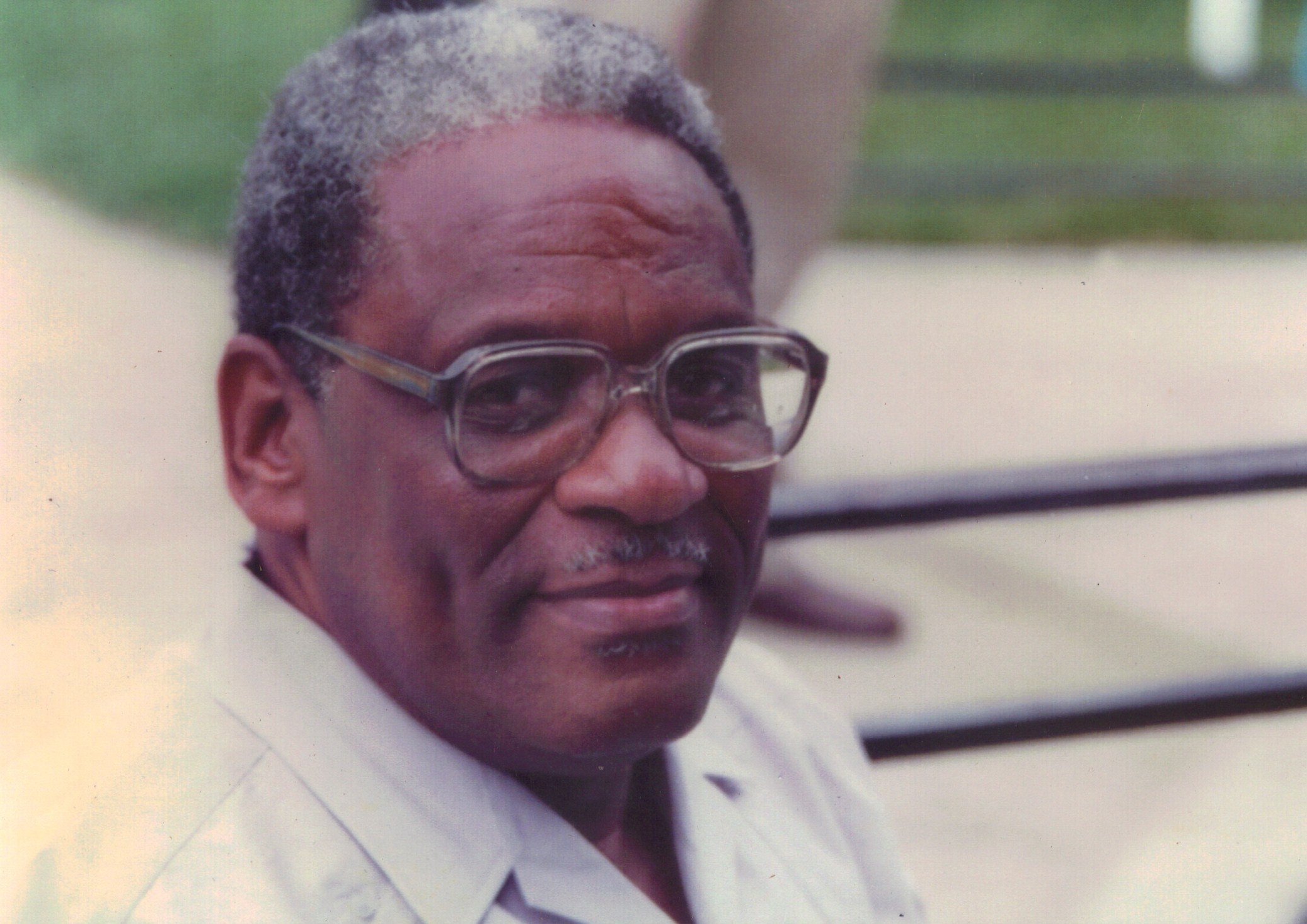
A MAN CALLED FREDDIE MUNNINGS

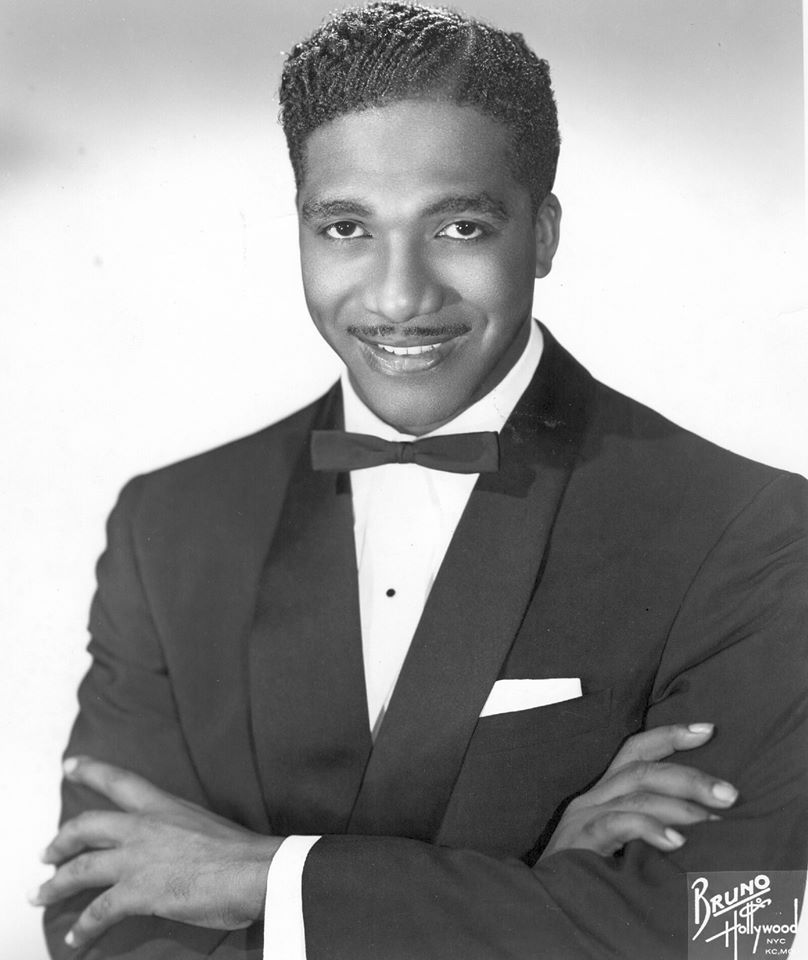
Freddie Munnings Sr.Mr. Munnings was a member of the Police Force and played the clarinet in the Police Band, and later got into commercial music by chance.  He undoubtedly became the most popular and versatile musician these Islands have produced.  The Silver Slipper Club on East Street was bought by the late Edgar Bain from his original partners, the late Gerald Dean, Viki Brown, Cyril Richardson, and Whylly Reid, and this was the home ground for the Rudy Williams Orchestra, in which Mr. Munnings played and later took over.  The entertainment spot flourished like no other.  Native shows were put on at least twice per night for locals and tourists.   The Silver Slipper was the first establishment where local musicians worked full time and made a living as professionals holding their heads high, and there were their counterparts, a cadre of dancers and support staff, who also made a living as full time entertainers.  At the Silver Slipper, international shows were brought in and the Freddie Munnings Orchestra ably supported them.Freddie Munnings Band_Silver Slipper_East Street

Around this time, Mr. Percy Pinder returned home from the U.S. and built a dance hall just across the street from the Silver slipper, called the Rainbow Gardens, where the Fred Ramsey Orchestra played, but the operation was no match for the charisma of Mr. Munnings and soon closed its doors and was turned into a movie theatre.  This theatre was unique in that it had two balconies where you could take your favourite girl and watch the movie in seclusion.  This theatre, along with the Cinema theatre just across the street from the Silver Slipper made East Street the capital of entertainment.

Mr. Pinder’s theatre went up in flames and he later built the Capital theatre on Market Street which is now Purity Bakery.  The Capital was a high class cinema not for all and sundry, the entrance fee took care of that.  In the early fifties, The Bahamas Playhouse was established for the winter seasons and Broadway plays with big name stars were brought in.  The building used for this entertainment was then a part of the Colonial Hotel just at the bend joining Marlborough and West Streets, at the waterfront, where the Hertz Rent-A-car is now situated.  These plays were then put on at the Capital Theatre for the masses and school children.  Also at the Capital there was a weekly talent show directed at different times by Mr. Bert Cambridge and Mr. Freddie Munnings.  These activities were big time.

Meanwhile, in the mason’s Addition / McCullough corner area there was the ACL Hall where a group of young musicians, led by John Chipman jammed every Saturday night to overflow crowds.  If you wanted to make a pickup for the weekend, this was one place to go.

Then there was the King of the rake and scrape, the Joe Billy Dancers on King Street, just off Market Street.  They also played to overflowing crowds.  The entrance fee was sixpence and the peculiar feature of this dance was that the ladies had to consent to any man who asked her to dance or she was immediately put out.  This also a good musical pick up place.

At the western end of King Street at Baillou Hill Road, stood the Zanzibar Cabaret and Hotel owned and operated by the late Felix Johnson.  Mr. Johnson emceed his shows and what an entertainer he was, dressed in tails and using a walking cane at the strains of “Sunny side of the Street”, you knew it was “Show Time” (his famous quotes, his fights).  It was safe to walk the streets at any hour of the night or morning.  As the number two club on the Island, the Zanzibar imported some of the best bands from Jamaica, the Eric Dean Orchestra, the Baba Mooda Orchestra, to name a few.  But the Zanzibar never really swung until Mr. Johnson was able to persuade the tall, handsome, curly haired, silver tongue man, who could beat Perry Como singing, who mastered the clarinet and saxophone, to play at the Zanzibar.  When Freddie Munnings sang, many husbands and boyfriends were embarrassed by the way their ladies responded.  The number of offspring he fathered is testimony to this fact.  Mr. Johnson also held his own in that category.

With these two giants teaming up, everywhere else was dead.  Giant musicians were brought in from the U.S. – names like: Roy Hamilton, James Brown, Les Paul, Jackie Wilson and others complemented by locals, Naomi Taylor, the Jungle Queen, and Becky Chipman, the queen amongst the ladies; Mary Clarke, Queenie, Lucille, Rosie, Maureen Duvalier and a host of shapely ladies.  Amongst the men we remember the Kemp brothers, Toe Joe, Pally, John “Chippie” Chipman, Peanuts Taylor (Peppi), etc. etc.

At this time let me mention individual musicians who excelled: Eric Russell, Eric Cash, Bruce Coakley, sir Buck Marshall, John Clarke, Jerry  Johnson, Martin Conliffe, George Moxey, Garnet Woodside, B-O-Bie, Dennis Donaldson, Blind Black, Jack Roker, Ed white, Chubby, Lou Adams James Sweeting, Jimmie Thompson, Charles Carey, Apple Elliott, Ralph Munnings; brothers from the south who joined us: Little G, Neville Sampson, Gladstone Sterling, Tom McCook, George Wright, Lane, Fred Callender, Billy Cooke, Rod Williams, Vernon Muller, Hackschore, Jackie Willisee, etc.

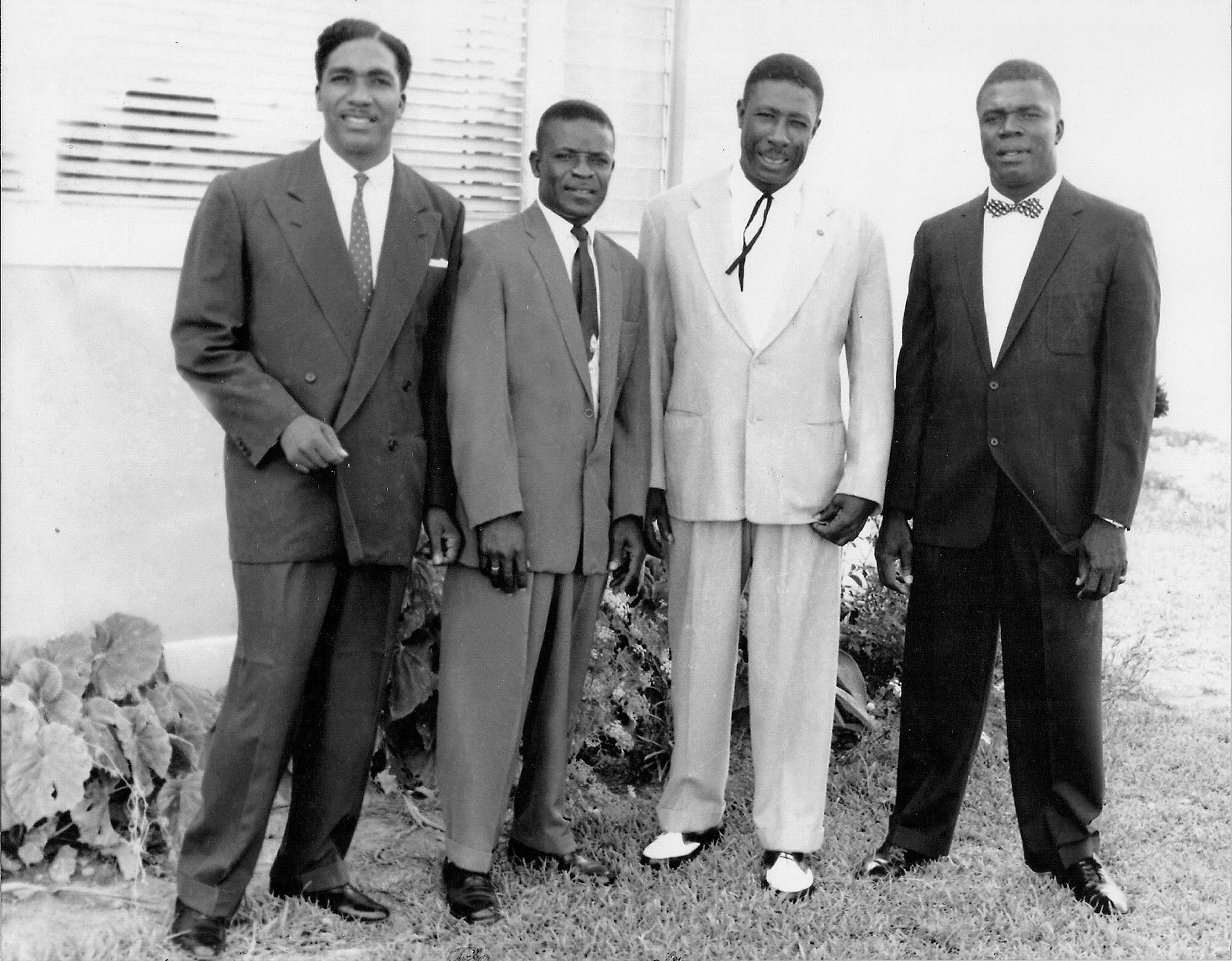
Munnings BrosIn a talk such as this there are certain names you cannot leave out, although they did not work in clubs Over-The-Hill or, if they did, it was very brief: blind Blake, George Symonette, of course King Eric had a recording studio Over-the-Hill and worked over here for a short time; Ronnie Butler, and Flash Rodgers.

Meanwhile, Mr. Munnings, on top of the proverbial world and probably the best known Bahamian of the era, naturally seized the opportunity to purchase the Cat & Fiddle Club when it became available.  Prior to this the Club was a dismal failure for more than one reason.

The popularity of Mr. Munnings could draw the crowds on the Island, and success after success led to the continued practice of bringing in the best: Nat King Cole, Count Basie, the comedian Flip Wilson and many more.  There was even an ice skating review brought in, and in our hot climate you could imagine the cost for constructing and maintaining a skating rink on the Cat & Fiddle floor.  Mr. Munnings branched out into several businesses, and at the pinnacle of his career he began to fade and fade from the active music scene, which still remains a mystery.  The Ghana Room was added later and operated as a separate club, although both clubs complemented each other.  With the departure of Mr. Munnings from the stage, the Cat & Fiddle also folded.

THE DRUMBEAT CLUB

Peanuts Taylor_2Owned by drummer, Berkley “Peanuts” Taylor, this club always had a good band.  Situated at Market Street and the Northern side of Wellington Street, this establishment catered mainly to tourists but had its share of local business, and held its own.  Unlike the clubs mentioned earlier, the Drumbeat was an enclosed club.  The club was re-located to West Bay Street, and quite recently had a tragic end.

THE  SMALLER CLUBS

These clubs known as the late spots operated at some odd hours and catered to a special clientele including musicians and entertainers from the larger clubs and hotels, and usually had a three or four piece grouping.  Musicians are a peculiar lot, usually they stopped playing on the button at their regular jobs, but would immediately go to one of the late spots and jam until closing time.

During the fifties, one such club was the Conch Shell, operated by Mr. Gene Toote.  I can well remember getting up at 10:00 p.m. to arrive at the club for the 11:00 p.m. jam.  As I rode my bicycle beyond St. Barnabas Church, the only thing between there and the club was BEC, tall pine trees and draught. Other clubs in this category were Flowers on Quackoo Street, the Taxico Club, Wulff Road, Hutch Lounge, also on Wulff Road, the Blue Note Club, Poinciana Drive, and a few others.

Then there was the Confidential Club in the Adastra Gardens.  Now this club is not really in the perimeter of this talk but I will include it because during the period that I worked there, it was run by a Grant’s Town man, Nelson Chipman.  What a character!  The name of the club itself dictates confidentiality, so you would have to use your imagination, as to things that really happened, but I could tell you that you worked hard as hell for that £16 a week.  Let me describe a typical slow night.  The band started about 10:30 p.m., first show at 11:00 p.m., then the club was emptied, musicians would fall asleep.  A taxi drives up half an hour later with four people and asks what time is the next show:   “In five minutes” shouts Mr. Chipman, and then he would go around waking up everybody.  A show is put on for four people and they leave, and the same scenario is carried on for the rest of the night and into the morning.

There was a saxophone player in this band who openly smoked ganja (as they still call it) and that damned thing smelled so bad.  The flame never goes out, and that was one way the police would catch you in the dark.  Sitting in the front of the band, patrons would naturally give any tips to the person up front and, when questioned, he would say “The man gave the money to me, not the band.  On one occasion, when he was given a blue £5 note, we had to beat him up and take the whole thing.  While on this subject, there was another famous musician who collected the tips for his group, and this is what he did – one tip went into his left pocket, next tip went into the right pocket and so on, and at the end of the night, he only shared from one pocket, until one night, when he said let’s see how much we share tonight, one fellow who kept score in his head blurted out “50 + 50, to his surprise.  At the Confidential Club, a very young limbo dancer was part of the show.  I believe Nelson Chipman gave him the name “Tony Seymour” and it was at the Confidential that he first began to sing and formed his band that took the new club the Banana Boat, to great heights.  In later years, as a taxi driver, Tony was murdered.  The Banana Boat building which is now being renovated as a Baptist church was financed by the late Canon E.W.G. Holmes and, according to records, he was the owner for a long time.

PAUL MEERES

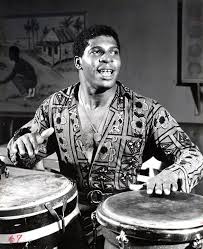
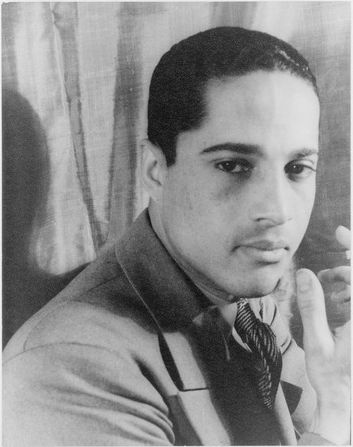
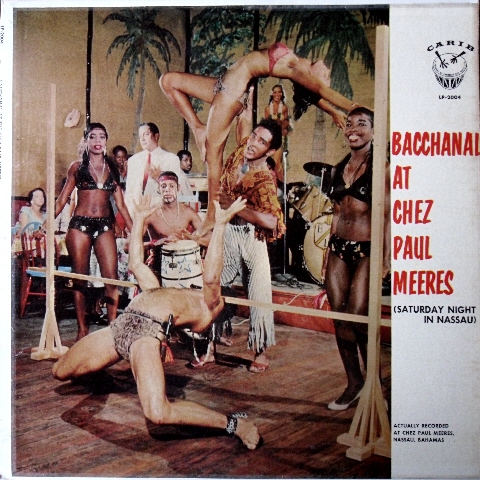
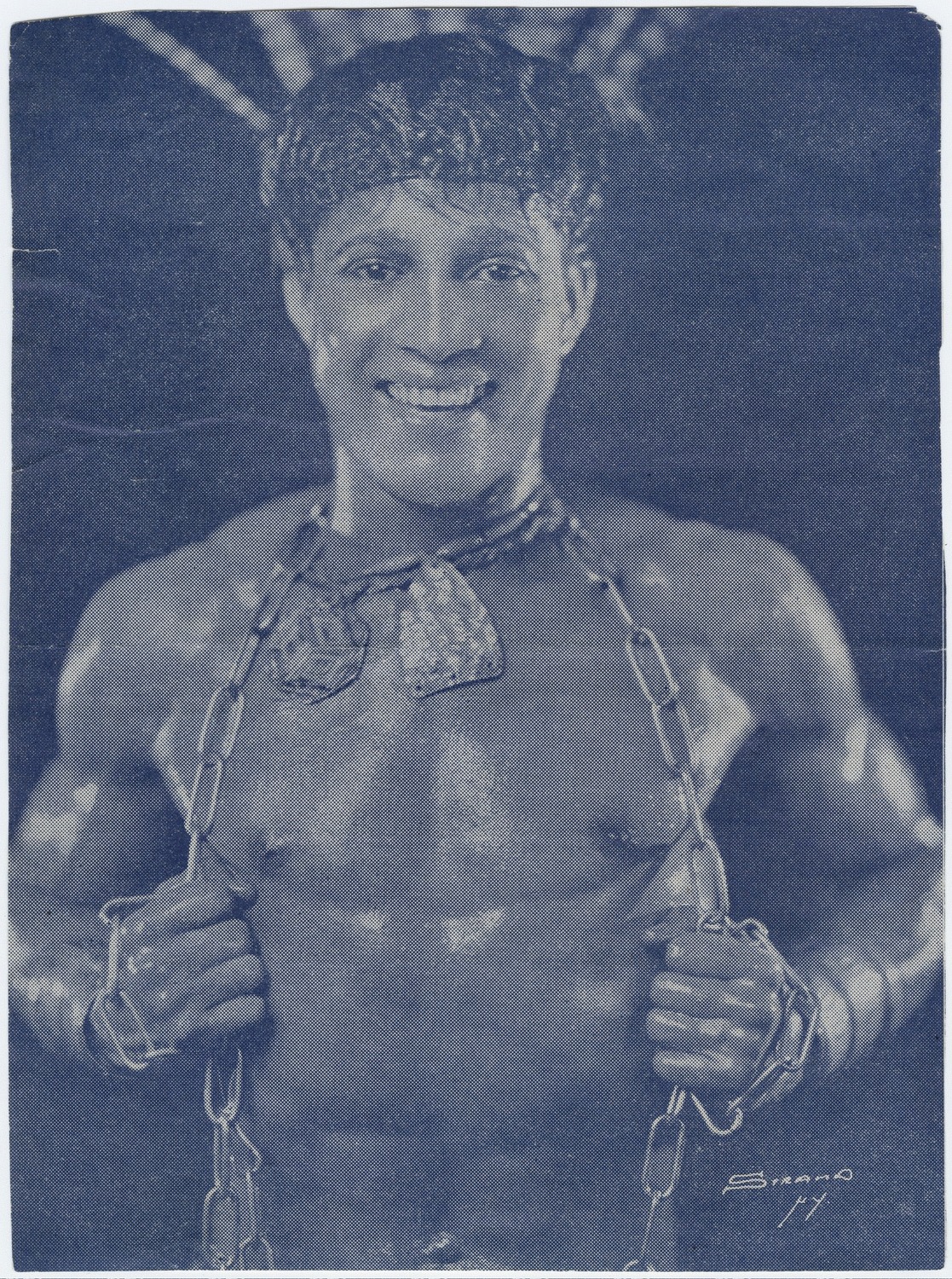
Paul Meeres_2I purposely left this for the last.  Bahamian Paul Meeres was an international super Star all over Europe.  Mr. Meeres had a black mother and a white father.  Paul was exceptionally good looking and those of us, who can remember the photo of him in the show window of Df. Cleary on Bay Street, would remember the daily crowds looking at his picture in dance costume.  Mr. Meeres returned home after having the Paul Meeres Hotel built at Market Street and Wellington Streets.  On the ground floor there was a night club where he dazzled patrons and showed us why he was a super star.  The late George Symonette and Peanuts Taylor played there.
Bacchanal At Chez Paul MeeresMr. Meeres had a tragic end that started when he decided to serve the prison sentence handed down to his Mother by the court for hiding a relative, who had escaped from prison.  During the time of his incarceration, many of his overseas visitors and friends were shocked about the whole thing, which added to his tragedy.  Upon his release, the old Paul Meeres was gone forever.  In his final years he was a regular from club to club, by now an alcoholic.  He was knocked down early one morning on Baillou Hill Road near Wellington Street as he apparently stumbled home.

There is so much more that can be said on this subject and those that made it tick but, all of the presenters in this series before me took roughly about half an hour so, I feel obliged to do the same.  That was the hardest part of presenting this paper.

Paul Meeres with ChainsIn conclusion, let me reminisce a little more.  Musicians are a special breed, special in a way that not many professions are.  It’s an ungrateful profession, and you must keep on top of it, or it will let you down.  You must pass the test each and every day as musicians so well know. It’s very demanding, exciting, dangerous, lonely, yet fulfilling and there are no pensions.  If you don’t provide for those rainy days, God help you!  In this fickle industry where the musicians are the first to be cut from the payroll, who are taken so much for granted, that provides so much excitement, can also bring to much devastation.  It is a profession oh so academic, yet so relaxing, carefree, and sobering.  The world without musicians and music would be a very empty world.  That is why music is the only art of heaven given to man, and the only art of earth we take to Heaven.

This lecture was presented by Ivan A. Hanna (1934-1999) on 20th September 1995 and is recorded here by kind permission of his widow Dolores Hanna.