
Joseph Spence: Who dares follow in his giant strides?
“Who follows in his train?”
From THE SON OF GOD GOES FORTH TO WAR
 Up through the years as The Bahamas developed admirably on the social, economic and political fronts, there has also been steady development in the area of culture and entertainment.
In each generation over that time, there have been entertainers who have been stand-outs who have left their indelible imprints, and many of their young successors on the entertainment stage have been greatly inspired by their glittering examples and have attempted to follow in their giant footsteps.
To his immense credit, for many years outstanding Bahamian radio personality Charles Carter, who has also been an executive at the Broadcasting Corporation of The Bahamas, a Member of Parliament, and a cabinet minister, has done an extraordinarily thorough and commendable job, wherever he could, of researching and transcribing the lives, times, and accomplishments of Bahamian entertainers over time.
He has exposed, through radio and other media, both the faces and the flip sides of performers and entertainers such as the late George Moxey, Blind Blake, Maureen Duvalier, Priscilla Rollins, Freddie Munnings, and, of course, the unforgettable Tony “The Obeah Man” McKay from Canaan Lane.
However, perhaps of late Charles Carter, who was a fellow student of Tony McKay and The White Boy at Rhodes high school in New York City way back when, has also widely headlined the famous Berkeley “Peanuts” Taylor, and Ronnie Butler who, along with Count Bernadino, insists that age is nothing but a number.
Yet Charles Carter, who must be hailed as The Bahamas’ chairman of the radio entertainment board, has always, stretching back to the 1960s, quite sensibly and with abiding admiration left no research hill unscaled with regard to the most ancient of the country’s pioneer entertainers whose influence over the years tentacled to faraway climes.
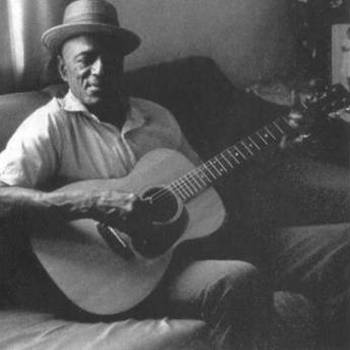
The reference here is, of course, to the inimitable, timeless, and unforgettable Joseph Spence who, had he been yet alive, would have celebrated his 100th birthday two days ago, on 3 August.
But who, exactly, was Joseph Spence? Many thousands of Bahamians would put that question, and well they deserve to know the answer. Art is long and time is fleeting, as Henry Wadsworth Longfellow advised and Sir Randol Fawkes was fond of repeating. Be patient.
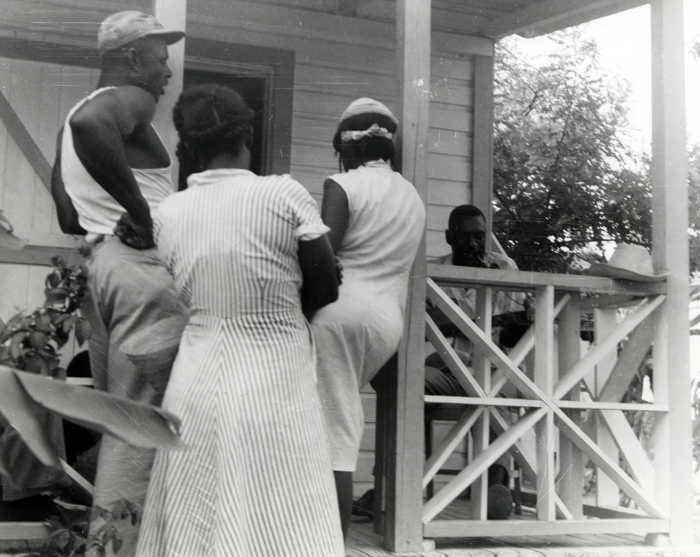 Joseph Spence was an Andros sponge fisherman who was born on 3 August 1910, four years before the assassination of Archduke Franz Ferdinand of Austria sparked World War I, supposedly the “war to end all wars”.
When he was barely nine years old, Spence was given a guitar by an uncle who resided in the United States, and although he had not the slightest clue what to do with the thing, that instrument triggered the foundation and direction of a long and intriguing life of music.
He painstakingly taught himself to play the instrument, no doubt encouraged by
another uncle, who lived in The Bahamas, and who was popular and sought-after as a flute player.
Eventually young Spence, his uncle and two percussionists began playing for dances in Andros, performing rhythms that included quadrilles, waltzes, polkas, and calypso pieces.
However, no matter how much Joseph Spence loved his music, and how proficient he became as a guitarist, he obviously could hardly earn a living from his performances for friends, and so from the age of 16 he began going down to the sea in ships.
That was around 1926. The war had ended in 1918, and there was a kind of peace around the world. It was also the golden, lucrative age of sponging in The Bahamas, and especially in Andros. He became a sponge fisherman. For some reason music and the ad hoc singing of spirituals had become associated with sponging, and so Spence took his faithful guitar along on his trips at sea.
On those occasions he carefully wrapped the instrument in a cloth and kept it below deck so that the strings would not rust in the salt air. It was perhaps when he played the guitar at sea, probably with a few of the other fishermen chiming in, there was most likely slowly developed the Bahamian tradition of “rhyming”, in which you made up line after line as you went along.
Interestingly, “rhyming” has long been considered an early ancestor of rap music, in which black folk made up verses usually based on Bible stories or traditional hymns. Joseph Spence, who had grown up in the church at Small Hope, Andros in a musical Bahamas, particularly specialised in that style of singing, bringing to bear his guitar-influenced version of the style.
Thus his specialised and personalised versions of spirituals dominated all other versions, becoming recorded and eventually performed on the international scene, particularly after the American company, Nonesuch Records, featured them prominently on releases.
Although truly unforgettable was Joseph Spence’s rendition of Down by the Riverside, the memory of which recently was so vividly and beautifully evoked by the exotic Naomi Taylor during the Sunday jazz session at Indigo, Spence had a number of other spiritual numbers as part of his expansive musical repertoire.
They were such as A Closer Walk With Thee. All Hail The Power Of Jesus Name, Be a Friend To Jesus, Living on The Hallelujah Side, Glory, Coming In On A Wing and a Prayer, Kneeling Down Inside the Gate, and the ever popular Bye and Bye which so many grieving Andros families requested he come and sing at the setting-up for departed members.
Tragedy came in 1938 when a blight killed the sponge beds around The Bahamas, and the sponge fishermen at Andros, including Joseph Spence, found themselves without jobs. Yet the musical sponge fisherman, Joseph Spence, was hardly discouraged, but with his simple faith interpreted the catastrophe in quite a different way.
Describing the blight to American writers John Stropes and Justin Segal, he explained: “God destroy all the sponge. You see, when the spongers used to bring the boat to the merchant, sinking down loaded with sponge, when they sell the sponge they still left in debt. They don’t hardly get nothing. So I figure the father say, ‘Well, I see they’re doing too much with this poor people having to kill these sponge. I better put them on something else.'”
 It has never been quite clear what else the Almighty had in store for the other fisherman, but He apparently inspired Spence to move to New Providence. A year after the sponge beds had died World War II broke out, and thousands of young Americans had to be deployed to fighting fronts in Europe and the Pacific. America had a shortage of manpower to work the farms and factories, particularly in the South.
Blessedly, in August 1940 the Duke of Windsor, who had given up the British throne for the woman he loved, arrived in Nassau to become Governor of the Bahama Islands. That was a tough economic season, when thousands of Bahamians, especially young men, were out of work.
The Duke has always been applauded for his initiative in travelling to Washington where he met with U.S. President Franklin D. Roosevelt and worked out a plan – the “Project” or “Contract” — in which Bahamians were allowed to travel and work on agricultural farms in the southeastern states.
Spence and his wife Louise took advantage of that opportunity and for two years worked on “The Contract”, his trusty guitar never far from him. That period helped his musical development tremendously, as he was exposed to American string traditions, eventually incorporating them – together with blues and country music – into his own techniques and emerging with a guitar style no one has to this date been able to duplicate.
In late 1938, some of his songs were recorded by the American folklorist Alan Lomax. However, interestingly, as Joseph Spence developed into an entertainment virtuoso, he had little regard for any kind of commercial success, and in fact owned no rights to his own works as recorded by many others..
In his time Joseph Spence popularized a number of secular songs, leaving on them his special mark of the guitar which as any point at one time sounded for all the world as three or four different stringed instruments played in perfect accord, much like the four parts of a musical score.
In fact it has been said that because Spence often sounded as if he was playing several guitars at once, some suspicious or simply inquisitive or doubting foreign professional musicians, upon listening to Spence for the first time, were certain the Androsian had another musician hidden nearby as an accompanist.
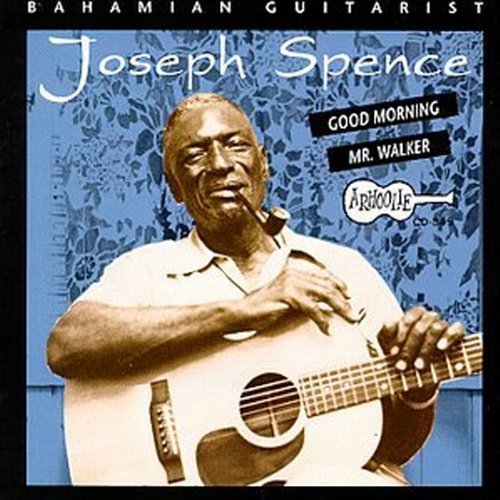
That was the effect of Spence’s guitar expertise, though unconventional and perhaps considered out-of-tune by regular standards. Yet in his description of Spence’s rendition of “Good Morning, Mr. Walker”, the renowned Jack Viertal, wrote thus about what Spence had produced: “There is no sloppiness in this, he tunes very precisely by playing the same figures over and over again until he is satisfied, and the guitar is always tuned to the same pitches.”
Secular songs he performed utilising that unique style included such as “Good Morning, Mr. Walker”, “Conch Ain’t Got No Bone”, “Crow Calypso”, “Diamond on Earth”, “Don’t Let Nobody Burn Down”, “Sloop John B”, Burma Road”, “Bimini Gal”, Brown Skin Gal, and “Don’t Take everybody To Be Your Friend”.
Having had his fill of travel, Joseph Spence returned to Nassau in 1946, a year after the war ended, finding work as a stone mason during the day, and at nights performing his beloved music at local hotels and upon requests aboard yachts moored in the harbour.
Yet, gradually, time was taking its toll on this unusual guitarist who for years had been celebrated far more grandly abroad than at home.
He suffered a heart attack in the mid 1970s, roughly around the time he was encountered by Charles Carter, without doubt his most faithful and adoring fan, who set out on a relentless odyssey of talking, interviewing, recording, and essentially capturing the real essence of Joseph Spence, essentially the quintessence of the real Bahamas.
But Spence bounced back from his illness, and became a night watchman at a primary school. Even then, in his mid 60s, he taught himself the piano, in fact creating on the keyboard a sound imitative of his guitar. By that time an American musical album had used some of the renderings of Joseph Spence in the widely-acclaimed compendium labelled, yes, The Real Bahamas.
Joseph Spence passed from the scene on 18 March 1984, just short of his 83rd birthday, and with his passing there expired from the cultural and entertainment stage of The Bahamas and indeed the world a stroke of musical genius ambitious aspirants will perhaps endlessly attempt to reproduce and imitate.
In his lifetime, Joseph Spence had spanned generations, plucking his guitar and singing from a boy during the first world war, through the second global conflict and the Korean War, and even through the 1960s when at least a handful of Bahamians were involved on the Viet Nam battlefronts.
He had crossed over the tenure of two powerful ruling political regimes, and indeed the year he died cabinet ministers Hubert Ingraham and Perry Christie were summarily dismissed from the government of the late Sir Lynden Pindling, and came to represent a new political culture and dispensation in The Bahamas.
At home and, intermittently abroad, Joseph Spence had seen life fully and seen it whole, and whatever else altered around him at home and abroad, he remained steady and consistent, particularly with regard to his unique music styling.
Yes, Joseph Spence, born a century ago and having passed from the scene a quarter of a century ago, was a living musical legend with a style uniquely his own, a winning style truly worthy of imitation or emulation.
Yet amongst today’s galaxy of budding entertainers, there must surely be those who will dare attempt to follow in his train. Who so dares… for what it’s worth?
P. Anthony White
5th August 2010
This article is posted here by kind permission of the children of P. Anthony White
P. Anthony White.. Online: https://pawbahamas.wordpress.com/
P. Anthony White on Facebook: https://www.facebook.com/P-Anthony-White-164631210228066/?ref=ts&fref=ts
Very interesting information https://jan70et.blogacep.com/24499958/https-aviator-jogo-net-br